When you have a historian introducing a concert, you know you’re in for a special kind of show. This is exactly how No-No Boy‘s show at the historic McMenamins Mission Theater in Portland started. The audience learned that the event was part of a series of “History Pubs,” which usually invites historians, authors, and people with lived experiences to share their slice of Pacific Northwest history. The event that night, co-sponsored by the Oregon Historical Society and the Japanese American Museum of Oregon, was described as both a musical history presentation and a celebration of No-No Boy’s latest album release, Empire Electric.
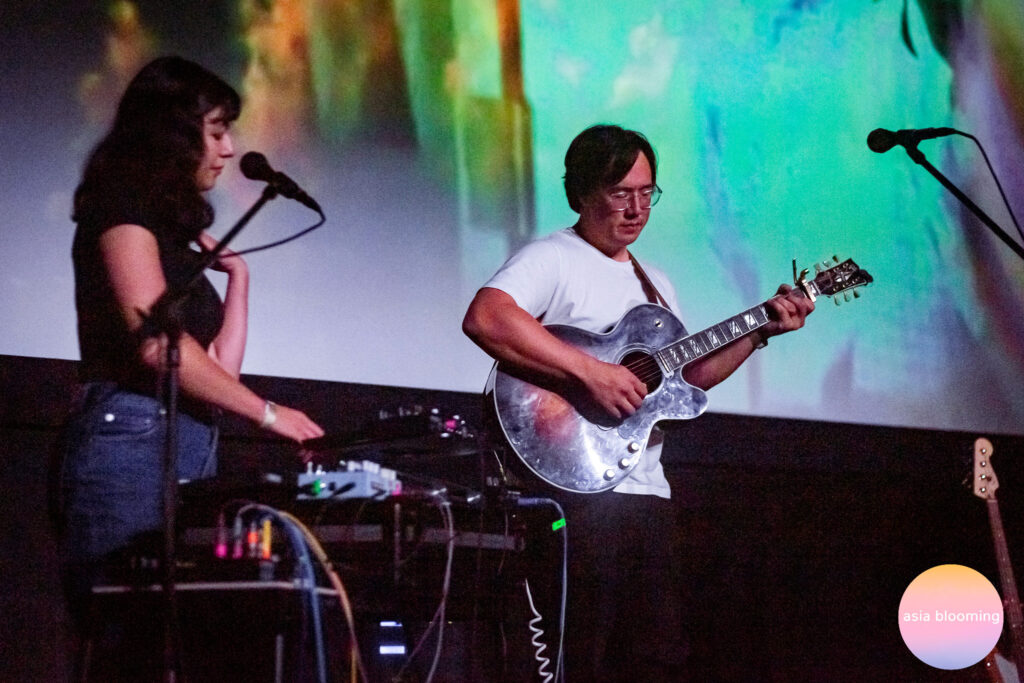
No-No Boy consists of guitarist and singer-songwriter Julian Saporiti and co-producer, collaborator, and wife Amelia Saporiti, and they were joined by bassist and backup vocalist Jacob Miller for this show. The trio eased into a lullaby-esque acoustic rendition of “Mekong Baby,” a track that reimagines difficult childhood memories into a healing balm. This song was performed again at the very end of the show, but that time with the addition of the gourd, birdcall samples, and other tropical sound samples that immersed the listener in a boat floating down the Mekong River Delta, where Saporiti’s family lived.
Saporiti’s journey into Asian American history began on a climbing trip when he saw a photo of a Japanese jazz band that was formed in the Heart Mountain detention camp. His curiosity was piqued by these musicians who were able to express themselves and bring levity to their community even under such demeaning circumstances. After learning about the semi-professional George Igawa big band orchestra, led by established musician George Igawa from Los Angeles, Saporiti wrote “The Best God Damn Band in Wyoming,” which recounts the story of the band and several of the members. This song and story was also showcased by the Heart Mountain Wyoming Foundation through a recorded interview and a performance with the last surviving member of the ensemble, Joy Terakoa. You could hear both indignation and admiration in Saporiti’s voice when he sang, “Locked up in prison camps for no fuckin’ reason / But they still found a reason to sing.” It’s a theme that percolates through his music: people’s resilience and dignity in the face of injustice.
Saporiti knows how important it is for individuals and communities to be seen for more than just the negative experiences they’ve been through and for communities to commemorate both the tragedies and the glories that they have experienced. This philosophy can be seen throughout the No-No Boy project and in his interactions with people and communities, enabling him to connect with folks of all backgrounds and dispositions on a fundamentally human level. One of Saporiti’s students told him about her father, a survivor of the Khmer Rouge genocide in Cambodia, and how he refused to answer her questions about his horrific past. And honestly, who can blame him? The stories that he was able to share–“apparently he had a cow named ‘Horse,'” Saporiti recounted bemusedly–painted a more relatable picture of the father’s past. This conversation went on to inspire a song from the album 1975 called “Khmerica.”
Saporiti turned up his Southern drawl to perform one of the most personal songs of that evening, “Nashville,” an autobiographical number that tells the story of Saporiti’s youth, friendship, musical beginnings, and early love. He shared that in his early years of making music, he never imagined people who looked like him as protagonists in his songs, so the No-No Boy project allowed him to see himself as the “main character” of his music. “Nashville” was originally written in his 20s and was recently rewritten as a way to reclaim his identity. There were two other songs that were rooted in Saporiti’s current home state, Oregon, “The Onion Kings of Ontario!” and “Western Empress of the Orient Sawmill,” which were about a Buddhist monastery on an onion farm and the first Japanese settler in Oregon, respectively.

While the No-No Boy project innovates in the folk genre by blending Americana, traditional ethnic instruments, and field samples, it’s apparent that Saporiti’s music is not just about good tunes and sonic experimentation; it is also about inspiring curiosity in his listeners to explore their own history. Learning about history helps you “solidify yourself, to do better in the present,” and what better way to delve into historical stories than through music?