In North Hollywood, adjacent to the classy gastropub The Federal and up a set of creaky stairs lies The Knitting Factory, On the weekend of October 14th, the intimate club was filled with Halloween decorations, and it hosted one of several shows as part of the Daze in the City program. The organizers of the Desert Daze rock music festival put on this week-long program, consisting of multiple shows in various venues across Southern California, in place of the typical festival experience in Lake Perrier this year.
The show on October 14th featured psychedelic rock groups Grave Flowers Bongo Band and TEKE::TEKE for a rousing, family-friendly affair. TEKE::TEKE was originally conceived as a tribute band to Japanese electric guitar and surf rock legend Takeshi Terauchi, but it quickly solidified its own distinctive blend of psychedelic rock, surf rock, and traditional folk sounds.
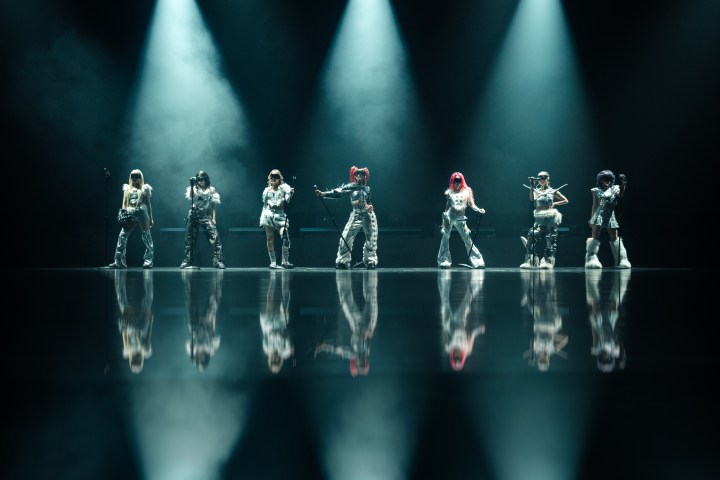
From the moment TEKE::TEKE came onstage, the show was full of surprises. The first was just the fact that the whole seven-piece band could fit on the small stage. The rhythm section, consisting of bass player Mishka Stein and drummer Ian Lettre, were in the back, while flutist and keyboardist Yuki Isami, trombone player Etienne Lebel, vocalist Maya Kuroki, and guitarists Serge Nakauchi Pelletier and Hidetaka Yoneyama took their spots in a tight row in front. During the performance, they used up every inch of the stage, with the wind players on the left following simple, pre-choreographed footwork, the guitarists on the right swaying front and back in a combat stance, and the theatrical Kuroki improvising dance moves whilst singing or playing one of several small percussive instruments littered across the stage. It was quite the miracle that nobody got elbowed! Combined, the effect created was one of a pulsating mass of movement on stage that amplified the sonic energy.
There were a few less pleasant surprises in the evening related to technical issues–namely the volume of the vocal mic and the lighting (or lack thereof) on stage. A few of the songs were performed in near-total darkness, and while it worked for the more subdued beginning of “Kaikijyu,” it was not the best experience to be squinting to see the band for more than one song. It took audience members (nicely) shouting, “Turn the vocals up!” and Pelletier jokingly commenting that they should’ve practiced with blindfolds for both issues to be addressed. But when the technical hiccups were ironed out, the band shone in its unabashedly eclectic glory.
After a cinematic intro that layered Kuroki’s lilting spoken words over an expansive flute and trombone interlude, the band launched into “Gotoku Lemon,” a song that cautions against falling for tempting solutions that seem too good to be true. Kuroki’s vocals blended seamlessly with the instruments, and it felt like she had a pedalboard for her voice–one moment it could be airy and wispy, the next throaty and growly, and the next piercing and nasally. You never knew what sound would be coming in the next phrase, and it was fascinating to see the breadth of her sonic palette.

While the setlist drew heavily from the band’s latest album, Hagata, there were also songs from the band’s first album, Shirushi, their EP Barbara, and even a cover of Unwound’s “Corpse Pose.”
“Hagata,” is commonly translated as “tooth mark,” but it has a deeper connotation of something that is no longer here but has left a tangible impression. It evokes a sense of simultaneity and in-betweenness, at once straddling multiple planes but not fully landing in either. There’s also an unsettling quality about this liminal space, which seeps through particularly strongly in “Yurei Zanmai,” which translates to “Ghost fever” and draws from elements of Japanese horror soundtracks: drawn-out shinobue (Japanese flute) lines and gutteral utterances. During the climax, the front row of musicians raised and lowered their arms in sync, as if warding away sinister ghosts. In “Meikyu,” Kuroki belted with sinister glee while the instrumentals got increasingly frenetic, at once incredibly groovy and rather ominous. This delivery complements the lyrics, which imagine you running frantically from a creature that is dead set on devouring you. Despite not having an explicitly Halloween theme, the influence of Japanese horror music and the eerie backstory of some of TEKE::TEKE’s songs made this performance particularly fitting for the spooky season. Not to mention, the Japanese legend of Teke Teke is straight nightmare fodder, though according to Pelletier, the founder of the band, this legend is not directly related to the band name.
“Kaikijyu” brought a darker, more introspective mood, serving as a respite from the energetic vibe of many of the other songs. The wailing flute and trombone over a sparse bass drum beat evoked lonely, underwater whale songs, and the vocals mimicked this airy tone. But perhaps the biggest surprise of the evening was in this song, when Lebel pulled out a bagpipe for the second instrumental break, which, ironically, made the piece sound even more Japanese, possibly because the piercing tone is reminiscent of that of a traditional reed instrument, the shō. To close out the show, they ventured into shoegaze with the fully instrumental “Chidori” and dialed up the surf rock with “Jikaku.”
With lyrics that are vivid, often fantastical, sometimes unnerving, and other times beautifully poetic, TEKE::TEKE’s music welcomes you into a fever dream that pulsates and morphs organically. The musical equivalent of a Salvador Dali painting, it’s an irresistible invitation to investigate the supernatural, to embrace the irrational, and in their live performances, they extend this invitation with the sanctimony of a ritual but the ferocity of a rock band. If you’ve ever wanted to convene with spirits while also rocking out to innovative, heart-pounding psych-surf rock, this band is a must-see.
Click on the photo below to view our photos from the show: