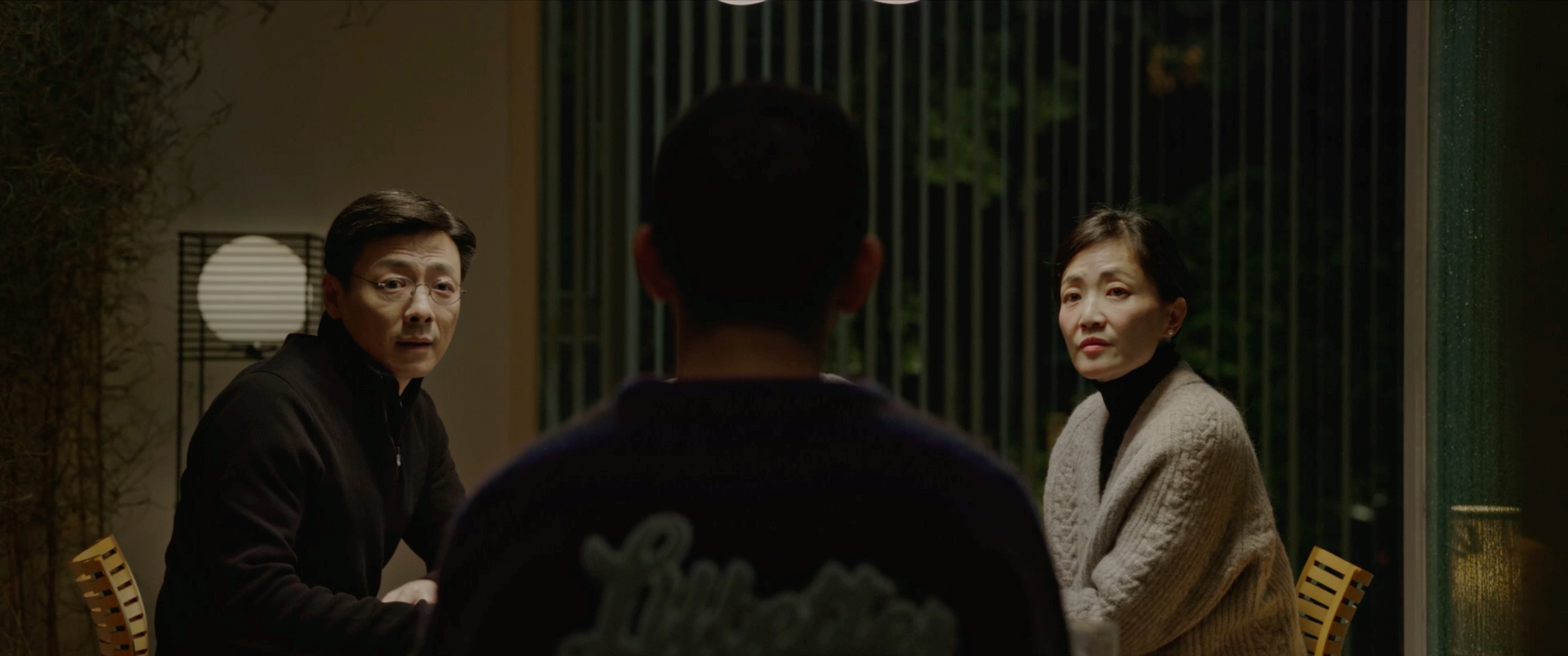

When a high schooler brings a classmate home one day, he opens the door for an unexpected series of events that alters the dynamics of his nuclear family forever. Released in the beginning of 2024, Jianjie Lin’s debut feature film Brief History of a Family is a mystery-thriller set in China during the one-child policy era. The opening scene is centered on the main character of interest, Yan Shuo, who is practicing pull-ups on the school grounds when he is hit by a basketball thrown by fellow student Tu Wei. Feeling guilty for his accidental actions, Wei invites Shuo to come back home with him. Wei comes from a wealthy background, exemplified by his family’s large and immaculately designed house. Shuo is a quiet kid whose mannerisms and overall reticence is often seen by peers as awkward and strange, but Wei’s parents are sympathetic toward him, especially after Shuo tells them he is being raised by an abusive and alcoholic single father.
Shuo’s studious and obedient nature is a direct foil to Wei’s carefree and rebellious personality. While Wei welcomes Shuo at first and the two become friends by proximity, tension begins to rise as Shuo begins spending more and more time at Wei’s home. Shuo begins inserting himself into the Tu family with ingratiating interactions with the parents, and what seems endearing at first gradually veers into more insidious territory. He has a late night talk with Wei’s mother, who describes how she no longer buys pineapple even though they’re her favorite fruit because her son and husband only like pears. In response, Shuo immediately offers to order her some. Mrs. Tu, who has been losing her identity in her role as a mother and housewife, is grateful for how Shuo sees her for herself. With Wei’s father, Shuo bonds with him through their appreciation for classical music, a fondness that Mr. Tu doesn’t share with his own son. Mr. Tu’s favoritism towards Shuo is amplified even more when it comes to academics, an area where Shuo is ambitious and excels while Wei prefers to chase after his dream of being a professional fencer much to his father’s chagrin.
While Shuo doesn’t outwardly appear aggressive toward Wei, he imposes himself in more insidious ways, and yet Wei has no choice but to watch as his family willingly takes in the newly orphaned teenager. While the viewer may start off feeling sorry for Shuo, it’s around this point in the film when there is likely a shift in one’s sympathies toward Wei. The two boys now share a bedroom together, and, in one scene, Wei offers a selection of different t-shirts for Shuo to wear as pajamas before Shuo says he wants the one Wei is already wearing, literally asking Wei to take the shirt off his back to give to him. While Wei accommodates him, he begins feeling unnerved by Shuo’s presence within his household.
Quiet yet unsettling in tone, the tension in Brief History of a Family comes from how it indirectly asks the viewer to judge Shuo’s actions. Is he just a boy being thankful to a couple who is taking him in like their own? Can we trust what he says about his own background and claims about his upbringing? Is he purposefully trying to push Wei out of his own family in this one-child society? Sun Xilun, who plays the part of Shuo, delivers a measured and calm performance, and from the eyes of the adults in the narrative, he is just an unfortunate kid making the best of his situation. But the cinematography, which sometimes leans deep into symbolism, suggests otherwise and inserts doubt into the viewer’s mind. Interwoven throughout the movie are short, almost abstract scenes that appear almost like dream sequences. One example is a microscopic view of an organism, slowly enveloping another until the two become one. In another, more overt, example is when Shuo stands in front of a painting, his head directly lined up with a pair of goat horns to form a devilish imagery. The cinematography also includes many still shots with minimal movement, as if inviting the viewer to inspect more closely and look beyond what appears in plain sight.
Wei’s feeling of isolation from his own family comes to a head when his parents take Shuo on a vacation without him and return to announce, without any consultation with their own son, that they would be officially adopting Shuo. Knowing that events have escalated out of his control, Wei can no longer handle being pushed out of his own family and his mental state begins deteriorating rapidly. In a particularly ominous scene, we see Shuo leaning down to Wei who is lying facing away in his bed. The camera doesn’t pan down to show their interaction but after Shuo leaves, we see Wei with his eyes open wide awake. On Shuo’s 16th birthday, Wei decides to take drastic action and the next sequence of events unfolds in a dialogue-less montage, revealing the fate of Wei, his parents, and Shuo.
Save for one violent scene towards the end, the film is never blatantly aggressive, instead exploring the psychology of the two teenagers with measured and thought-provoking interactions. Although slow in pace at times, the solid cast of characters and the changing dynamics of their relationships keep the viewer engaged and questioning throughout the film. Excelling in its show-don’t-tell storytelling style, Brief History of a Family is a markedly solid debut for Jianjie Lin.