


On a crisp autumn evening, attendees were treated to a high-caliber performance, splendid scenery, and the aroma of osmanthus blossoms wafting in the air at the special cultural event, “Charm of Chinese Strings.” Hosted by Portland’s Lan Su Garden, the event consisted of two parts: a traditional Chinese music performance and a meet-and-greet session for attendees to interact with the four musicians. Coming all the way from Beijing, the four award-winning musicians all teach and perform at the reputable Central Conservatory of Music, the alma mater of world-renowned artists such as Tan Dun, Lang Lang, and Yuja Wang.
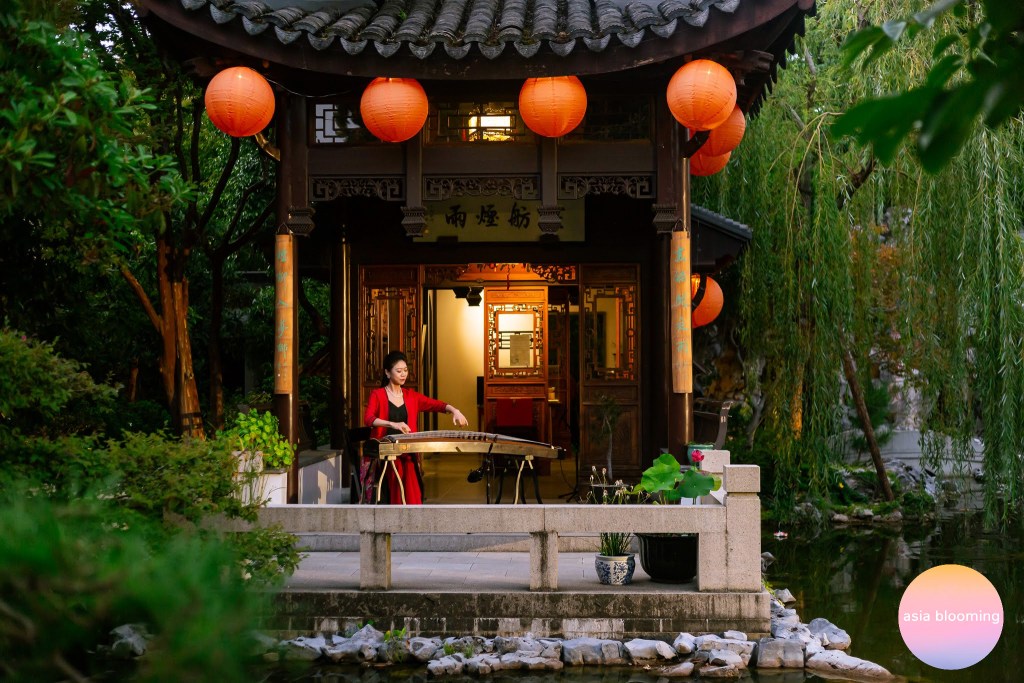
After brief remarks from the garden’s executive director and San Francisco-based Chinese Consul General Zhang Jianmin, the performance commenced with Li Han beautifully performing the classic folk song “Singing the Night Among Fishing Boats” on guzheng, a zither with movable bridges. The piece is one of the most well-known pieces in guzheng repertoire and depicts a scene of fishing boats returning home at sunset. As the sunlight faded, the decorative orange lanterns and the wooden lanterns lit up, giving the pavilions a warm glow.

Zhang Liumeng, stationed next to the “Moon Locking Pavilion” in the middle of the lake, was poised to perform on the sanxian, which translates to “three strings.” It looks and sounds a bit like a banjo, but the sounding chamber is covered in snakeskin and the neck is much longer than a banjo. She performed “Journey in the Desert,” a dramatic piece with a heavy Central Asian influence that captures the intensity and mysteriousness of the desert landscape. The piece features lots of note bending and uses a scale more similar to the Arabic scale than to the major pentatonic scale commonly used in Chinese traditional music. Stationed at the pavilion on the west edge of the lake, Ma Yingjun played the yangqin, a hammered dulcimer with a bright and resonant timbre. The piece she performed, “Spring,” blends a contemporary Western classical compositional style with the grace and sensitivity of traditional Chinese music.


On the other side of the “Moon Locking Pavilion” sat Liu Xiaojing, who closed out the solo portion with a performance of one of the most famous pipa pieces, “Dance of the Yi People,” a contemporary composition that is based on southern Chinese folk music. The pipa is an upright, fretted lute with a completely solid wood body and a distinctively bright, clear sound, and Liu Xiaojing effortlessly executed the virtuosic tremolos, harmonics, and quick sixteenth-note passages in the lively piece.
The performers then performed two duets, one of them with a sanxian and yanqin pairing and the other with guzheng and pipa pairing. The distinctive timbres of each instrument blended delightfully, and there were moments of back-and-forth that felt like a conversation between the musicians. To close out the performance, all four musicians performed “Sky and Mountain of the Spring” together for the encore, creating a dense and mesmerizing sound. The piece started off in a somber mood before transitioning into a cheerful dance section. What a delightful, joyous way to end the performance!


After the performance, the audience was invited to interact with the musicians and try out the instruments. All of the musicians were enthusiastic about sharing their knowledge and passion for their instrument, giving mini-lessons to willing participants and demonstrating their favorite pieces. With the help of bilingual volunteers, non-Chinese speakers had a unique chance to converse with these talented musicians while also connecting through a shared love of music. It was a delightful evening for visitors to learn about Chinese traditional music and, for some, also to reconnect with their cultural roots.
