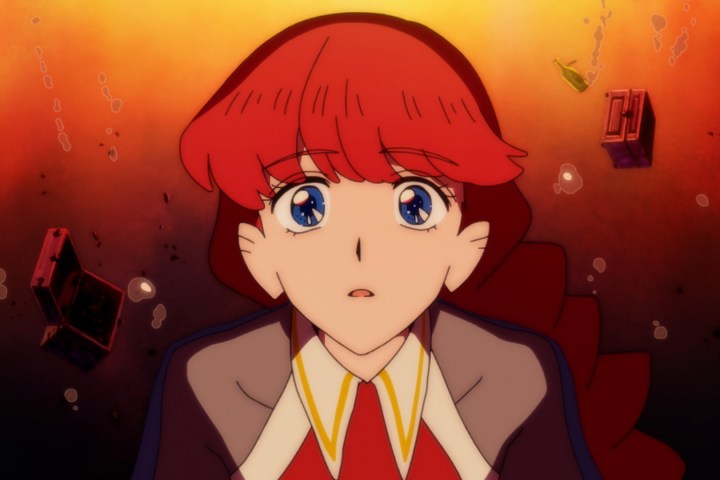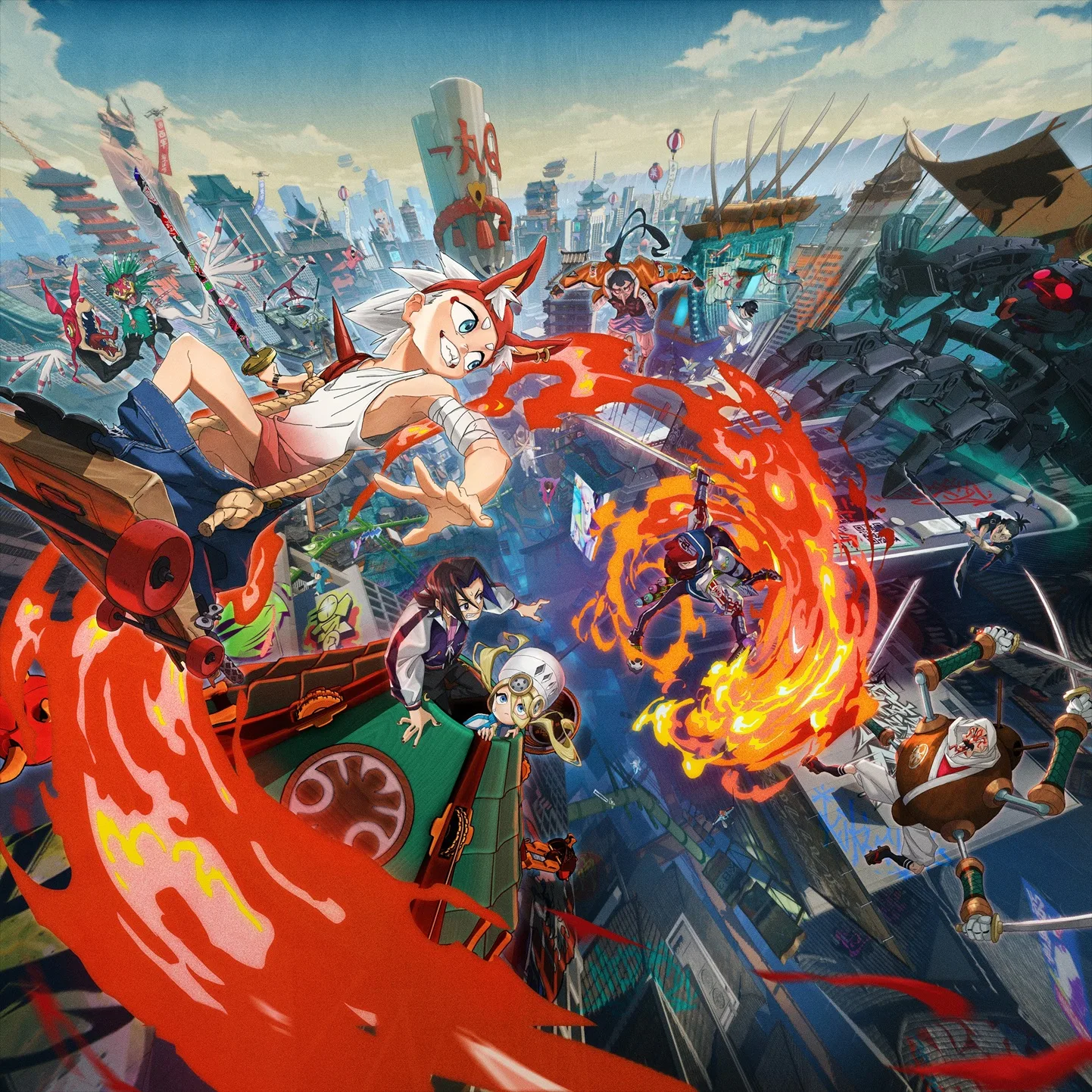

CHOCOLATE Inc.’s latest theatrical anime project, KILLTUBE, is a unique Edo punk-themed film set in a dystopian world, where outcasts must duel via streaming for fame and survival. Condensing 108 experiments from different fields of expertise into one theatrical anime film, KILLTUBE is set to release in 2026.
At this year’s Anime Expo, the voice cast was revealed, with Yui Tsukada taking the lead as Musashi, Kengo Kawanishi as con artist Kikuchiyo, and Ayane Sakura as genius inventor Leonardo. Following the film’s panel at Anime Expo, Asia Blooming spoke with Director Kazuaki Kuribayashi and Animation Producers Kenichi Shimada and Fuuko Noda about the story and its production.
The film revolves around a societal phenomenon known as duel streaming. Streamers are battling against one another to earn more views, more likes, and more streams, and only those who come out on top are able to survive. “I saw a new possibility and new visual that I wanted to create from combining influences from duel streaming and Samurai,” Director Kuribayashi began. “I’ve liked Samurai since my youth. There’s this culture of fighting to rise up the ranks and even to the death, and I saw a similarity between that and the streaming culture of building followers.”
While the director was inspired by this unique blending of modern and traditional concepts, it was a bit of a challenge for the animation producers. “Every day is a hard day, but of course, it’s not hard to naturally be inspired by the world of KILLTUBE,” Shimada started. “It was moreso gluing together new ideas from the director, breaking rules with how to make things happen as a producer, and doing new things that made it harder.” Agreeing with her co-producer, Noda admitted that she loved the challenge of it. “It wasn’t easy balancing out the ins and outs of how complex this artwork is,” she shared. “For example, our promotional poster is hand drawn, but the actual movie is in 3D. Finding the balance of how to blend in the background with the CG and hand drawing was a challenge. And there’s a very like fragile balance to it, but being able to go past that really allowed us to expand and create new things.”
In addition to nailing the nuances of the edo-punk concept and blending the different eras into one, there were a lot of teams involved in the project, including CHOCOLATE Inc., STUDIO DOTOU, Kassen, and Wachajack. Having so many hands on the film certainly had its advantages, but it also added complexity to the project. “The good was that there were always new ideas, whether it be characters, stories, or world building, and not doing it alone was always a great thing. We’d always have conversations with even the writer or the character designer, and creativity really goes in both ways,” Kuribayashi shared on the positives. “It could be time consuming, and because we were doing something new, it was hard to build a new workflow,” he also admitted. “The producers probably had a lot of difficulties there, but just the building of a process was difficult because we weren’t doing the typical thing where we write, then build characters, then build the world. It was just an ongoing loop, very cyclical, so we just kept going on and on.”
One of the biggest reasons for having such a large team on the project was to put every bit of effort into creating the detailed and layered world of KILLTUBE. “Within the process of bringing 2D into 3D, it was very interdisciplinary, with different creators, even from the external outside. Although there were different creators and different avenues of creativity, there was one person that was quality controlling it, keeping the same tone and mannerisms. That was a big key point for us,” Shimada shared. “The music also played an important role, especially in adding depth,” Kuribayashi said, mentioning yet another team and aspect of the movie. “Musashi is a very energetic, outgoing, fun character, but it becomes cliche when you add music that is energetic and fun with that. By adding something that was a little bit heavier or mellow against this character, it created more layers.”
In the spirit of experimentation, it was important to the team for the film to come up with fresh ideas, from the edo-punk concept to the storyline. “I wanted to create something with longevity,” Kuribayashi shared. “I appreciate movies because the audience is committed to watching and being focused for those 90 minutes, so I wanted to leave a lasting impression and allow the film to grow with the viewers. We’d very much like to contribute to the process of diversifying within the (anime) culture,” he continued. “Of course there’s the golden path of a popular manga becoming an anime, then being a film and a game. That’s great, but it feels limiting. We wanted to prove that original films can be successful and to expand the possibilities.”
Chasing his big dreams with his original concept and story, the director’s vision was brought to life with the help of the producers. “It’s been fun, but hard,” Noda admitted. “Pre-production was definitely harder, working from zero to one. Even while we were creating the scenarios, the artwork, and the storyline, there were many moments when we decided something seemed good in the moment, but then realized another way would have been better when the visibility of the whole creation became more fine-tuned. There was a lot of great responsibility with understanding what these adjustments could cause.”
Taking pride in their work, producer Shimada summed it up with a declaration of ambition. “This project can only be executed now, because of us. This is the first film, and this is the only first, so it will give something that the second and then the third won’t have. We want to disrupt the norm and explore.” Adding on to his thoughts, producer Noda spoke more on relatability and connection. “This film connects to us very deeply, and the audience can get the feeling of accomplishing a challenge [after watching]. The process, the look, and the story were all made while diving into new processes and finding new ways of doing things.” Wrapping up the conversation, director Kuribayashi shared his hopes for KILLTUBE: “This sounds over exaggerated, but I would like to think that the release of this film will shift the culture and the history of animation. The success of this film is really going to create a new era, and it comes back to the point I made earlier. I plan on passing on the know-hows of this process to the community, so that this is also an advancement for other filmmakers as well.”
A culmination of five years of hard work from a unique team of artists, directors, producers, and actors, KILLTUBE aims for a December 2026 release.