
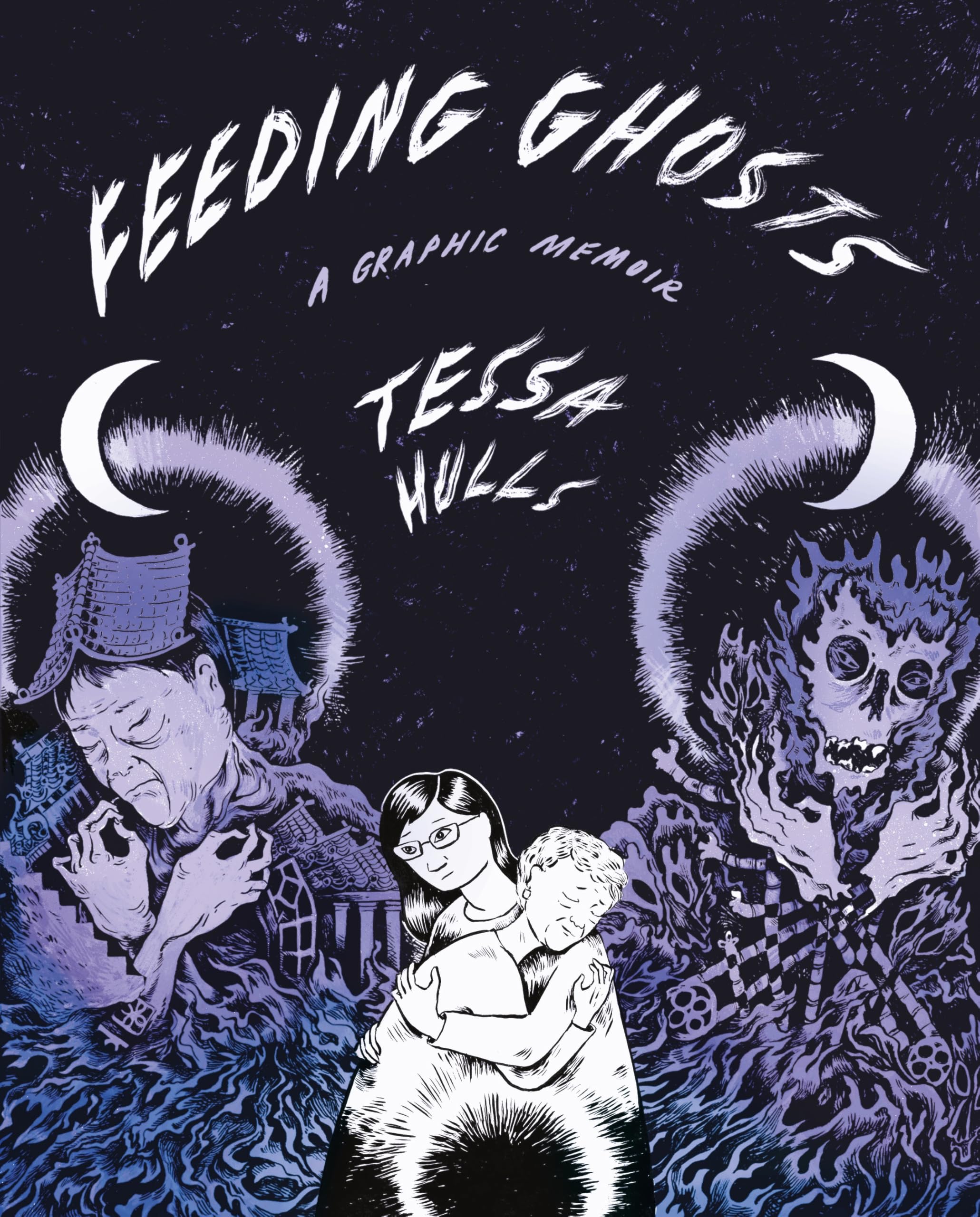

How do you start unraveling a family history laden with trauma? For Tessa Hulls, this journey began when she started writing what would become her graphic novel, Feeding Ghosts, winner of the 2025 Pulitzer Prize for Best Memoir. A deeply personal exploration of herself, her mother Rose, and her grandmother Sun Yi, the book examines the ways in which trauma and love are intertwined and their persistence through multiple generations and societal changes. Told in ten parts, Hulls follows a chronological sequence of events starting from 1920’s China and ending in present day America, while also weaving in her perspective as the author and subject.
Reflecting on her past, Hulls notes, “I couldn’t embrace myself until I understood our ghosts.” The title, Feeding Ghosts, alludes to the author’s own journey through the research and writing of the book, which involved untangling narratives from her grandmother’s past and confronting her complicated relationship with her mother. During the Communist era in China, Sun Yi entered into a brief relationship with a Swiss diplomat, resulting in the birth of her Eurasian daughter. A journalist who openly defied Mao’s Communist ideals, Sun Yi was essentially forced by the government into exile. She wrote her own memoir, which included her dissenting opinions of the Communist party and was consequently banned from returning to China. In the process of Feeding Ghosts, Hulls commissioned a translation of the original text so she could read her grandmother’s own account of her life experiences. Hulls includes direct text from her grandmother’s memoir alongside additional commentary and details of major events occurring in that timeframe. She gives color to Sun Yi’s musings and decisions by putting it within the broader historical context while also acknowledging that her grandmother may have been an unreliable narrator. She astutely observes that, much like how the Chinese Communist Party created their own truths by solidifying them in written propaganda, her grandmother likely had her own biases when it came to how she wanted to represent herself in writing for posterity and was likely in the early stages of a mental breakdown. Hulls writes, “In each instance, there was a reality someone needed to see. So someone wrote it down. That never made it true.” In this sense, Hulls does an excellent job balancing being a historian and a biographer.
Sun Yi’s legitimate concern for her daughter’s wellbeing during a tumultuous political period propelled her eventual descent into madness, and watching her mother fade away made Rose, Hulls’ mother, stricken with fear and paranoia that her own daughter would also become a victim of mental illness. Hulls writes, “In this, my mother and I were identical – the topographies of our childhoods shaping themselves around the intimate form of our mother’s fear.” Through honest conversations with her mother, Hulls describes how she is able to break through the generational trauma. “My grandmother’s darkness stole the light from her daughter, and with all the best intentions in the world, my mom almost stole that light from me.” Hulls writes openly about mental illness, its toll on the women in her family, and the fractured relationships it leaves in its wake when it is cast aside as a personal failure or covered up due to shame. Throughout the book, she explores the conflict created by the inherited trauma and different cultural systems that have influenced their mindsets. She recalls her childhood days, and her fear of Rose’s “ghost twin.” Facing off against this cold and volatile version of her mother, Hulls describes how she built up her own walls. Adopting the persona of a cowboy, she fought fiercely for her independence, eventually leaving home to venture as far as she could until she realized, as she put in her own words, “I couldn’t embrace myself until I understood our ghosts.”
Tessa Hulls’ willingness to divulge deeply personal stories and bare her emotions unfettered is what makes Feeding Ghosts a true gem. As a biracial kid growing up, Hulls felt neither Chinese nor American. She questioned whether she had any right to claim her Chinese ancestry while simultaneously recognizing that her features projected her Asian-ness to others. But throughout the course of writing this book, she reconnected with her Chinese identity, learning Mandarin and bonding with family members back in China. Hulls explains that she initially started out with writing the book as a purely historical narrative, intending to keep her emotions out of it, but there was no running away from her family’s ghosts that appeared during the process.
Making the most out of the graphic memoir format, Hulls brings her stories to life in a dynamically visual way, often using metaphors and extending them into vivid illustrations. Hulls makes use of the flexibility of this medium, letting her artistic depictions flow between panels and span across entire pages when she wants to make a particular emphasis. She opts for an evocative and bold style, with high contrast black and white drawings.
Feeding Ghosts is ultimately more than just a labor of love; it served as a catalyst for Hulls to not only confront her family’s ghosts but empathize with them and set them at ease. As Hulls writes, “Maybe this is what it means to the child of immigrants – forced to bear witness as the first generation far enough from the pain to be able to see how deeply it is there.”
