
Warning: This interview contains spoilers.
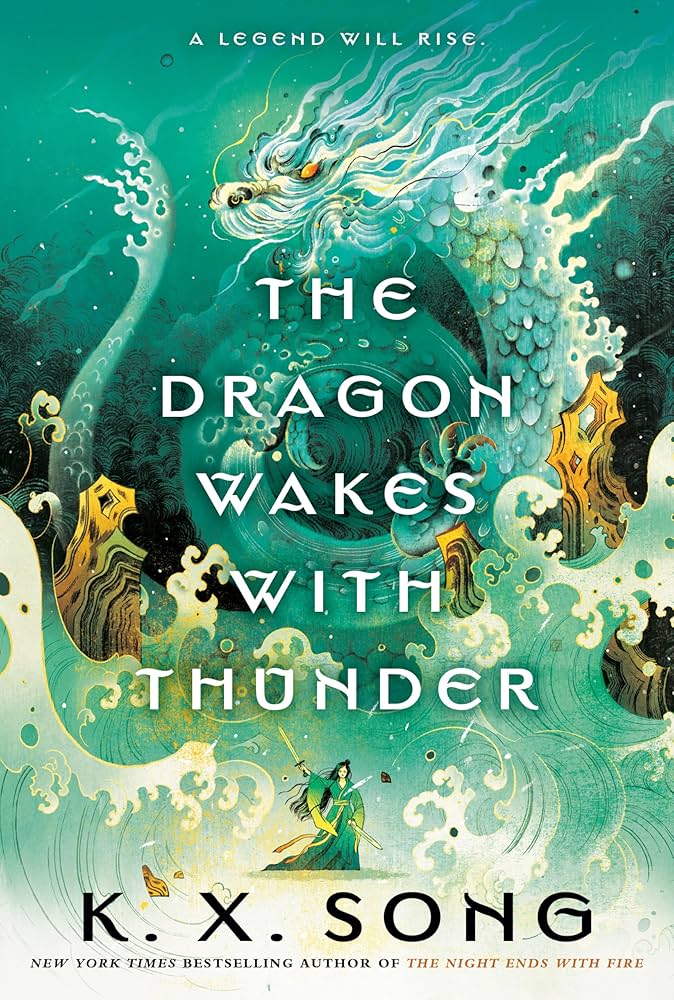
This summer belongs to the dragons. K.X. Song returns with The Dragon Wakes with Thunder, the follow-up novel to The Night Ends with Fire, hitting shelves on August 19. While the story begins like Mulan’s tale– a daughter taking her father’s place in battle–it goes on its own darker path. Her decision stems not from duty, but from her own hidden greed. Ahead of the book’s release, Asia Blooming sat down with K.X. Song to take a deep dive into the duology.
I’ve heard you consider The Night Ends with Fire as a dark retelling of the Ballad of Mulan. For those familiar with Mulan, there are varying recollections of this legend, but most of us would be familiar with the Disney version. Can you give us a synopsis of your interpretation of this legend?
Song: Yeah, definitely. I would say that The Night Ends with Fire is my version of Mulan. That is, if Mulan was motivated, not out of filial piety, to help her dad, but rather out of her own selfish ambition and her desire for freedom and for power, and I wanted to explore what would happen to her status as a heroine if she was motivated by these darker traits, like would society still revere her as a hero? Or would she instead be seen more as a villainous role?
And then the other thing, too, was that I had just been finishing my original debut novel, An Echo in the City, which is a very different book in terms of genre. My first novel was historical and realistic. It dealt with a lot of topics that are very personal and close to my heart. I think I just really wanted a break from reality. And I wanted to write the most escapist fantasy adventure that just incorporated all the themes and things that I loved as a kid. And so, I put in star-crossed romance, love triangles, enemies to lovers, dragons, just like all things that I really wanted to read and loved reading as a kid into a book that was able to help me forget about the pandemic and everything else that was happening in the world at the time.
The fantastical elements are certainly there. Night Ends of Fire felt a bit like the martial arts film, Crouching Tiger, Hidden Dragon. There’s a certain couple in that film that also went from enemies to lovers.
Song: Yes! I love the trope where it’s like we are enemies, but I will help you just this once. Dramas just encapsulate that all the time. There’s also the costumes with the long trailing sleeves and how there’s always knives hidden inside.
Exactly! That’s how I imagined Prince Lei, who is one of the love interests of our protagonist, Meilin. Speaking of which, we also might as well talk about our heroine! The first book follows Meilin and her path to becoming the savior of your version of a fantastical ancient China. Tell us more about her and the first book.
Song: Oh yes, so Book One begins with Meilin, who is our Mulan, as she runs away from an arranged, but abusive marriage by disguising herself as a man and joining the army. In the army, she awakens her desire for something more in life than the very constrained life that she would have experienced living under her father’s thumb and her would-be husband. It goes through this sort of journey into coming into her own power, coming into her own confidence and into her own story. She also makes a deal with a dragon which may or may not have some consequences. But that’s basically the gist of Book One.
How about Book Two? There’s a massive cliffhanger, where she sort of finds herself in jail. Tell us what Book Two means for our protagonist.
Song: The Dragon Wakes with Thunder is all about the consequences of her actions in Book One and about how no matter how pure your intentions are, power does corrupt and change who we are at our core.
I was inspired by seeing so many historical leaders, and even leaders in our current times today who might come into their power with very sort of benevolent intentions. But being in that seat, there’s no way to not be changed by it if you’re human. I really wanted to go through Meilin’s corruption arc and sort of unpack what it means to be someone who has lost touch with a lot of her former values and ideals.
At the same time, too, there are a lot of different relationships happening in my story, a lot of secrets, a lot of machinations, broken trust, formed enemies, maybe even lovers, where I wanted to sort of cause as much chaos as possible, and overturn every stone that I had set up in Book One. I wanted to blow it all to pieces in Book Two.
Oh boy! That was a lot to unpack, and this is just a duology!
Song: Oh yes, I wanted to tell this story as a duology becuase the second is already the finale to the series. You can just do everything you want to do, and any scene that is ambitious, cinematic and climactic, you can throw it into the book. And so, I hope that reading The Dragon Wakes of Thunder will be a satisfying experience for readers.
Let’s take it back to the different relationships you explored in your series. In Book One, Meilin deals with more black-and-white issues. We have an enemy, we must defeat it to reach the happy ending, but obviously that’s not how the story goes, and even Meilin begins to learn that in Book Two. She also is introduced to the Imperial Palace and meets who we know as the Ladies of the Court. Can you share more about what Meilin learns here at the Palace versus the outside?
Song: Definitely. I was trying to pay homage to those Chinese dramas with the palace intrigue that I grew up watching and loving. I wanted to feature a lot of different types of strong women because I think that Meilin represents only one archetype of the strong female character, but there are so many that exist in different forms, and I wanted to be able to showcase that.
Through the Palace spotlight, we’re able to see people who are working from within the system, and also people who are very morally gray. As the villains in this story, they are the people who we want to see meet their downfall because they’re standing directly in Meilin’s way. However, she recognizes and respects these villains like an artist admiring a rival’s work, despite it making her own job much more challenging.
I had a lot of fun with the Palace intrigue and the scheming. I wanted Meilin to sort of go in a different direction. Book One taught her how to fight, stand up for herself, and achieve the impossible through hard work and determination. Book Two is her learning how to subtly demonstrate one thing while saying another thing to get what she wants. Because that’s another form of power, too. And that’s something that Meilin must learn to accomplish a lot of her goals.
Not all women were villains to Meilin in your story though. We also have Meilin’s relationship with both her stepmother and her own birth mother, which are both different. How do these relationships affect Meilin’s growth throughout your series?
Song: I don’t know how deep I can go without giving spoilers, but I guess what I’ll say, the stepmother is definitely not the traditional evil stepmother archetype and is much more caring, maternal, and thoughtful. She does a lot of womanly duties that really helped to make Meilin feel cared for and feel at home with her.
Meanwhile her birth mom actively makes Meilin stand on her own but in a way that is also meant to push her away. A big part of Meilin’s journey in Book Two is trying to figure out why her own mother did what she did. What was she trying to accomplish? Her own mother has ties to the Dragon that Meilin also is involved with in both Book One and Two. Through her mother, Meilin wonders if there is something wrong with her relationship with the Dragon. Her mother is a very complex character, and I wanted to write more about her but due to pacing we had to keep it short and re-focus on the parts that would only affect Meilin’s current growth.
Overall, through her story, I wanted to emulate what maybe those of us with immigrant parents have experienced, which is like sometimes we don’t see the direct fruits of the labor they had to endure; in retrospect, we realize that we’re only able to run because our parents walked. For example, I’m the one who’s ostensibly very creative in my family, like I have books published, and I consider myself a writer and author. But my parents were also creatives too. They just were never able to showcase that creativity as openly and in such a public forum, but they instilled in me my love for creativity and that helped me get to where I am today.
As for the Dragon, who is named Qinglong in your stories, it is one of the Four Mythological Beasts of Chinese legends, alongside the Tiger, Black Tortoise, and Phoenix. They each have vastly different personalities, and Meilin encounters other characters that have forged a bond with these god-like entities. What determined which beasts were associated with which characters and why the Dragon for Meilin?
Song: I wanted the creatures to mirror the humans, in that the creatures are all morally gray and not definitively on the side of right or wrong. All four of the beasts have lived different timelines in my books, which I alluded to in the epigraphs at the start of each chapter. They have played the hero or the villain in each of these lives. It happens to be that in this timeline the Dragon is playing the villain, and I knew I wanted to write Meilin to have this dark emotion that was focused on greed. I interpreted greed as a desire for power, and I wanted this to feed into Meilin’s own ambition, but at the same time, if you let it get out of control and let it take over all your personality, when do you need to stop and like how much is too much? I wanted to showcase that with the push and pull relationship she has with the Dragon, which is why I chose it for her. Besides, the Dragon is the iconic Chinese creature everyone will know about.
True that! Dragons are definitely the it creature nowadays in fantasy. Speaking of all of the beasts though, there is one more we don’t meet in the books, but your epilogue alludes to it. Does this indicate a new book?
Song: So I will say, never say never! No immediate plans. But I would definitely be open to it in the future.
Here’s what most readers are probably waiting for, let’s talk about romance! We have a love triangle with two different princes here, Prince Sky and Prince Lei. Each has a different impact on Meilin, which honestly even I was like who will she end up with?! Tell us more on how you crafted the romance and did you always have it in our mind who the end game was?
Song: Ah, yes. I always knew who I wanted Meilin to be with, but we can’t get into too much detail! I will say that both men have different qualities for sure and we see more of it come out in Book Two that may or may not be red flags. However, neither prince is a bad guy and are both great guys in their own rights, but we have Meilin who prioritizes her independence and freedom. It’s just that her deepest fears and anxieties tend to conflict with one of the prince’s greatest wants and needs in some ways. I did sprinkle some threads since Book One, but I hope it’s not necessarily a surprise and I think most readers will be satisfied.
Big question that most readers and critics are curious about. Was there any choice behind the mix of Chinese and English (pinyin) names for your characters?
Song: Ah, yeah, it’s a great question. I was really surprised about the response to that. I think it’s because I grew up in both the U.S. and China. And so there’s a different relationship that I think Chinese people have to these topics versus those in the U.S. To kind of give context, I also based my duology on the Romance of the Three Kingdoms. Despite that, I’m not actually writing a Chinese classic. I’m doing a retelling that is inspired, but not at all faithful to the original.
For example, Prince Lei, he’s inspired by Cao Cao, which is this very like villainous character in the Romance of the Three Kingdoms, and Sky is inspired by Liu Bei. Who is this like very honorable, virtuous, heroic figurehead in the classic. I wanted to pay homage to those characters. And so that’s why I included their surnames, as part of their character names. But then I wanted to change their primary names to allude more to their personalities in this retelling that are not exactly the same as in the classic.
In the end it’s a fantasy where I can just play around with it and write speculative and whimsical things. Yes, it’s inspired by China, but it’s not China. In fact, my next piece is going to just have the whole kitchen sink put into it. It’s going to be wacky, but writing it just brings me so much joy because it will be so whimsical.
I’m already looking forward to that! That’s what fantasy should be. It is interesting to see how much has changed over the 10 years of publishing for Asian American writers. More doors and more authors writing what they just want to do.
Song: Oh yes, and I will say, like, I’m so privileged and lucky to be following in the tradition of like really rich, beautiful Asian American stories that have come before me, and that is so much of what helped pave the way for stories like The Night Ends and Fire because I was able to tell this very non-conventional story, where there are characters who don’t necessarily do what people would expect them to do. It’s not just the classic hero’s journey.
Your original debut was a young adult book, but based on our discussion writing in the adult space seems to have more freedom. Which side would you prefer writing for? YA or Adult?
Song: I think they’re just different. Some think that writing YA is harder because you must adopt the voice of a young adult. But I find that young adults these days are so mature. They’re exposed to so much at such a young age through social media, through changing politics, and through different things happening in the world. And so, when I was writing An Echo in the City, my voice itself was actually very intuitive for YA because I felt like I could be just as thoughtful and just go in really deep with it.
As for Adult, I was just leaning towards darker themes. And I think some of it is influenced by what’s happening in the world and how I’m reacting to it. And a lot of what my stories are inspired by are sort of the questions that keep me up late at night. Adult provides a better space to explore the morally ambiguous and darker themes, and I want to leave my readers with a question that doesn’t exactly have a clear answer but is one they’ll still enjoy.