

Upon first seeing the title of the show and the photo of Clayton Lee smiling innocently on a white bedsheet, I assumed it was a classical piano concert. But after reading the show description more closely, I became less sure of what exactly it was, though for some reason I was still convinced that a piano would be involved. What else would Goldberg Variations mean? Even before the show began, my expectations were already subverted, a trend that only continued as the show went on. As people streamed into PICA, filling both the seated and standing space, a Wikipedia article on American wrestler Bill Goldberg was projected onto the big screen.
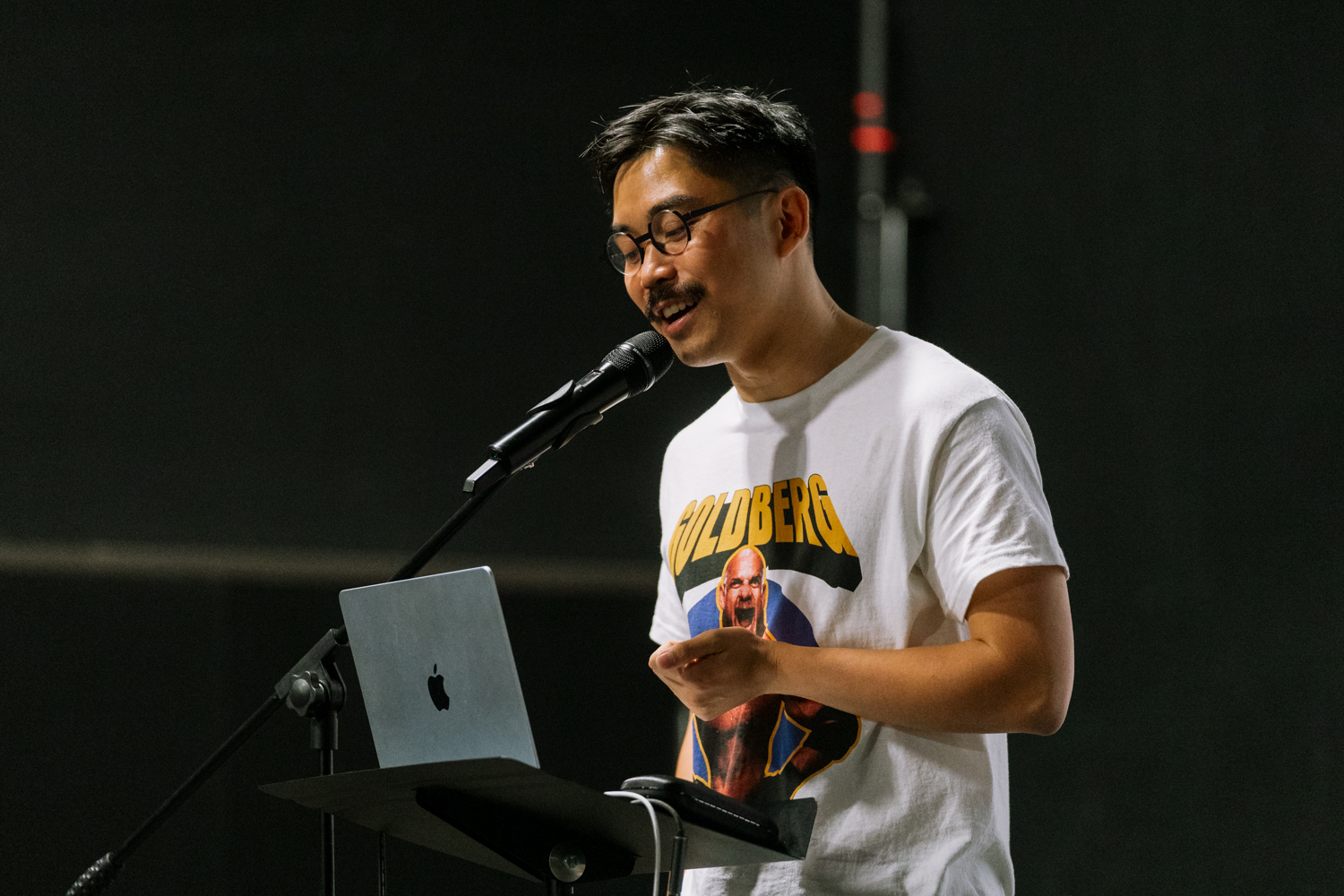
Standing onstage in a t-shirt, fiddling with a laptop on a music stand and a mic, Lee seemed soft spoken and matter-of-fact, his tone conversational. What ensued was at once a research presentation, a stand-up routine, an interview, a dating show, and a therapy session. Lee stated his hypothesis with the seriousness of a scientist–“My theory is that all of my past romantic and sexual partners have resembled professional wrestler Bill Goldberg.” So that’s where the title comes from, I realize belatedly. Like any proper dissertation, Lee brought evidence. Videos of Goldberg, social media accounts of his exes, paywalled articles with a headshot of an ex, even an AirBnB listing in LA hosted by his ex-boyfriend. Precise and thorough, almost to the point of being unnerving, it brought up questions of privacy and consent in the age of unerasable digital footprints.

“There’s a version of this performance where I go through all my lovers in detail, which would be a multi-day performance.” He spared us this version and only went through the “greatest hits.” He hypothesized this way often during the show, making us wonder how many of these alternative versions have actually been enacted. “There’s a version of this performance where there’s a boxing ring in the middle of the room and Bill Goldberg comes out and lifts me up over his head,” he mused, before cutting off this fantasy with the financial impossibility of guest starring Goldberg. To assuage this devastating fact, he hopped offstage to look for a “Goldberg variation” from the audience. After receiving a couple of no’s–to which he responded “rejection is my kink,” he heard someone volunteering a man in the standing area who fit the bill: bald, scruffy, with bushy eyebrows, and wearing a red, white, and blue set of matching jacket and pants. Lee proceeded to interview the man, asking increasingly intimate questions that eventually led to the guy taking off his top to show off his abs, and Lee sitting on his lap. There were a lot more yes than no’s even as the questions got more provocative, but Lee did eventually get past the guest’s comfort zone with requests for demeaning language. After a certain point, the questions went from “Do you find me attractive? Would you choke me?” to “Did you know I hated your dog from the beginning?” and “Are you happy after we broke up?” seemingly serving as a retroactive therapy session to help Lee process his breakup. A theme of Lee’s work is to push the boundaries of performance, which was showcased here in the rapid succession of different modes of presentation, as well as in interview questions that became increasingly probing and, often, increasingly uncomfortable for both the guest and the audience. What is too taboo to say or do in a performance? What are the ethical or moral rules of this space, and are they different from in the real world?
But Lee was not done with testing the limits of this performance. The lights dimmed and turned red, he took off his clothes to reveal sparkly underwear, and the curtains at the side of the venue opened up to reveal a whole boxing ring. What ensued felt more like a fever dream than a performance and involved a dizzying amount of wrestlers, ropes, ladders, shirtless men, and bottles and bottles of (artificial) ejaculate. Highlighted in the midst of all this was the “performance” of hyper-masculinity. The deep voices, rough demeanor, and hunky bodies of the professional wrestlers were overexaggerated to contrast with Lee’s not-quite-muscular body and meeker attitude. The bulky men delivered body slams and verbal assaults onto Lee, who groveled in a mix of fear and delight, shrieking as he was lifted high over the wrestler’s head. This happened twice. Despite knowing that this was Lee’s fantasy and that everything was done safely, I (and many of the other audience members, judging by the gasps in the room) felt worried for the well-being of Lee, who was continuing to amass red marks from slaps and throws. There was a moment when one of the wrestlers had pinned another to the corner and was punching him in the head (theatrically), and the audience chanted the number of punches, tentatively at first, as if we were all questioning if it was right to cheer on this depiction of violence. The ambivalence faded quickly as the chants grew louder, but that underlying discomfort stayed throughout the piece.


Photo Credit: Ali Gradischer
The entire boxing ring segment was an exercise in humiliation for Lee — from being thrown around like a ragdoll, to being tied up (ceremoniously, at least) and left hanging on the ropes of the ring, to having to listen to digital conversations with his ex being read aloud, and lastly to being drenched with whitish goo by a cadre of attractive men he doesn’t even get to see. Only at this point did Bach’s composition get played, but not live, rather, a synthesized version broadcasted over the speakers.
There was an instinct to look away so as to not cause further embarrassment, but perhaps we were more uncomfortable than Lee was. The line that separates pleasure from harm is blurry, especially in a world seeped with racial and sexual violence. Is humiliation okay with consent? What about when there are witnesses who did not explicitly consent to seeing that?
Visually stunning, weirdly intimate, and deeply provocative, Goldberg Variations was a performance filled with twists and turns that pushed the edges of what audiences and venues are comfortable with. It was authenticity bared so unapologetically that it was almost unnerving. It was a foray into the blurry lines between pleasure and violence, reality and fiction, art and life.
