

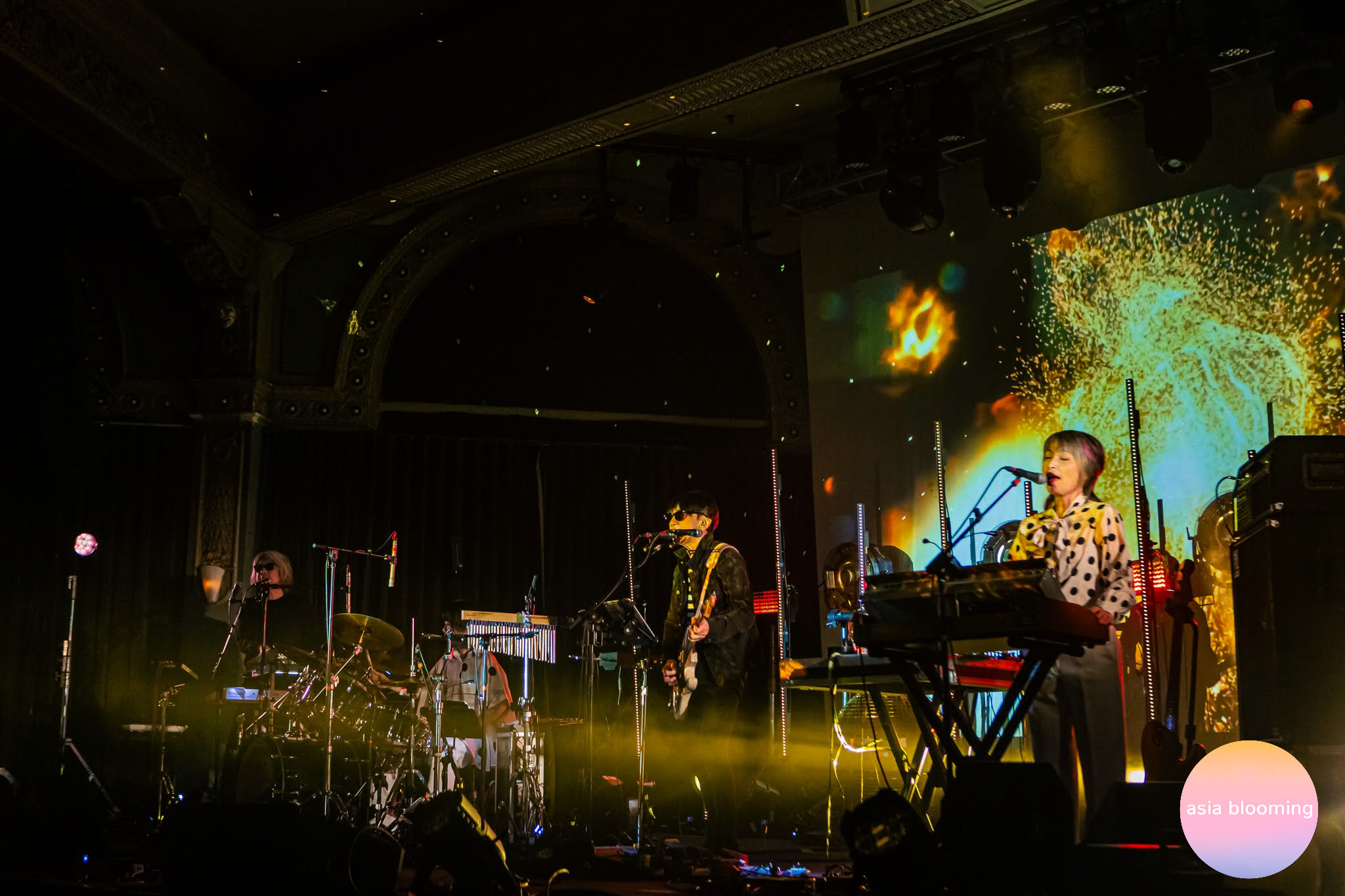
Hailed as a pioneer of Shibuya-kei in the 90s, Keigo Oyamada, the Japanese experimental artist behind Cornelius, continues to bend the borders of what’s possible even in his third decade as a solo act. Ahead of the Portland show on the DREAM IN A DREAM world tour, a Crystal Ballroom staff member gestured at the stage and mentioned, “This is a new setup for us.” A large piece of white fabric was draped in front of the stage, obscuring what lay behind. The show kicked off with the band launching into “Mic Check,” as bright green line drawings scampered across the makeshift screen. The song samples the sounds you would hear during a mic check (“One, two, three, four / Can you hear me”), stacks them onto a hip-hop beat, and intersperses the track with sometimes watery, sometimes futuristic synths. As the crowd attempted to peer into the small slits in the screen and onto the stage, the backlight suddenly illuminated, projecting the silhouettes of the four-piece band onto the screen and drawing cheers of excitement. With a “clack” and a “swoosh,” the fabric screen fell to the ground, revealing the band and a large projector screen behind the band. Simple, but epic.

Oyamada, on guitar, was joined by three other band members on bass, keyboard, drums, and synths. He maintained a restrained nonchalance, and while there were no hair flips or stage prancing, there was plenty of sonic and visual stimulation in store for the audience. At first, I thought Oyamada’s dark sunglasses were to make him look cooler, but I soon realized that they offer much-needed protection from the blinding LED beams careening across the stage. It would honestly not be a bad idea for concertgoers to also wear sunglasses for Cornelius’ shows; there were a few moments where I had to avert my eyes from the overwhelmingly bright lights.
Some of the songs had a similarly jarring effect as the lights. “A Point of View” stitched videos of native tribes making music, which, at first transitioned through videos at the pace of a brisk documentary, but it quickly sped up and chopped up the videos so much that they became samples. These samples were then looped, combined, reversed, and modulated into a fantastical, overstimulating audiovisual whirlwind. Songs like “A Point of View”, “Helix/Spiral”, and “Count Five Six” situated attendees squarely in wacky fever dream territory, bombarding the crowd with disjunct sounds that are initially disorienting but quickly coagulate into hypnotic earworms.
In contrast, “サウナ好きすぎ、より深く / Too Much Love For Sauna (Falling Deep),” a rearranged version of his 2019 release “Sauna Sukisugi”, is an immersive watery reverie of dreampop and soft jazz. The sparse instrumentation, ascending keyboard arpeggios, and mesmerizing underwater scenes projected on the screen envelope the senses so gently that the previously bombastic songs seem like nothing more than an outlandish dream. “MIND TRAIN” can best be described as what a gentle alien abduction would sound like, replete with whirrs, clicks, buzzes, and zaps, as well as slowly panning blue lights that are curious, almost invasive, but without malicious intent.


Cornelius’ fantastical world was most prominent in “In a Dream (Haruomi Hosono Rework),” a city pop track with experimental electronic flavors that was accompanied by projections of an Escher-style, vertical, floating city with faceless pedestrians and the occasional giraffe and panda crossing the street. Like in a dream, the otherwise situationally outrageous events were portrayed as normal occurrences. In a similarly outlandish vein, everyday objects took on a life of their own and played with each other to the math-rock-esque “Fit Song.” Cornelius’ alternative world flipped everyday logic on its head by humanizing objects and depersonalizing humans.
The thought provoking video projection for “Environmental” showed the Japanese and Chinese characters for “mental environment” and starred a faceless main character who attempts to follow his own path. As the wistful soft-rock-turned-city-pop song progresses, the masses get into some comedically gravity-defying situations, and our main character somewhat succeeds at resisting following the crowd as they dash frenetically towards an invisible goal, at one point standing alone in the clouds. But ultimately, he succumbs to the pressure of the masses. There was nothing in the song itself to suggest a dramatic inner battle, and it makes you stop and think about all the seemingly inconsequential times that you went with the normal path instead of carving your own. How many instances like that would it take for you to be swept up in the current?
Instead of simply walking off the stage, the band disappeared behind a blast of magenta-tinted smoke. After enthusiastic audience requests for an encore, the musicians returned onstage and performed a couple more songs, including “Chapter 8: Seashore and Horizon,” from Fantasma, which is what “Here Comes the Sun” would sound like in an alternative universe. The cheery and nostalgic melodies of this song and “STAR FRUITS SURF RIDER,” reminiscent of 80s TV show end credits, bade the audience goodnight.
Cornelius’ music and live performance tapped into a hidden layer of reality using light, sound, and smoke in mesmerizing ways. The futuristic, the wacky, and the nostalgic mesh in surprising and creative ways, making for a delightful dreamlike experience.
