

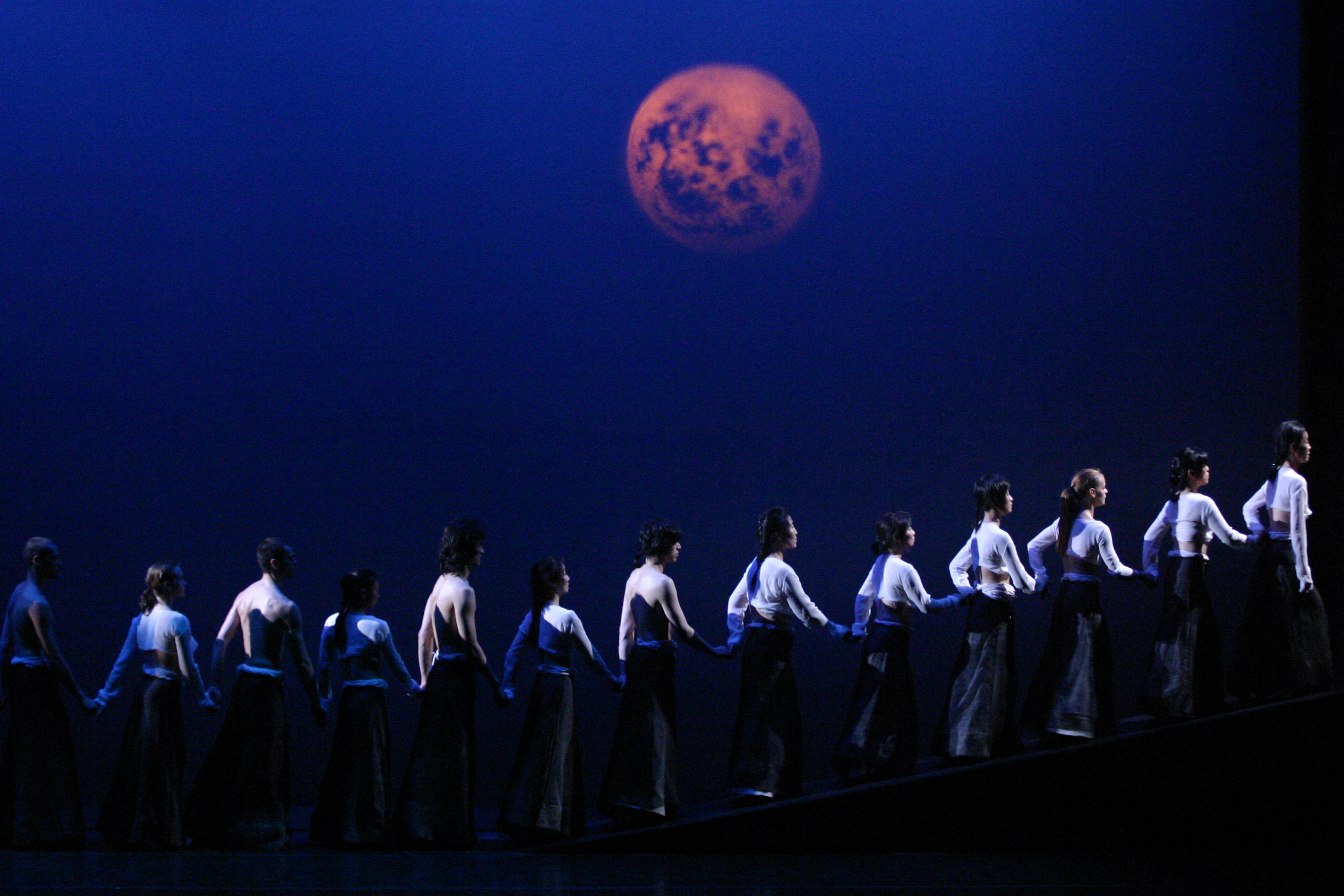
South Korea-based Changmu Dance Company brought their work <HERE> to Portland’s Arlene Schnitzer Concert Hall on March 19, filling up the almost 3,000-seat Art Deco venue. The choreography takes inspiration from “Ganggangsullae,” a folk ritual traditionally performed during the full moon to usher in a bountiful harvest. Choreographed by Kim Maeja, founder of Changmu Dance company and a recognized pioneer in fusing traditional dance with contemporary forms, the performance brought together East and West, tradition and invention through a series of vignettes. The first half of the performance drew from ritualistic dance forms and was set to slow Korean folk music, and the second half was set to the dramatic cantata, Carmina Burana by Carl Orff.
Against the rich blue background, dancers entered the stage in a line, holding hands, weaving and circling around the stage. The mesmerizing shapes and patterns created by the connected line of dancers on the left side of the stage contrasted with the solo dancer on the right side of the stage, the yin and yang of collectivism versus individualism. The collection of dancers moved as if it were one organism, shape-shifting and swirling with precise, yet leaderless coordination. The choreography found a bridge between unity and individuality by having dancers enter and exit the stage and strike a pose on the ground one by one. Individual actions made sense in the context of the whole. One of the “games” in Ganggangsullae called “treading on roof tiles” offered a perfect depiction of the relationship between the one and the whole. The pattern involved several dancers holding the waist of the person in front of them to create an elevated path. One of the dancers stepped up onto the shoulder of one of the bent-over dancers and, holding onto a male dancer on the ground for balance, started slowly walking on this newly formed path. The last person in this path ran to the front of the line to infinitely extend the path.
It’s an elegant display of stability created through collaboration, and it also emphasized the importance of every single person’s contributions.
The nuanced lighting and inventive costumes complemented the choreography to create a visually stunning effect, like a painting come-to-life. At times, the lighting allowed the audience to perceive the individual ripples of the dancers’ muscles as if they were sculptures at a museum. Other times, the lighting cast harsher shadows and emphasized the shapes and creases of their clothes. Some of the costumes worn throughout the evening, like the gauze tops, satiny pants, and flowy white robes, gestured towards the spiritual roots of the choreography. Others were more experimental and surprising, like the light gray, wrinkly dresses with a neck-pillow-shaped butt extension and a tail-like remainder of fabric. Towards the end, the male dancers sported a black outfit with a vibrant, cape-like fabric attached to their backs.
The selection of dancers for each vignette, the quality of their movements, and their costumes vacillated between gender essentialism and gender equality. For most of the sections in the first half of the performance, only company members of the same gender were included, reflecting both Korea’s traditional gender values and the fact that the Ganggangsullae is a women’s ritual. A particularly striking scene was when two of the male dancers executed choreography with heavy influences from martial arts and acrobatics, their power and athleticism on full display upon a red, sun-like projection. This level of strength and athletic prowess was not matched by the women-only sections, drawing a fine but definite distinction between the genders. Yet, the piece found ways to blur that distinction.
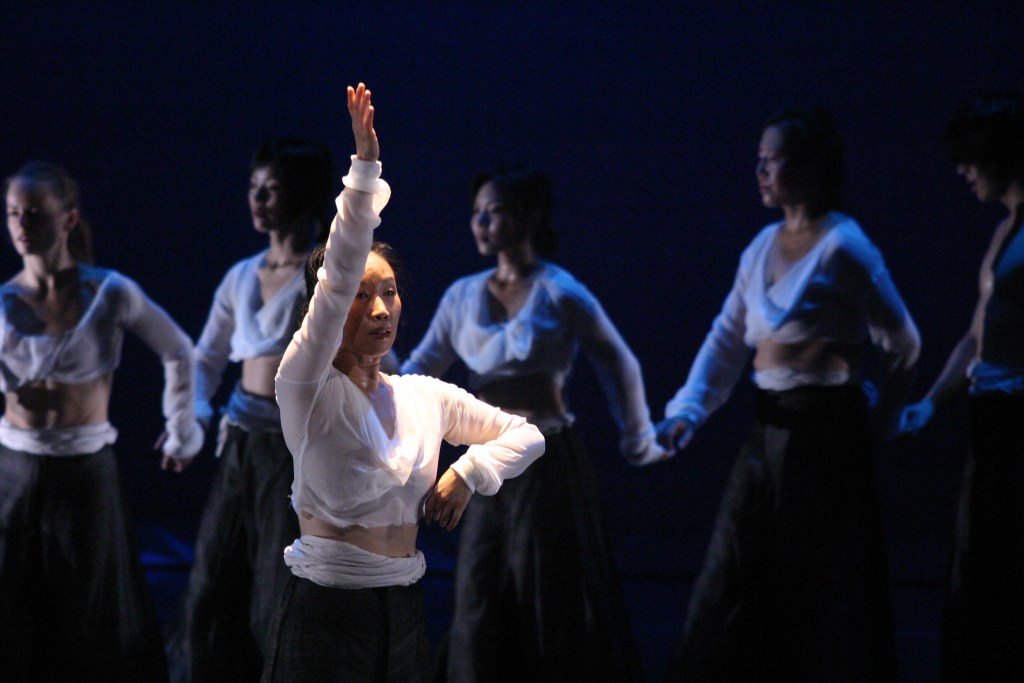
In a section set to a resampled version of a folk song, all the dancers came onstage wearing cropped white tops and ballooning gray pants, synchronously swaying left and right and swinging their rounded arms like combative monkeys. The difference between genders was dialed down to underscore the power in unity. A duet in the second half, set to Cours d’amour (The Court of Love) in Carmina Burana, featured distinct gender roles (the man was the “gazer” and the woman was often “gazed upon”) and costumes (the male dancer sported a white vest strewn with feathers and the female dancer wore a flowy purple dress). Despite these aspects of difference, both dancers moved with a fluid yet rooted grace that transcended gender difference. Interestingly, despite the musical score and the choreography loosely depicting heterosexual courtship, there’s no loving embraces or dramatic eye gazing. In fact, there’s almost no eye contact between the dancers, and there’s a good amount of space between them for much of the duet. Even when the man slid in between the space created by the woman’s wide legged stance, it was done in a collegial manner instead of a sensual one.
Perhaps the most applicable word to characterize the quality of the evening’s dance is “restraint.” Even in the aforementioned love duet, the dancers were reserved and self-contained. Throughout the performance, there were many moments when the dancers performed moves at an excruciatingly slow pace. It was effortful for both the dancers to move extremely slowly while maintaining their balance and also for the audience, who were forced to confront our own impatience. Even during quicker movements, the dancers moved in an unhurried manner and with controlled fluidity. This comportment contrasted a flavor of contemporary dance that finds emotional expression through strong contractions and maximalist movements. In some ways, this may be a reflection on what it means to embody Korean cultural norms, which were influenced by Confucian principles, in an increasingly Westernized world. Even while maintaining a tempered disposition, the dancers were able to express grief, pride, and confidence.
In bringing together dichotomous worlds of East and West, past and present, the piece situated the audience firmly in a “here” in a visually captivating yet meditative way. It’s a reminder that traditions are meant to evolve, and that they can be given new life without losing their intentions. It’s a hypnotic homage to the wisdom of collectivity, in which the whole is more than just the sum of its parts; it’s the raison d’être for them.
