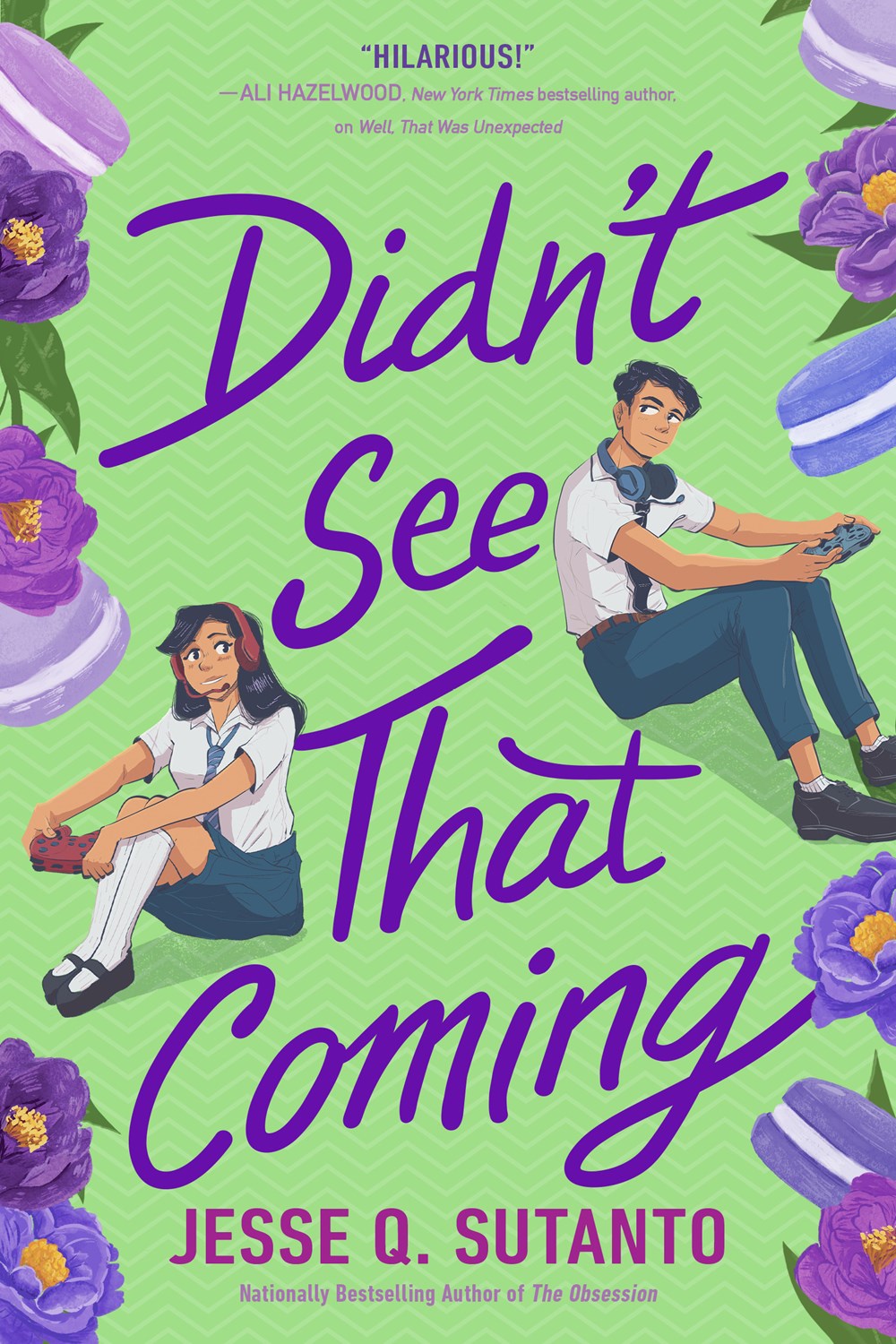

Life is full of change, both positive and negative. They can be made by choice, such as someone painting their nails a different color, or they can be completely out of your control, like the changing of the weather. For Kiki Siregar, the most recent involuntary change in her life comes in the form of a school transfer, when her parents switch her over from liberal Mingyang to conservative and pretentious Xingfa. To survive her new school, Kiki is faced with two choices: keep her head down and go against her own morals and beliefs, or speak out and become a pariah in her new school. In Jesse Q. Sutanto’s Didn’t See That Coming, readers are given a direct look into Kiki’s first few weeks at her new school, as she loses and finds herself once again, and makes some new relationships along the way.
Kristabella Siregar, who prefers to be called by her nickname Kiki, is a Chinese-Indonesian teenager living in Jakarta. She’s always been popular in school, known for speaking up for what she believes in and being confident in herself as a strong young woman. Aside from her school life, Kiki is also an excellent player of Warfront Heroes, an online first-person-shooter game where Kiki has forged a friendship with another player with the username Sourdawg. Unfortunately, living in Asia means that society does not favor outspoken and confident young women, and society most certainly does not think they should be gamers. This is what has led Kiki to join the game as Dudebro10, a move that has allowed her to enjoy her gameplay peacefully as she’s perceived as cis male.
Despite how satisfied she is with her life, things suddenly take a turn for the worst. Hoping to equip her with skills to survive in their conservative country, Kiki’s parents decide to transfer her to Xingfa, a Chinese school with traditional values and viewpoints. The young student clashes with her classmates, teachers, and principal immediately, being too outspoken and opinionated for their liking. They deem Kiki rude and ignorant, and thanks to the power of social media, the hashtag #CrazyKiki soon becomes the number one trend and her new nickname at school. The once popular and confident young woman begins to doubt herself and keep her opinions quiet, allowing her misogynistic peers and elders to bully her into submission. Her only solace becomes her 13-year-old friends, Sarah Jessica Parker and Eleanor Roosevelt, and their new dating app “Lil Aunties,” and her online best friend, Sourdawg. Even then, her friendship with Sourdawg also takes an unexpected turn for the worst, as Kiki discovers that he is a fellow classmate at Xingfa.
While working to salvage her reputation at school and keep her real identity a secret from Sourdawg, Kiki finds herself caught between her two seatmates – Jonas and Liam – as they vie for her love and affection. The young student sets off into her final year of high school, chock full of surprises including romance and friendship.
While the plot may be predictable, the execution is what makes this novel special. Kiki is a refreshingly confident young woman protagonist, who believes in herself, knows she’s beautiful, and stands up for what she knows is right in the face of adversity. Or, at least, she was, before attending Xingfa which effectively tore her apart and broke her confidence and sense of self worth. This book boldly calls out the unfair treatment of women, especially in Asian countries. Women are seen as lesser, and their thoughts and opinions are disregarded, even if they’re an expert in their field. Kiki’s gameplay in Warfront Heroes is the perfect example; as soon as she changed her username to Dudebro10 and assumed the role of a cis male, no one questioned her abilities, and no one harassed her via direct messages anymore. Aside from misogyny, the book also brings light to issues of classism. Kiki’s school principal was seemingly prepared to take her report of being bullied seriously, until he learned that the bully was Jonas, who is part of one of the richest families in Jakarta. To add insult to injury, the principal then deemed Kiki dramatic and overly sensitive, stating that Jonas could do no wrong, and that she should take the adjective “crazy” as a compliment.
While dealing with these heavy and prominent topics, Sutanto keeps the novel lighthearted with a bit of romance and humor. Kiki never planned on falling for a classmate, especially with how most of them treated her, but when her seatmate begins to defend her and stand up to Jonas with her, she begins feeling butterflies in her stomach. Being young high school students, Kiki’s romantic journey is, however, not a smooth one. When she finally begins to make friends, she’s struck with the realization that they also have interest in Liam, and when she finally thinks she’ll be able to arrange a “blind date” with Liam via Sarah Jessica and Eleanor Roosevelt’s “Lil Aunties” app, Jonas manages to get in the way. Personality-wise, Kiki is also a bit petty, which can be seen when she gets revenge on Jonas in Warfront Heroes, and it adds to the comedic qualities of the book. Considering how strongly she speaks up against injustices and how confident she is, it’s easy to forget what age group these characters are in until coming across these amusing moments.
The best way to describe Didn’t See That Coming is modern and empowering, with the perfect amount of cringeworthy young love. It’s a reminder for young girls that it’s okay to be confident and that confidence does not immediately equate to pretentiousness or being “stuck up.” It also is okay to lose your confidence and feel low too, as even the most self-assured people have those moments. While the novel gives readers a serving of romance, Didn’t See That Coming proudly asserts that we should love ourselves and stand up for our beliefs, just like Kiki.