
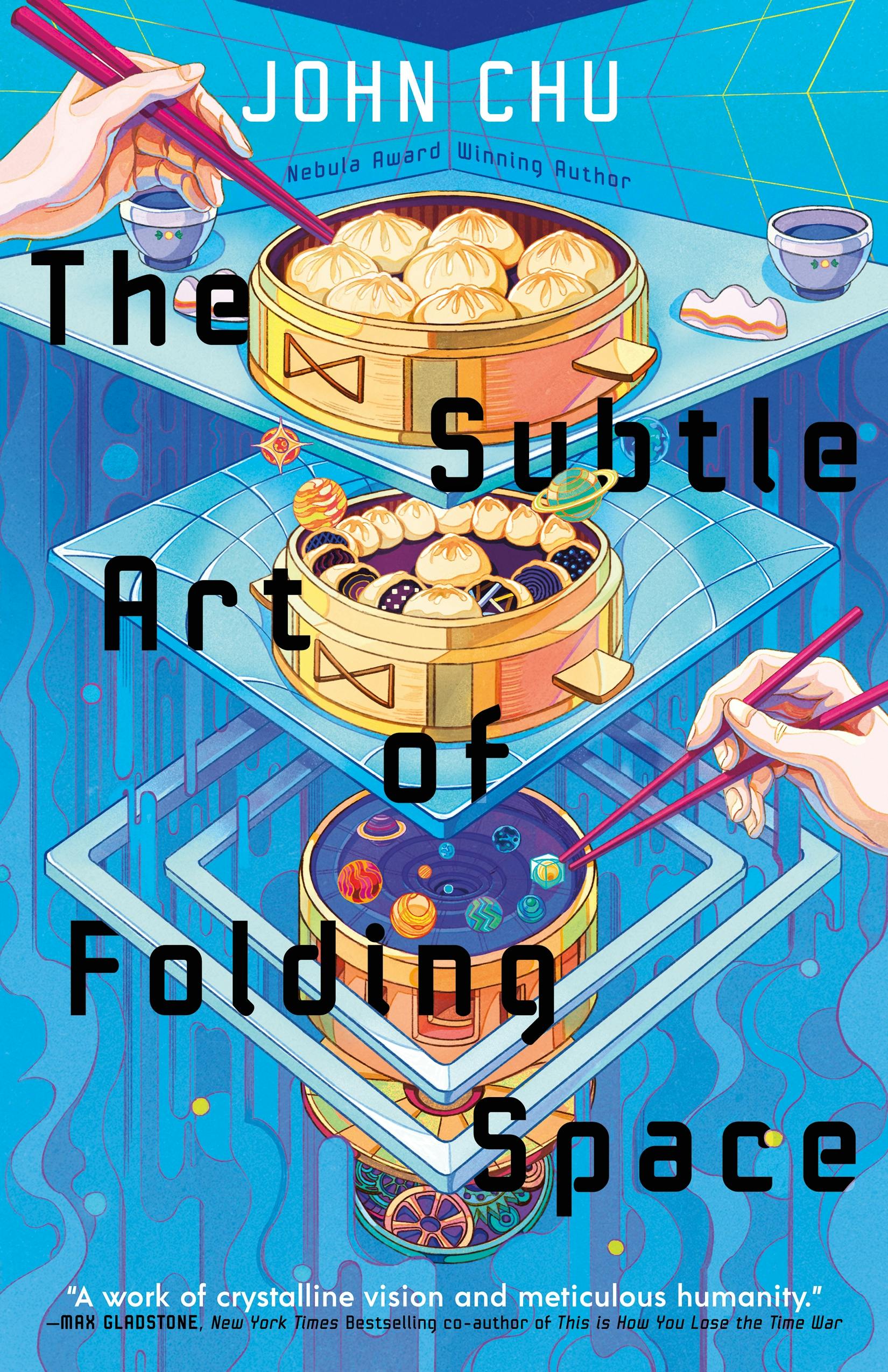

In a collision of quantum physics, family tragedy, and delicious Chinese cuisine, John Chu weaves together these seemingly incongruous topics into a smart sci-fi adventure in his debut novel, The Subtle Art of Folding Space. Based on his Hugo-nominated short story, Hold-Time Violations, Chu imagines a world (or rather multiple worlds) where physics and reality are controlled by the skunkworks, a complex system of pipes and valves that ultimately define the inner workings of each universe. Responsible for creating and maintaining these universes are a group of experts with the roles of Architect, Builder, and Verifier, who are able to manipulate and conjure objects from thin air.
The protagonist in The Subtle Art of Folding Space is Ellie, a Builder whose mother has fallen into a coma as a result of her deteriorating health. We are introduced to Ellie immediately as a stubborn, quick-thinking young woman who has a fraught relationship with her sister, Chris. To describe their interactions as sibling rivalry would be a massive understatement — Chris genuinely seems out to kill Ellie. However, Ellie does not even think this is out of the ordinary, having adapted to Chris’ hostile behavior toward her growing up and merely viewing these attempts to harm her as tests. Hiding under a mask of the dutiful older daughter, Chris does not reveal her true nature easily, and it’s unclear at first whether she is truly wicked or just a bully. Ellie, on the other hand, demonstrates her integrity in clear form. When she discovers that her mother, once a celebrated Builder herself, is only still alive because someone has altered the skunkworks to prevent her from dying, she makes the difficult decision of dismantling the modified universe to save the fate of the world, even though it means the death of her mother. Soon, she is tasked by the Chief Architect to look into how the covert channel was created in the skunkworks, and she sets off with her friend Daniel, a Verifier, to investigate.
While Ellie is the heroine of the story, Daniel plays more than just the role of a sidekick. Chu paints him as a young man whose intimidating physique contrasts his lovable personality, and Daniel’s calm demeanor is a satisfying foil to Ellie’s hot-headedness. He supplies not only the muscle when interrogations turn physical, but also emotional support for Ellie, especially as she struggles to reconcile her traumatic relationship with Chris. Although there are non-human characters in Chu’s novel, even the people seem to have an otherworldly characteristic to them when he hones in on an aspect of their personality and almost exaggerates it on the page, from Chris’ incensed indignation to Daniel’s looming presence.
In works of science fiction, it’s easy for passages of prose to devolve into convoluted explanations, but Chu makes his writing more palatable (excuse the pun) by using food as both a literal and metaphorical device to facilitate his world-building. Daniel’s process for inspecting the skunkworks involves manifesting a physical representation of the mechanisms in the form of delicious delicacies. While Chu does not overtly emphasize the main characters’ Chinese heritage, he expresses their ethnicity through the food they eat and interact with. Careful attention is given to the description of the dishes, described in mouthwatering detail, and the comfort they bring to the characters. Chu also uses Chinese characters in the text rather than the Pinyin romanization to maintain authenticity of the food names. By incorporating food simultaneously as an essential element of his fictional world as well as an extension of cultural symbolism, Chu demonstrates his imaginative thinking and unique ability to approach everyday themes from unconventional perspectives.
Although the pacing around halfway into the book feels a little unsteady at times, the punchy dialogue helps push the plot’s momentum forward and leads into a climactic scene between Ellie and Chris, in which Ellie finally confronts her sister. The story comes full circle in the end, focusing on the sisters’ relationship and grief over their mother’s death. While the novel may be classified as science fiction, the heart of The Subtle Art of Folding Space is in its exploration of relationships and the difficulties of navigating obligations to oneself, one’s family, and the universe in which we all, in one way or another, are responsible for protecting.
