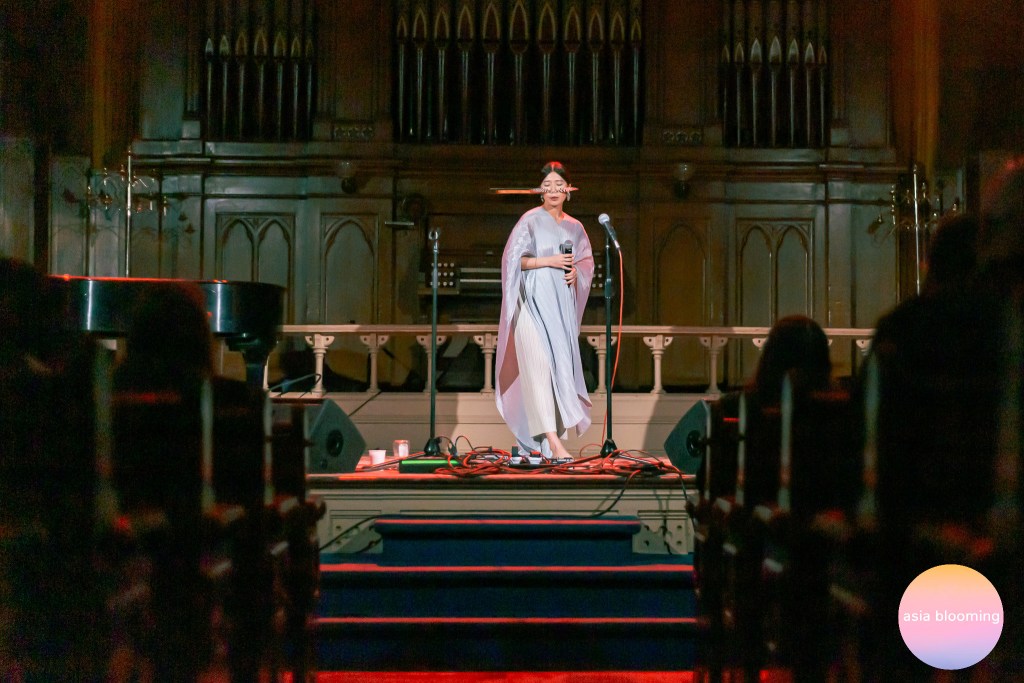
On a rainy evening, London-based Japanese singer Hatis Noit created a sacred haven at The Old Church as part of the church-turned-performance-venue’s “Moon” series, which features artists using sound as a pathway for healing and spiritual discovery. Opening for the evening was local artist Patricia Wolf, an electronic musician who wove pulsating, organic soundscapes with a table full of synthesizers.
After Wolf’s performance, the lights dimmed and the audience hushed in anticipation, while fixing their gazes on the stage and wondering which backstage door Hatis Noit would appear from. To the crowd’s surprise, a resonant voice echoed from the back of the venue, and Hatis Noit emerged from behind the pews, slowly ambling towards the stage. Her crystal clear voice easily resonated through the space even without electronic amplification. Clad in an amorphous, gossamery outfit that resembled pieces of layered fabric more than a dress and sporting two feathers on her nose, she looked like a mix between a forest fairy and an angel. Her outfit, like her name, represented the connection between the divine and the earthly. She aims to do the same in her music. The voice is arguably the most embodied form of music-making, and her expression centers on using this instrument to touch the depths of our emotions and spirits. When Hatis Noit performed, she transformed the space into a sacred container, drawing out reverence the same way that dramatic landscapes do. It’s not so much the harmonic progressions or the precision of the specific vocal techniques that is enrapturing, it’s the way they all blend together to access something deeply intuitive within us.

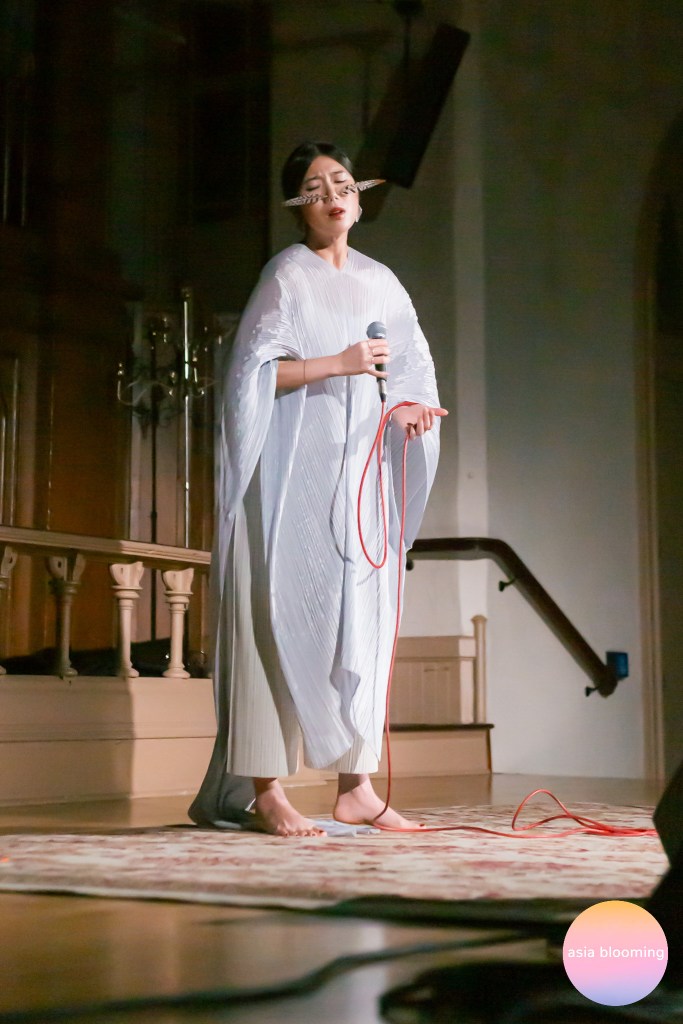
There is a freedom in Hatis Noit’s compositions and performances that is not constrained by the typical Western classical approach, which prioritizes precision, formal structure and harmonic logic, and replicability. While both approaches can begin with improvisations (think Chopin impromptus), Western classical composers usually crystallize them into a written score, while Hatis Noit allows her songs to transform and find their character over time. The fact that every performance, especially when the songs are newer, results in a slightly different outcome is a feature, not a bug. Not having a written score also allows the singer to transcend the preference for discrete notes, unlocking an array of slides, vocal flips, and bird-like sound effects that offer a more primal, embodied quality to her songs. In “Aura,” she layered soft pulsing “mmmuah’s” with long tones to create an atmospheric backdrop, then she added poignant upper lines that include yodel-like techniques as well as a more Western classical sound. There’s a sense of awe and discovery as the dominant line meandered calmly and curiously.
“Inori,” the only song in the set with pre-recorded material, featured the sound of waves crashing and faint construction sounds recorded in Fukushima. Despite initial reservations, the singer agreed to perform there at a re-opening ceremony for the region, and while there, she was surprised to learn that many people have been waiting to return to the area despite its history. The song was initially intended to interrogate the destructive potential of nuclear technology, but after engaging in conversation with locals, it became a heartfelt offering of peace and goodwill to the region’s inhabitants. I was a bit perplexed that the recorded wave sounds overpowered the vocals at the beginning of the song, and it was unclear whether this was the intended effect. But as the song progressed, Japanese-sounding murmurings were introduced and the singer made her way around the venue. Her unamplified voice blended seamlessly with the looped layers, and I realized that tears were starting to stream down my face. Hatis Noit’s voice clearly and wordlessly conveyed the heartbreak of displacement, the yearning to return home–even when home bears a tragic history–that I could not help but be moved to tears. The song closed the same way it opened, with the rustling of the waves, an impersonal yet familiar refuge after a profound journey, as well as a reminder of the incredible patience and transformative power of nature.
She closed her set with “Sir Etok,” a song named after the indigenous Ainu people’s name for Shiretoko, which is a peninsula in northern Japan and Hatis Noit’s hometown. It’s a regal composition featuring puffs of air that serve as bass drums, a hypnotic 4-note motif, and a vocal flip technique. At the very end of the song, she put down the mic, stood at the edge of the stage and unleashed a strikingly high-pitched, dolphin-like squeal. It sounded more like a cry from a wild animal than a sound made by the human voice, perhaps a reminder that there’s a wildness deep within each of us.