Adults and families with young teenagers crowded into the Crystal Ballroom in Portland to see alt-pop singer BoyWithUke, a self-made artist known for his signature mask and ukelele-forward songs about growing up and the highs and lows of love.
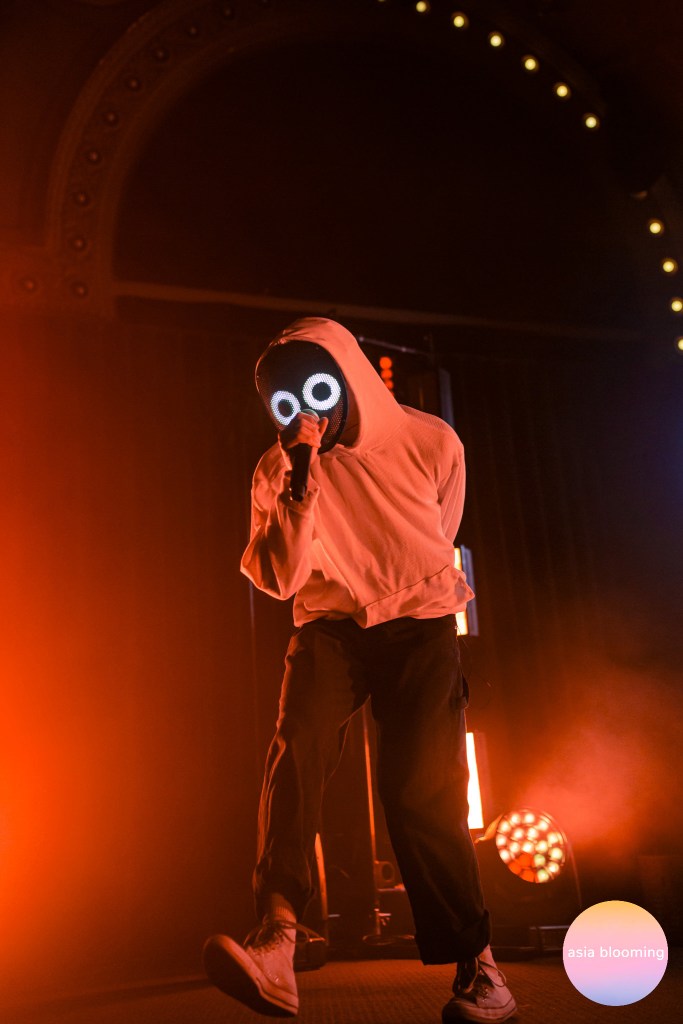
While BoyWithUke was backstage, the crowd was captivated by a projected chess game, presumably controlled by the performer himself. Even before he stepped on stage, the crowd spontaneously chanted “BoyWithUke,” giddy with excitement. He appeared in his iconic black mask with two LED circles for eyes, bouncing around the stage in front of an endless stream of futuristic graphics projected onto the screen. He was totally relaxed, doing meme dance moves in his hoodie as if he was at home, never mind that there were over a thousand people in the audience. This is not to say that he doesn’t put on a performance–he even admitted that the mic he uses is just a prop that “looks better in photos”–but rather that he does it in a way that doesn’t feel contrived. Most of his setlist is pulled from his latest album, Lucid Dreams, which includes stories from his life and the struggles that he’s been through. “Nightmare” recounts the sleepless nights tormented by memories of a past lover, and “Migraine” reflects on the pressure of a rapid rise to fame. His voice has a slight rasp and a maturity beyond the singer’s 21 years of age. His encore song, “Trauma,” draws from his experience growing up in a household that wasn’t very well off, constantly wondering if things would get better. (Spoiler alert: it did get better, so much better.)

One of the themes that shows up in his music is the tension between social pressures and the desire to stay true to himself. In “Rockstar,” he crooned, “Bite my own tongue just to say / For the numbers I made / I feed it like an animal,” comparing his fame to a hungry animal that restricts how he can express himself. There’s a certain kind of comfort in knowing that even someone who seems so self-assured onstage also wrestles with doubt, gets “stressed that you haven’t heard of me,” and has to “pretend I’m alright” (lyrics from “Migraine”). Admitting this through his music makes him not just more relatable, but also just more, well, human. A real person who has worries and hopes and overwhelming feelings, not just a faceless, hit-making entity. The most obvious example of him choosing his truth over social pressures is his face reveal. He’s shared in interviews that the mask alleviated his anxiety early on in his career, but after a while, he no longer needed the “training wheels.” Despite the resistance from his creative team, who warned him that doing so would turn fans away, he wanted to be able to embrace his identity publicly.
There were surprises throughout the show to keep the audience on their toes. Midway through his set, BoyWithUke removed not only his mask but also his hoodie, revealing his chiseled upper body and six-pack abs and eliciting enthusiastic cheers from the crowd. After physically unmasking, he metaphorically masked his voice in the next song, “Bad Things,” by applying an autotune effect, and, in another surprise twist, the song segued into a high-energy EDM breakdown that momentarily turned the venue into a kid-friendly rave, flashing lights and all. The venue’s iconic bouncy ballroom floor shook and rippled as the crowd jumped in excitement.


There were even more easter eggs in the show: he brought up a random fan onstage in the “fishing for fans” segment, performed two unreleased songs, and even sang a parody song that he called “Buy My Merch.” But perhaps the most unexpected occurrence happened during “Homesick,” a touching song about feeling lost in the world and “missing a time or a place.” At the start of the song, he brought a full-sized mannequin onstage. Instead of dancing with it or serenading it, he took the mic stand, stepped back, and swung the stand at full speed at the mannequin, shattering it into pieces. Perhaps the mannequin represents the digital persona he feels trapped behind and the pressure to chase fleeting validation. He longs to be seen, not as merely a TikTok success story, but for his messy, emotional self. Or perhaps the act of destruction is a way for him to express the gnawing groundlessness of never feeling quite at home. The ambiguity of the metaphor allows the audience to make sense of it in a way that speaks to them.
BoyWithUke finds authenticity in a world obsessed with appearances. Even though his dance moves and laid-back style appeal to the Gen Z crowd, his candor about his struggles and melancholic themes in his songs offers comfort to the older crowd.
Click on the photo below to view our photos from the concert: