


Comedic dynamic duo, Mr. Yabatan and Dogen made their U.S. debut appearance at Anime Impulse OC 2024. The two creators found great success on social platforms with their fresh take on both Japanese language and culture. Their comedic wit crosses all borders, and given their popularity, one of their videos have likely graced your Recommended page. During our interview with Mr. Yabatan and Dogen, they spoke of their humble beginnings and what it took to achieve success as comedy content creators in Japan.
Could you please introduce yourselves?
Mr. Yabatan: I am Mr. Yabatan and I’m from Norway. I’ve been living in Japan for seven years, and I make funny videos!
Dogen: My name is Dogen and I’m from Seattle, United States. I’ve been living in Japan for around 13 years, and I also make comedic videos in Japanese. I met Yabatan when I found him as one of the only other foreigners making comedic content in Japan about six or seven years ago at this point. I reached out to him, and I was quite intimidated by him, to be honest, because his videos had so many views. But I was like, if you can’t beat him, join him. So I reached out to him and the rest is history.
Yabatan: I actually ignored him for six months. Eventually I replied, and here we are in LA!

Why did you both land on comedy during a time when much of the content about Japan on YouTube was centered around either anime or vlogs?
Mr. Yabatan: I’ve always been into acting and making people laugh ever since I was a child. I had a camera because my dad was a producer. Making people laugh has always been something I’ve been good at, even in school. I was the annoying little kid for the teacher, right? I wanted to do comedy and I just love making people laugh. You can also hide behind it, and you don’t have to be yourself. I really enjoy that because that’s also part of acting, right?
Dogen: I had kind of the complete opposite experience where I wanted to get into creative writing. I went to a couple of concerts when I was younger that had such a profound experience on me. I wanted to get into creative stuff, whether it was music, video editing, or creative writing. I ended up in creative writing. I had a blog at the time, and I knew that I wanted to try and get more into creative writing. I was still at university, and I took multiple classes on creative writing.
I was kind of under the false impression that a lot of people have when they get started, which is that just because you’re the only person you know within your immediate friend group that’s doing it, that you must be good at it. So, I thought for a long time that because I was the only one of my peers that was writing, mostly just because of my blog that I must be kind of good at this. But all of my professors at university said, “You’re really bad at writing, except when you do comedy.” And that was a real shock to me, because I was always the quiet one in the classroom, unlike Mr. Yabatan.
For someone who does creative writing, I’m not nearly as well read as I should be. I think that for a long time I was kind of insecure about that. I would try to hide that using overly complicated words. Comedy was the only time when I wasn’t trying to flex too hard. After I moved to Japan and continued to do creative writing, I had more people independently tell me the same thing: “This creative writing that you’re doing is not very good, but when you do comedy, it’s actually kind of funny.” I guess I just got to roll with it.
How did you both come to work with Anime Impulse? Do you plan on doing more conventions in the future?
Mr. Yabatan: Initially it was GeeXPlus, and we started working together last year. Most of my work is in Japan with Japanese companies, and I wanted to kind of expand a bit abroad. I contacted GeeXPlus, and they wanted to work with me. Corey [of GeeXPlus] was pitching this idea with me and Anime Impulse. Then I said, I can’t go alone and I have to bring my buddy, Dogen. That’s why we’re here, thanks to Corey.
Dogen: I think we’d both like to do more events like this in the future. It’s been a lot of fun. It’s been interesting being back in the States, and it’s really good to connect with fans, and see events like this because I don’t really get the opportunity to go to a lot of Anime Expo style events. This feels huge to me.
Mr. Yabatan: It’s my first time in America, and I’ve never been to anything like this.
Speaking about conventions, I’m sure you’ve been approached in public here and in Japan. How do you balance being open and keeping a distance from fans?
Dogen: I think both our online personalities are fundamentally different from who we are offline. No one has ever seen a picture of my wife or my kids, as far as I can tell, because I’ve never posted any of that information online. I did a house tour a couple years ago, when I built my house, and I’m really glad with how that turned out. But I try to keep most of my life private, because, let’s be frank, that’s not what I want to be known for. I want to be known for comedy and my creative writing. Because I tried to purposely keep those two lives separate, I’ve never had any trouble with that. I also have a different situation than Mr. Yabatan, since I live in Beppu, where it’s mostly old people who are retired, and they want to live there because of the onsens.
Mr. Yabatan: Well, I live in Tokyo, so more people obviously recognize me every day. I try to keep things private as much as I can. But when people come up to me, I just turn into Yabatan, and everything is fine. Of course, some days it’s nice to be recognized. Some days are harder.
Dogen: Like when you’re sleep deprived.
Everyone has an idea to start something, but not everyone follows through. I believe you both created your accounts long before you began uploading content. What sparked you to start, and what kept you going?

Yabatan: I wanted to be a comedian in Japan. I thought, “How can I get into the Japanese entertainment industry without knowing anyone?” And I’m in Norway! Not in Japan. I figured social media was taking off, and I can get some attention on social media. That’s the main reason why I created my social media channels in order to have fun. I started making funny videos in my room in Norway. I had a goal, which was to be a Japanese comedian. But it was not very consistent. I would probably upload one video every third month, or something, in the beginning.
I always wanted to go to Japan, and I kind of knew that if I could go to Japan and make videos there, I could probably make something happen. When I was making videos in Norway, it didn’t take off at all. I got probably about 800 followers, which I was pretty happy with. But once I got to Japan, it started taking off.
I also read that someone took your video and re-uploaded it on Twitter and it really blew up.
Mr. Yabatan: Yeah, that’s what happened. Someone stole the video from Instagram and posted it to Twitter, and all of Japan knew about me. It was the craziest week in my life. But then, I was prepared for it and I had been thinking about it for a long time. It’s easy to go viral and then disappear, which happens to most people. I knew it was my chance. I just kept posting videos, and every time I posted something, it just took off. It’s also luck.
That’s true, you can’t plan virality and consistency.
Mr. Yabatan: That’s the scary part. It’s not in your hands, right? People choose who you will become, and that’s what I thought was scary. “Can I talk in this voice when I meet people? Or do I have to be this guy the whole time?” In the beginning, it was really scary when people came up to me and asked if I was Mr. Yabatan. I was like, do I say “Hey? Yes, yeah, it’s me!”
Dogen: For me, when I originally started on YouTube, I used to do this thing called martial arts tricking. It’s an underground sport that’s not very well known, so the only way to learn how to do new techniques was to record videos of themselves and post them on the internet. For a really long time, nobody could afford to do so if they weren’t already working and making money. When I started tricking, I was like a teenager, so I didn’t have any money. So every trickster around the world, as soon as YouTube became a thing, we were all like “This is what we’ve been waiting for! Free video hosting.”
I used the name Dogen because I had been interested in Zen Buddhism for a long time. I used that YouTube account for tricking for a couple years, and then I went to Japan on the JET Program after graduating. I kept trying to get into creative writing, and I spent probably the first five or six years after graduating doing more or less “normal jobs,” whether that’s teaching English through the JET Program or student recruitment at a university. But most of the time, I was also doing creative writing at night. Generally that was well received, but I thought that it would be even better if it was in video format.
I probably wasn’t a very good English teacher and was okay at student recruitment, but I can’t do things really well unless I can get very passionate about them. I’m one of these obsessive personality types, where if I can get passionate about something, it’ll become like my entire life. I enjoy putting hours and hours and hours into every script for every video.
Mr. Yabatan: I’m the same.
We know how international fans are to your content, but what are some of the comments you’ve received from Japanese viewers? Are they similar to the English speaking viewers?
Mr. Yabatan: They say almost the same thing. The international community likes the places I go, the people I talk to, and the Japanese learning aspect. I have a lot of Japanese humor in my videos, which is difficult if you don’t know Japanese. Japanese people will notice the puns or other comedy in my videos. Or even the comments about the [cute] way that I speak, “喋り方がかわいい”, which is obviously done on purpose because I know that it triggers something.
Dogen: I would say that probably 80% of the jokes that I tell are more from a Western perspective. Because of that, there’s a fair number of jokes that kind of go over the typical Japanese fan’s head, naturally. When I do make the 20% of jokes that are from that other perspective, it typically goes over 80% of the foreigner’s heads. Funnily enough, when I make content more for foreigners and the Japanese demographic doesn’t get it, and vice versa, it’s usually the same kind of comment.
Mr. Yabatan: I agree, it’s usually the same except for the small details that you will notice as a Japanese person.
Dogen: One thing that I like to do is to layer the joke, where it’s a two-part joke. If you understand English and the Western perspective, there’s a joke there. There’s only been a handful of times when I’ve gotten comments from people that have picked up on both. A lot of times, I’m just doing it for my own sake because I think it’s funny.
Mr. Yabatan: Yeah, I did something recently for the Obon holiday. I was walking around with an obon, which is a tray in Japanese. I was walking around with a tray, which is difficult for foreigners to understand. If you don’t speak Japanese, you don’t know why I’m holding this. But Japanese people, they got it and were dying of laughter. I didn’t even have to say anything.
For people who study Japanese in school, there’s a lot of focus on the JLPT (Japanese Language Proficiency Test). Both of you have found tremendous success without having to rely on that. For anyone who aspires to create Japanese content or be an entertainer, what would you say is most important?
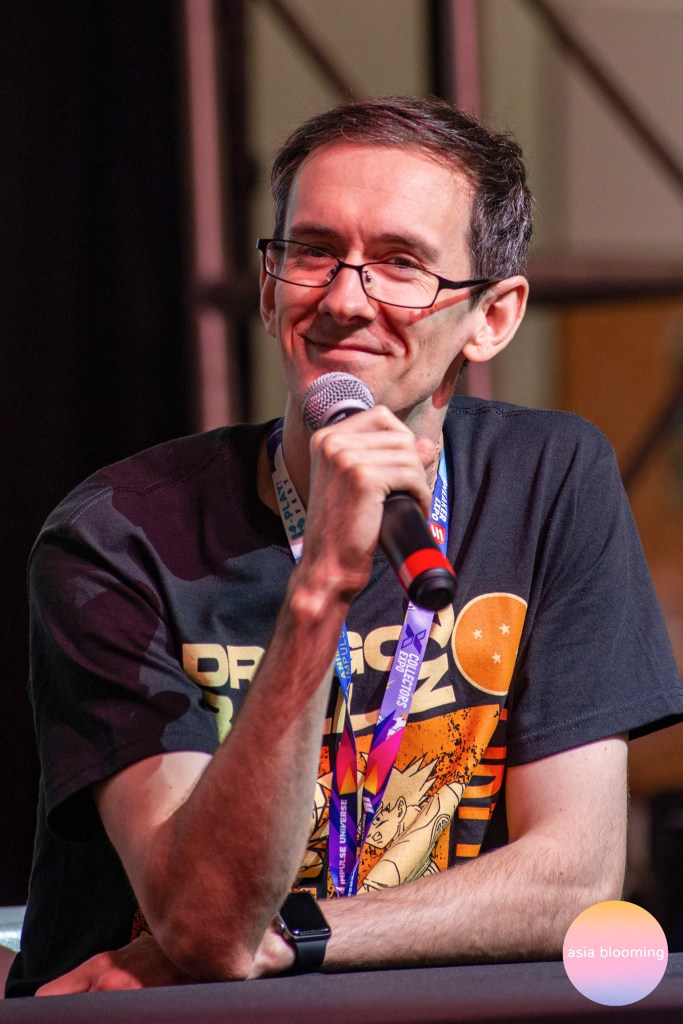
Dogen: If you want to get into content creation in Japan, you need to have a vision. If you don’t have one, you might end up wasting a lot of time along the way. If you want to get a job at a Japanese company, then the N1 or N2 helps tremendously. But if you’re going to be a cosplayer, or try to do comedic content like what we do in Japanese, you’d be better off spending your time listening to native Japanese in movies as opposed to trying to remember kanji. Structure your studies around your end goal.
Mr. Yabatan: Planning is the most important thing. Is there better advice than that? I did enjoy the Japanese language school as it was a good foundation. As long as you have the foundation, you can build and form your own path.
You’re both content creators, but what do you guys think about Vtubers?
Mr. Yabatan: I love Vtubers. I was on Onigiri’s stream. When I went to her studio, I was impressed with all that it takes to be a character on screen.
Dogen: I think that it’s a great new form of expression. Particularly for a lot of women, it can be hard to put yourself out there on the internet. Talking about privacy earlier, I’ve heard a lot more horror stories from my women friends than my guy friends. One of the great things about VTubing is that you’re a layer separated from reality because people won’t be able to recognize you in real life. VTubing is a great way to level the playing field, so to speak.
Mr. Yabatan: Not everyone wants to be in front of the camera, but they still have talent. I like the idea that you turn into someone else and express your talent with that character.
Last four rapid fire questions that were heavily debated on Twitter. Which team are you on?
Team Ebi (shrimp) or Team Kani (crab)?
Dogen: Ebi
Mr. Yabatan: Kani
McDonalds or KFC?
Dogen & Mr. Yabatan: McDonalds
Cream or jam on a scone first?
Dogen: Cream
Mr. Yabatan: The scone is pretty dry, so I’d say cream.
Takenoko No Sato vs. Kinoko No Yama
Mr. Yabatan: Takenoko No Sato! Because I don’t like the stick, since it’ll be dry after eating the chocolate.
Dogen: Agreed, Takenoko No Sato.
