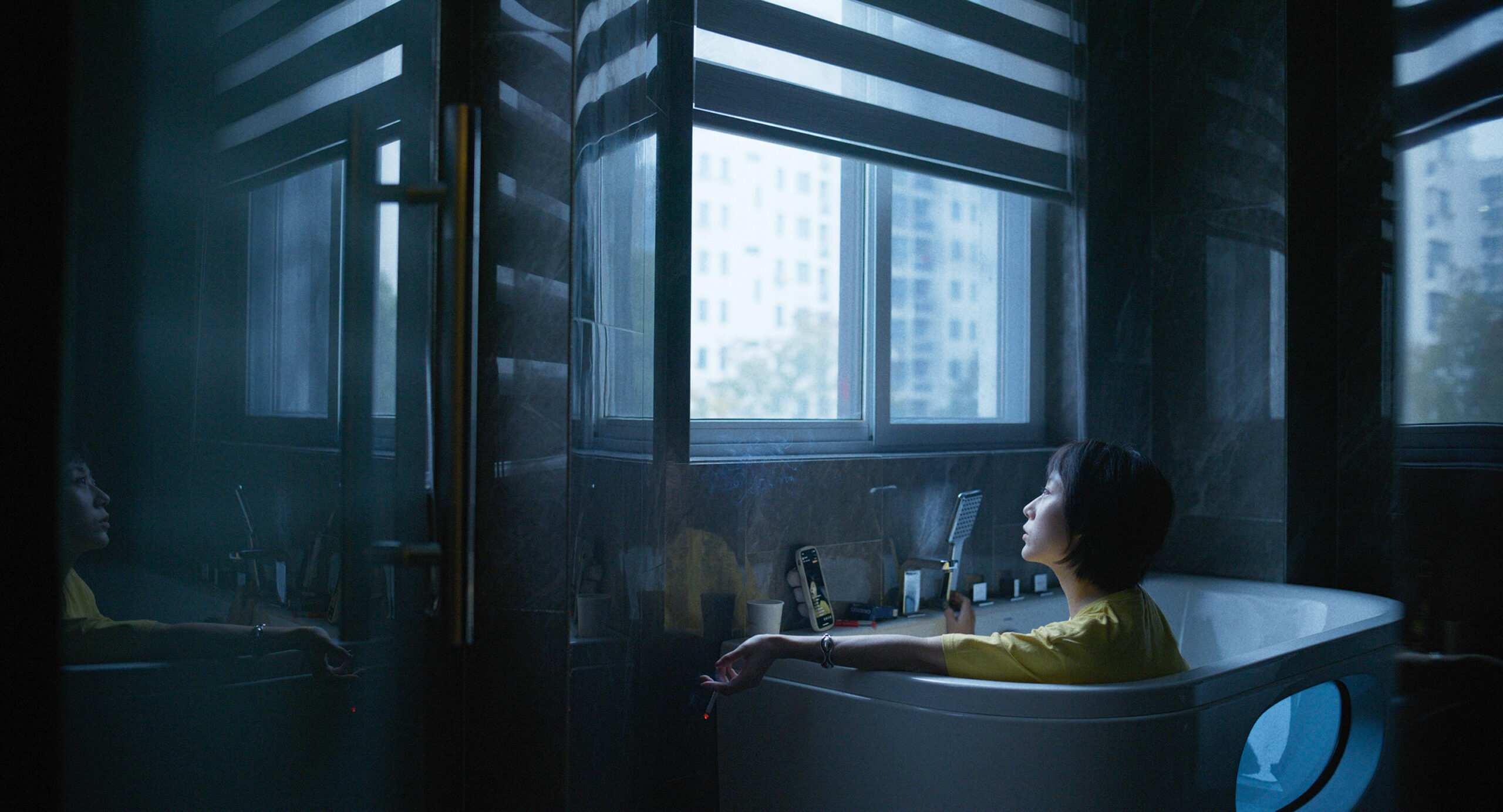
Filmmakers Zhengfan Yang and Shengze Zhu’s latest film, Stranger (2024), uses seven vignettes to explore concepts of strangeness, belonging, and proximity. These accounts offer a lens into the lives of characters who are fictional, but whose stories are very much plausible.
It’s no wonder several of the vignettes in Stranger are set in a hotel. It’s the epitome of a liminal space, a place meant for people in transit and a place that offers rest but not a sense of belonging. For both the man who moved to the U.S. from China and the influencer returning to China during the pandemic, being stuck in a hotel is a constant reminder that they don’t fully inhabit their locale. As the influencer is quarantined in her hotel room, she gets upset about being called “trash” during her time abroad as well as on livestream in her homeland. The resulting sense of alienation is amplified by her frustration about not being allowed to go outside. Her primary mode of distraction–livestreaming–is a temporary salve for her boredom and loneliness, but as her viewers drop off to go to dinner, she is once again reminded of her essential imprisonment. She tries to find comfortable poses to rest in, the shots framing her amidst the straight lines of the window blinds, doorway, headboard, and bookshelf, her curved, mobile body contrasting with the angularly built environment. She’s boxed in not just physically, but also figuratively, self-censoring to retain her social media following.
One of the vignettes shows a man dressing up as an Americanized version of Chinese literary figure Monkey King. This self-exoticization allows him to make a living in this new country, but it alienates himself from his culture and his identity. Like the influencer, he shrinks himself into a stereotypical caricature to make others happy. The malaise that sets in from playing a character and from feeling disconnected from his homeland and his new locale unfortunately cannot be erased with alcohol. This existential loneliness is experienced by several characters, who try to abate it through distraction, fantasy, rebellion, or alcohol, all poor substitutes for a genuine sense of belonging and connection.
Even though the film brings you into the personal lives of several people, it replicates the experience of being a stranger to them. In vignettes where the camera does pan and zoom, it does so in a way that reinforces the viewer’s outsider status. For instance, in the wedding vignette, the camera is always on the outside perimeter of the room, often behind tables or decorations. Yet, this outsider viewpoint also allows the viewer to see through the façade of matrimonial harmony, gaining access to knowledge that only a handful of other wedding guests seem privy to. As a virtual stranger, you have no context about this family’s past, but perhaps it is this very lack of context and lack of personal stakes that allows you to bear witness to the situation more clearly.
Not a whole lot happens, but the film doesn’t need a whole lot to happen to explore concepts around belonging, alienation, and proximity. In several of the vignettes, the camera stays static and the subjects move into and out of the frame. Without the attention-grabbing camera pans and frame switches, viewers are invited into a more contemplative state where they are better able to pick up on emotional nuances and subtle expressions. The static frame forces you to make sense of the scene yourself, but there’s not quite enough context to deduce the intentions of the subjects, so you’re left with more questions than answers. In the scene where the costumed man is looking at the mirror, the camera pans from facing the mirror towards the man, but by the time it makes a 180-degree rotation, the man has disappeared from view. It’s a quiet reminder that the subjects in the film are not just there for your entertainment, and you’re not owed an omniscient view of their actions and thoughts.
One of the most visually appealing scenes is the final scene, which features a grid of apartment windows in a building. The contents of the windows are mundane happenings in people’s daily lives, and even though the specific activities and furniture arrangements are different, the underlying motivators are not. The grandfather playing with his grandchild, the man comforting his partner, the woman tidying the kitchen–they’re all driven by the tendency to care for each other and for their space and to connect with loved ones. Maybe the message is a hopeful one, that you have more in common with others than you think. But in a world of mental, emotional, and physical walls, the challenge is to see through those barriers to find shared humanity. And then maybe, just maybe, we’ll be a little less lonely.