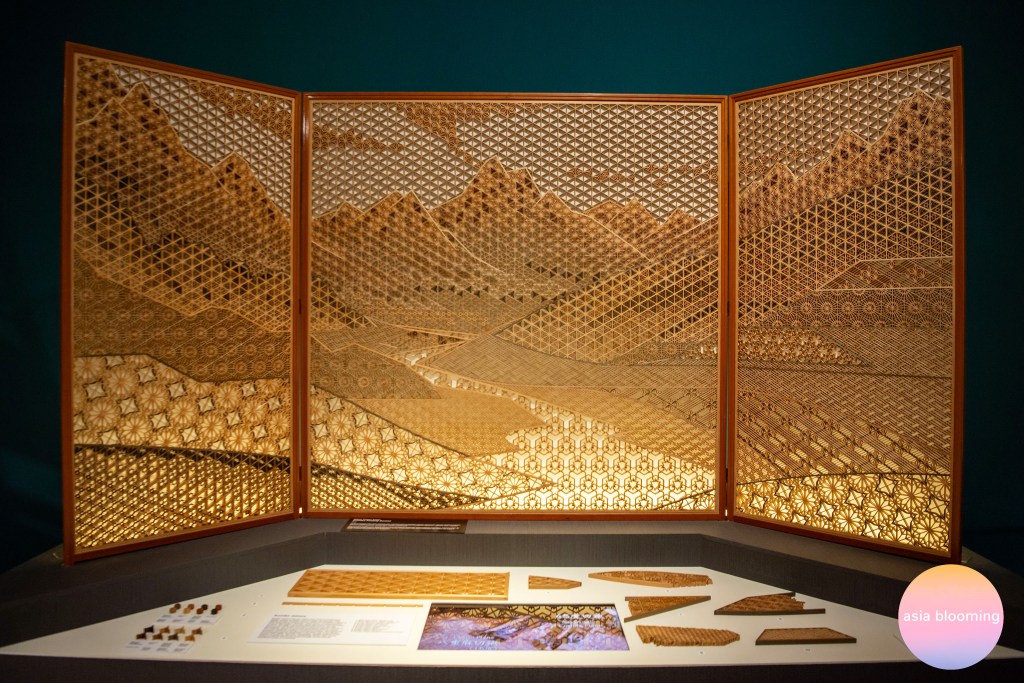
Japan House LA hosted an opening night for its latest exhibition, “Masters of Carpentry: Melding Forest, Skill and Spirit” and its curator, Marcelo Nishiyama. At the exhibit, visitors can see various examples of Japanese wood joinery (kigumi) and learn about what goes into traditional architectural craftsmanship. The exhibit runs from November 11, 2024 to January 22, 2025 at Japan House LA, and will travel to Japan House London and São Paulo afterwards.
Raised in Brazil until he was five years old, Nishiyama and his parents moved back to Japan, where he would later work for the Takenaka Carpentry Tools Museum (TCTM). He’s specialized in architectural history and design at the museum for over 20 years, and he curated other exhibitions on behalf of TCTM in Poland and France.
During the TCTM’s previous exhibition on kigumi, the Japanese Minister for Foreign Affairs saw their exhibition at Tokyo. There, it was suggested that he enter the Japan House competition for a chance to become a touring exhibition. As part of an effort to preserve Japanese carpentry (daiku) culture, the exhibit shows off the world-famous tools and thorough selection of materials.


“This exhibition shows off the skills of the carpenters who bring to life the spirit of the forest,” said Nishiyama to an opening night crowd. “If they use 1,000-year-old trees, they must build a building that will survive 1,000 years.” In a trade and craft shrinking at an alarming rate, the number of specialized, highly skilled, and experienced woodworking carpenters also continue to grow fewer. “In modern times, there’s a greater call for wooden architecture as a renewable resource as new technology has developed all over the world.”
Speaking with Asia Blooming, Nishiyama explained how he brought the exhibit, “Masters of Carpentry: Melding Forest, Skill and Spirit,” to life. Although the structures featured in the exhibit seem simple, their hidden intricate designs require expertise and precision. A full-size model of a small Japanese teahouse took three master carpenters from Japan four days to reassemble while the shrine buttress took an entire day. On what went into its reconstruction, Nishiyama dove into the logic behind why they chose to display those models. “We had to think about what’s the most suitable example to rebuild as there are many types of tea houses,” he explained. “We could also present the big scale model of the shrine, but there are so many. We thought about how to create the concept of the exhibition story that would allow the viewer to understand.”


When displaying the models abroad as opposed to in Japan, Nishiyama described it as a “different operation” compared to other work: “When we do the wood joint work, it’s impossible to demolish. Once it’s connected, it’s too precise and tight.” Since the craftsmanship of joinery isn’t meant to be taken apart, they had to be flexible in their procedures. He continued, “For the reassembly, we had to change the operation. Like making the holes a bit bigger, about 0.2mm. We have to think of the quality of the material as well as the humidity.”
Tying back carpentry to reverence and appreciation for the environment, Nishiyama stressed the important relationship between a craftsman’s skill and understanding of nature. “Trees, like people, have different personalities; it’s essential to know their growing environment. Rather than simply looking for the best quality of trees, you need to know what environment it grows in, consider its characteristics, and determine how it can be used. I believe that all people are essentially the same, but each person is placed in a different environment and that environment nurtures them. That is why I believe Japan is nurtured by wood, cypress, and cedar.”