

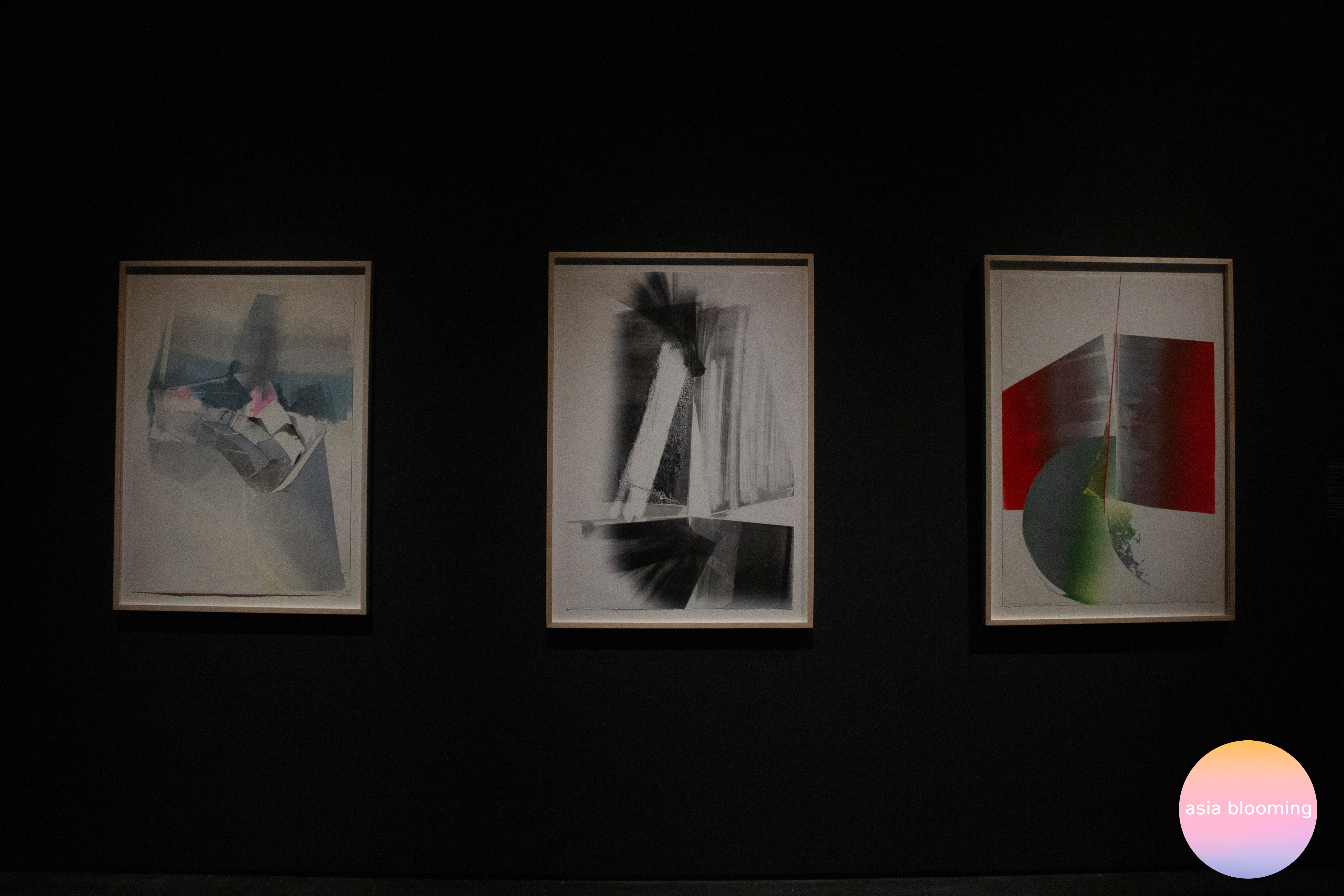
Organized by curators Susie Ferrell and Wan Kong, the Los Angeles County Museum of Art (LACMA) is featuring two new exhibits with over 40 artist contributions. The Zheng Chongbin: Golden State exhibit highlights artist Zheng Chongbin and his decades-long career, featuring unique art pieces in several different mediums. The Line, Form, Qi exhibit is in partnership with the Fondation’s INK Collection, and features artists from China, Hong Kong, Japan, South Korea, Taiwan, Vietnam, and more.
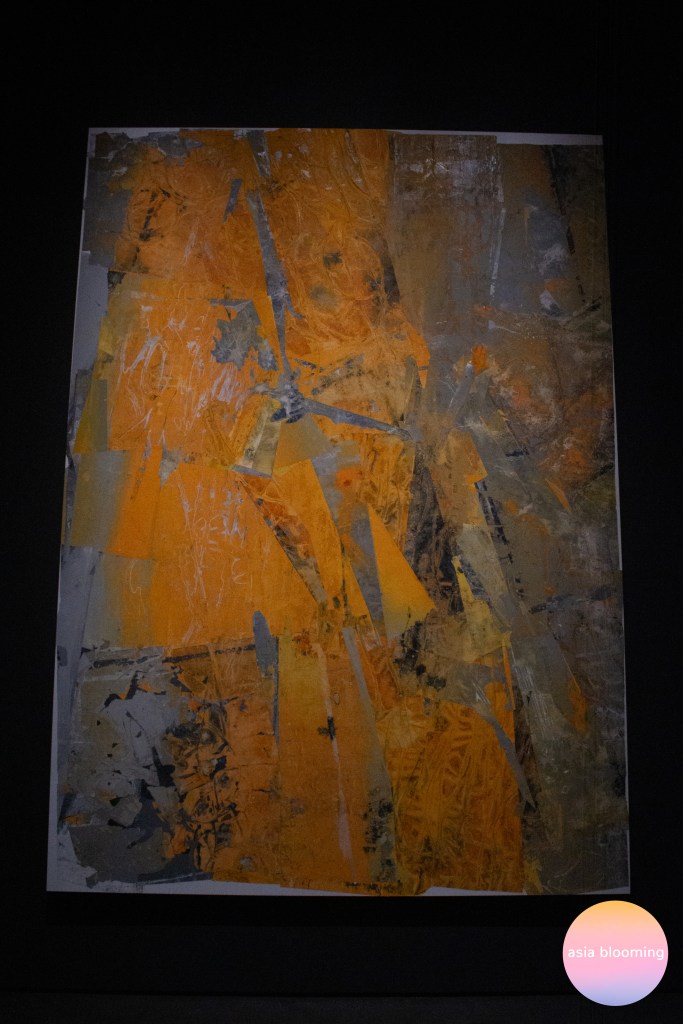
Although this is not Zheng Chongbin’s first solo show in the U.S., this is his largest one to-date. The collection emphasizes his work with light and space, and acrylic and ink. When first walking into the gallery, attendees are immediately immersed in a dark setting with dim lighting. With spotlights on each artwork and the peaceful ambient sounds, it’s as if you’ve walked into a separate, private world away from the busyness of everyday life. The pieces are primarily in grayscale tones as you walk the path of his exhibit, until you reach the highlighted Golden State canvases. Golden State is a close-up study of Californian light, and an abstract view of the state’s shape. The piece features harsh and sharp lines, with broken pieces overlapping one another, which was said to take inspiration from California’s fault lines, rock strata, and forest fires. This piece was created specifically for the gallery, and is equally impressive in size and in detail.
What is most attention-grabbing in Zheng Chongbin’s exhibit is his artwork titled Mesh. This 2018 piece features footage of medical scans, nature, and abstract patterns projected as light onto a mesh screen. While the screen itself remained stationary, the video projections and the viewer’s movements create an illusion of movement in the screen itself. While it can be disorienting at first, the combination of video and the natural sounds create a calming viewing experience in the midst of the busy museum bustle. “I’ve used different materials to create different effects [within my art],” Zheng started, sharing some more information on the piece. “The effects [of this piece and the video] are intended to be viewed in person only, as Mesh is really about the environment created as a result of [the combination of] the sound, mesh, and projector images.” Revealing another interesting tidbit on the piece, Zheng shared that parts of the videos were AI-generated. “I used AI to create certain parts that I physically could not make as a human, but I feed my own work and command prompts to it for it to reference.”
Like night and day, stepping next door into the Line, Form, Qi exhibit has attendees blinking rapidly to adjust to the light. While Golden State was shrouded in darkness, Line, Form, Qi is bright and welcoming, enticing attendees to learn the art and versatility of traditional Chinese calligraphy.
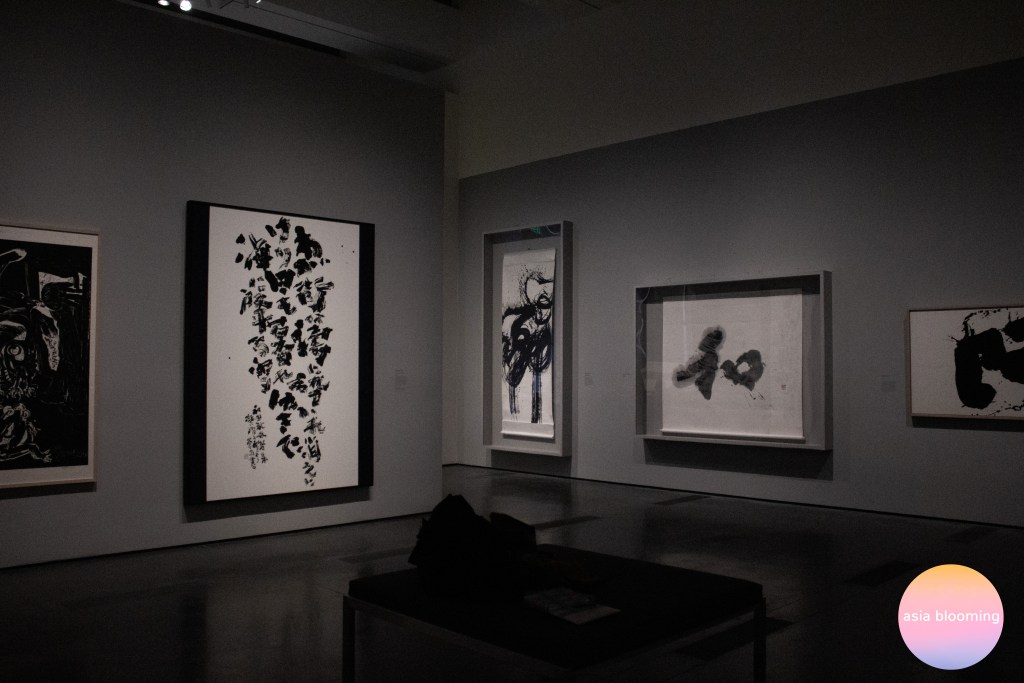
Much like Zheng Chongbin’s exhibit, artwork in this gallery varied in medium, style, and size. Some pieces are drawn or painted on canvas, while others are burned into paper, to name a few. Some are meant to be enjoyed while looking up at the large piece, and there are some laid down horizontally in enclosed cases, meant to be enjoyed from an aerial perspective. Though the written Chinese language is mainly used in Chinese-speaking countries, the featured artists are from all around the world. “This exhibition is primarily about the art of writing Chinese characters, but Chinese characters are not just used in the Chinese language. It has been deeply influential on the traditional languages in South Korea, Japan, and Vietnam,” curator Wan Kong began. “For this exhibition, we cast a very broad net. We included artists from mainland China, Hong Kong, Taiwan, Singapore, South Korea, Japan, Vietnam, and even Western artists influenced by East Asian culture, particularly calligraphy.”
This exhibit is split into four different sections: Pictograph, which spotlights experimentation with writing and painting and the deconstruction of Chinese script, Message, which touches on the relationships between content and form in Chinese writing, Re-Form, which highlights artists and their creation of new forms through their experiences, and Abstraction, which uses components of calligraphic art in non-traditional ways.
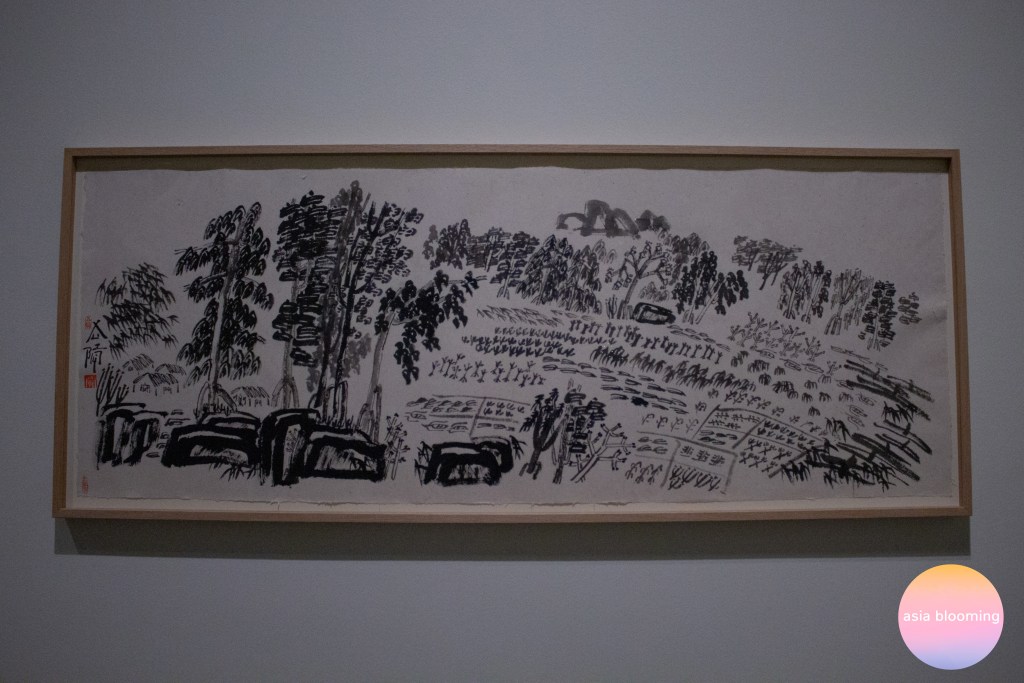
In Pictograph, one piece that stands out is Xu Bing’s Landscript, which is a simple yet captivating piece of work that combines traditional calligraphy and landsape painting. Rather than illustrating each element of the landscape, Xu Bing wrote the Chinese characters for them. Instead of drawing countless trees in the forest, the word “tree” was written over and over in slanted and stylized ways that would mimic a tree. Dirt was replaced with the Chinese character for the word dirt, and so on. Landscript takes a slightly whimsical approach to honoring the beautiful brushstrokes of traditional calligraphy writing.
In Message, Li Jin’s Food and Dishes #1 is a mind-lingering piece. Created with just ink and color on paper, the 2008 artwork is displayed in a horizontal case, and shows a variety of food items atop calligraphy writing in the traditional format, from top to bottom, right to left. Many Asian cultures hold a heavy emphasis around mealtimes, as they are valuable time frames for families to gather together to enjoy warm, home-cooked meals. This artwork evokes a sense of nostalgia with its unique format, as if one is looking down at a full dining table during a family gathering.
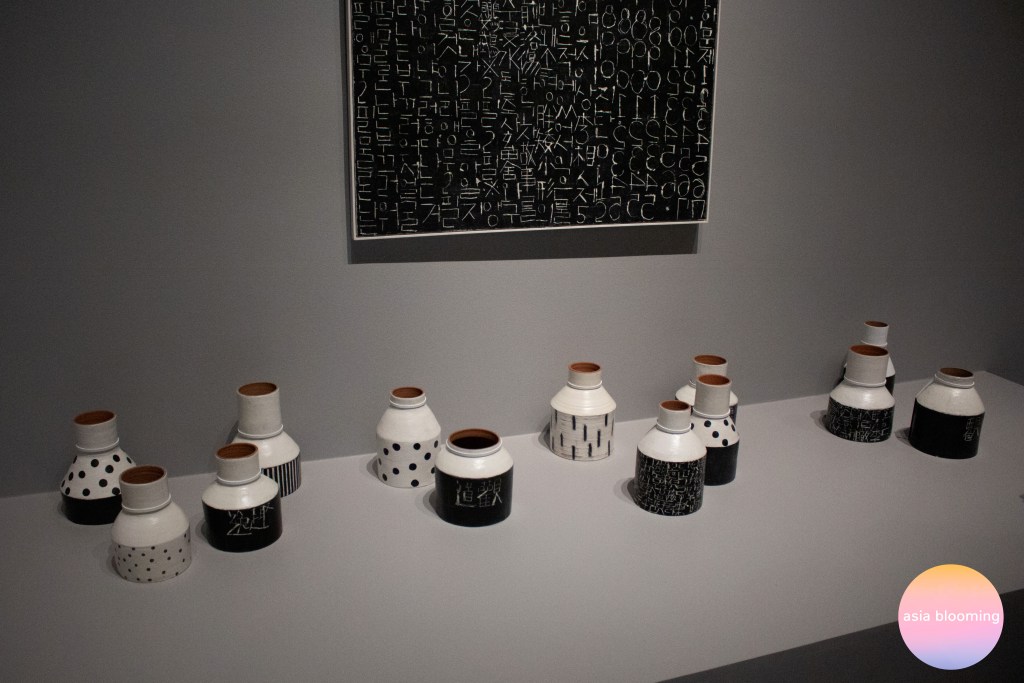
Also part of the same section is Lee In’s Black, Something 2 and Black, Something 3, which commands attention as soon as it comes into view. As one of the only pieces in the collection that is painted on a non-flat surface, the ceramic pots on display are the first thing that everyone’s eyes turn to, especially once the large black canvas comes into sight. “I made this piece by covering my canvas in black, and etching out the written characters,” the artist began, sharing the process of his work. “Then, I wrote in the words to the poem “Ogamdo” by Yi Sang.” Ogamdo features Chinese characters, Korean characters, and numbers, all in varying directions and font styles. He continued, “Yi Sang wrote this poem when he was in the hospital, as it was a visualization of what he had in his view and mind while he was sick.” Though he had assistance when it came to making the ceramic vases, the painted characters on them are all by the artist himself. “Some pieces also feature parts of Ogamdo, while others just contain other writings based on how I felt while I was painting them.” On why he chose Ogamdo to decorate his works, Lee In cited his desire to create something that bridges the past and the present: “This poem was written in the 1930s, during the dark time period in Korean history that was between the Joseon era and modern day. I wanted to create something contemporary that still showed the influence from that time period. A lot of our history and culture is from China, but nowadays, there are more differences. I wanted that to reflect [in this piece].”
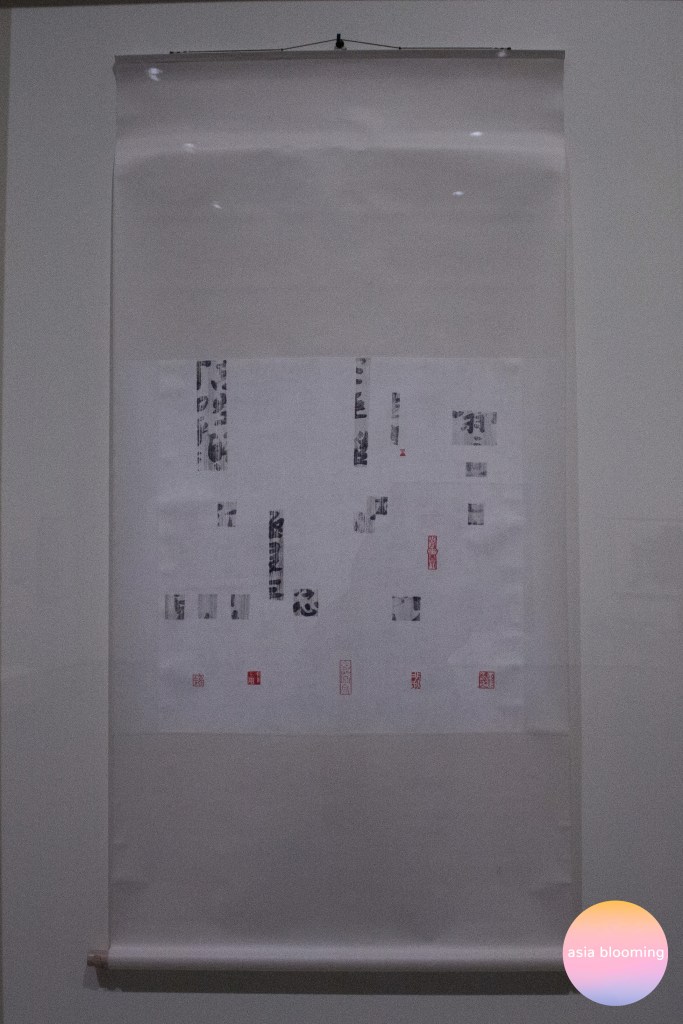
In Re-Form, two pieces stand out: Accidentally Passing, Form Sand Script by Fung Ming Chip, and Digital Series #4 by Wang Tiande. Sticking to the reformation theme, Fung Ming Chip’s artwork features paper that is painted with small windows of water first, then sprayed with powdered ink “sand.” The unpredictability of where the ink would land and stick is what makes the artwork unique. Though the writing was planned and executed by the artist, the piece’s final form is simply determined. by chance. For Wang Tiande, rather than working with paint at all, his artwork features calligraphy burned into paper. Using cigarettes to burn characters into the paper canvas, Digital Series #4 uniquely depicts the tradition of calligraphy and the longtime practice of smoking.
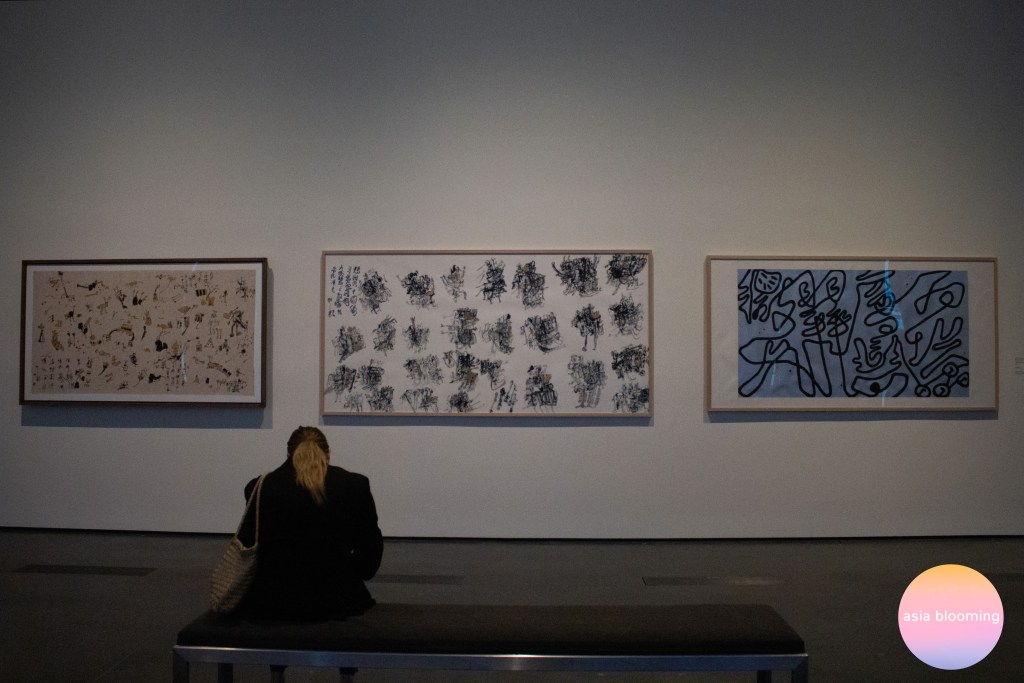
In Abstraction, much of the art focuses on textures, layers, and splashes of color, highlighting specific aspects to tell a story. Wei Ligang has several art pieces in this section, but Wei State of Myriad Beings, Untitled, and Stone Tower on Green Mountains are placed side by side to tell a connected story. While each work depicts different scenery and concepts, what they share in common are the materials used. All three are created with ink and paper, but Wei State of Myriad Beings and Untitled also had bits of gold foil. The artist shared there isn’t much meaning behind each small detail, and his decision to use the gold foil reflected that arbitrariness: “[In 2012 when I] made the Untitled piece, I had so much of the gold foil left. Most artists would just toss it away, but I kept it, and I ended up making a piece around the use of the rest of it. [That piece was] Wei State of Myriad Beings.”
On Zheng Chongbin’s exhiibit and his unique artistry, curator Susie Ferrell shared, “Zheng Chongbin’s Golden State is a very focused show, and it tracks the changes in his practice following his move to California in the late 1980s. With LACMA’s history of exhibiting light and space, it was particularly poignant to feature these pieces. The exhibition really shows Zheng’s range in media and aesthetic, and his commitment to the change of nature and allowance for nature to take control over his paint and paper.”
Regarding Line, Form, Qi, curator Wang Kong said, “In this exhibition, the artists are so creative in making their artwork contemporary yet deeply rooted in tradition. They enrich it, they subvert it, and they explore and push the boundaries of the art of calligraphy.” She continued, “Calligraphy almost acts as a bridge to connect this foreign and esoteric world of East Asian tradition to modern Western art, and it gives us a new perspective to appreciate the art of calligraphy and Western art. You don’t have to understand the traditionalization of calligraphy to find enjoyment and inspiration in this collection.”
Line, Form, Qi: Calligraphic Art from the Fondation INK Collection is on view through October 19, 2025, and Zheng Chongbin: Golden State is on view through January 4, 2026.
