
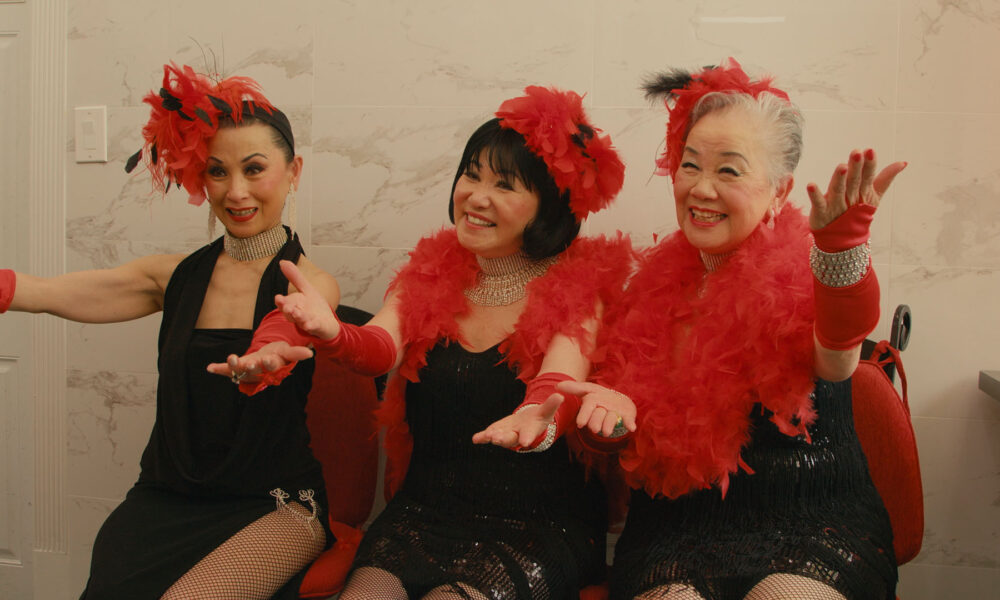

Chinatown Cha Cha Cha introduces us to the San Francisco-based Grant Avenue Follies (GAF), a troupe of Asian American seniors who put on performances rooted in Chinese culture, often involving elaborate costumes, to inspire other seniors and to raise funds for senior citizen groups. The founder and retired nightclub dancer, Cynthia Yee, welcomes dancers and non-dancers alike to join the troupe. One of GAF’s featured guest performers is octogenarian Coby Yee, a Chinese American dancer at the “Oriental” SF nightclub circuit in the early 1900s, whose story the film centers on.
The film opens with archival footage showing the history of Chinese showgirls in the US before cutting to Coby donning a white and gold lacy costume and headdress in a hotel in Las Vegas. She is assisted by a man who we later learn is her partner, Stephen King. We see the duo perform at the Burlesque Hall of Fame, with Stephen singing a love song and Coby slyly removing her flowy layers, just like how she did many times in her younger years performing striptease at nightclubs. Coby shared that she initially refused an offer to perform at strip clubs typically catered to white male tourists, noting that the racy dress code made her uncomfortable. Eventually, however, she overcame that discomfort to access the high pay that came with being what was then called an “exotic dancer,” and she became one of the most legendary Chinatown dancers in the US. Her performances were an innovative blend of traditional Chinese dance, costumes, and props and American dance styles such as tap, jazz, and rock n’ roll.
The film celebrates Coby’s esteemed experience as dancer-turned-owner of SF’s biggest nightclub, Forbidden City, as well as a costume designer and seamstress for herself and fellow dancers. She’s also shown teaching adult students and the next generation of performers, but we get to see most of her bright, feisty personality in the scenes involving her and Stephen. The couple met in their 50s, and while Stephen admitted it was not quite love at first sight, they soon became dance partners and then life partners. The way Coby’s eyes lit up when talking about their partnership and the footage of them dancing in a living room when they initially got together shows the deep well of fondness that their relationship rests on. Their connection is a reminder that love can appear at any age. But like any good relationship, there’s also a touch of spice amongst the sweetness. There’s the scene of Stephen hiding behind fabric to scare Coby, and there’s also the endearing one where they humorously throw play-fighting punches at each other.
Seeing the interviews of Coby and the GAF dancers and their interactions with each other, I’m struck by how vibrant, lively, and supportive they are. The group randomly bursts into song and dance and giggle like teenagers, proving that old age can be an active and joyful season of life. Our society’s notions of worthiness inherently assume youthfulness, but these dancers show that there’s no age limit to performing, to dressing up, and to learning something new. Some of the dancers in GAF started dancing as older adults, and they found it a way to express themselves and to share their joy with others. Everywhere they go, the dance group finds kindred spirits who share their devotion to performance and/or Chinese culture. There’s a scene where Cynthia looks into the mirror and bemoans her wrinkles, as if she is surprised that her reflected visage does not match her inner feeling of youthfulness. “Don’t worry,” she tells the camera in a hushed tone, “I have a gimmick,” perhaps referring to how dance and community have become her fountain of youth. Botox, begone!
At the same time, the film doesn’t diminish the realities of aging. One of the scenes shows the GAF ladies sitting around a table, drinking tea, sharing their memories about fellow troupe-mates who have passed away. Losing close friends and teammates is a reality of getting old, but it doesn’t get any easier. The tears sparkling in the ladies’ eyes reflect the tea in their cups. There’s another shot of Stephen leaning on an ochre couch and thinking out loud. “When you’re gone, and all the people who remember you are gone, it will be like you never were,” he shares. “[We] want [our] life to mean something,” he continues, starting to tear up as he expresses gratitude for being memorialized through this film. The camera pans and zooms to Coby who is sitting a couple feet away from Stephen, locked in on her desktop game of Solitaire, a comedic contrast to Stephen’s existential mood. And in one of their trips, Coby is shown using a wheelchair, though her bubbliness is not diminished by this fact.
For Coby and the GAF members, dancing is more than a hobby, it’s a way to feel alive. And in the ending scene, where she is wearing a flowery orange dress and a matching cap, dancing in front of the ocean, she looks so joyous and vibrant that one would never guess her age. The rest that appears on the screen shared sad news – that Coby, a few days after receiving the “Living Legend of Burlesque” award from the Burlesque Hall of Fame, passed away in 2020. The film portrayed Coby in such a fond manner that it was difficult to not be emotional at this end scene, which continues to celebrate her bright personality and love of dance.
Chinatown Cha Cha Cha is a delightful watch, personal and at times, poignant. Its subjects’ former careers are controversial, but the film uses that to its advantage, allowing the stories of the GAF dancers to refute the racial, ageist, and sexist stereotypes of Asian women. It’s inspirational and touching to see models of what it could mean to age well, to age joyfully. And while these lovely ladies cannot live forever, their stories will live on in the hearts they touch through their performances and through this film.
