

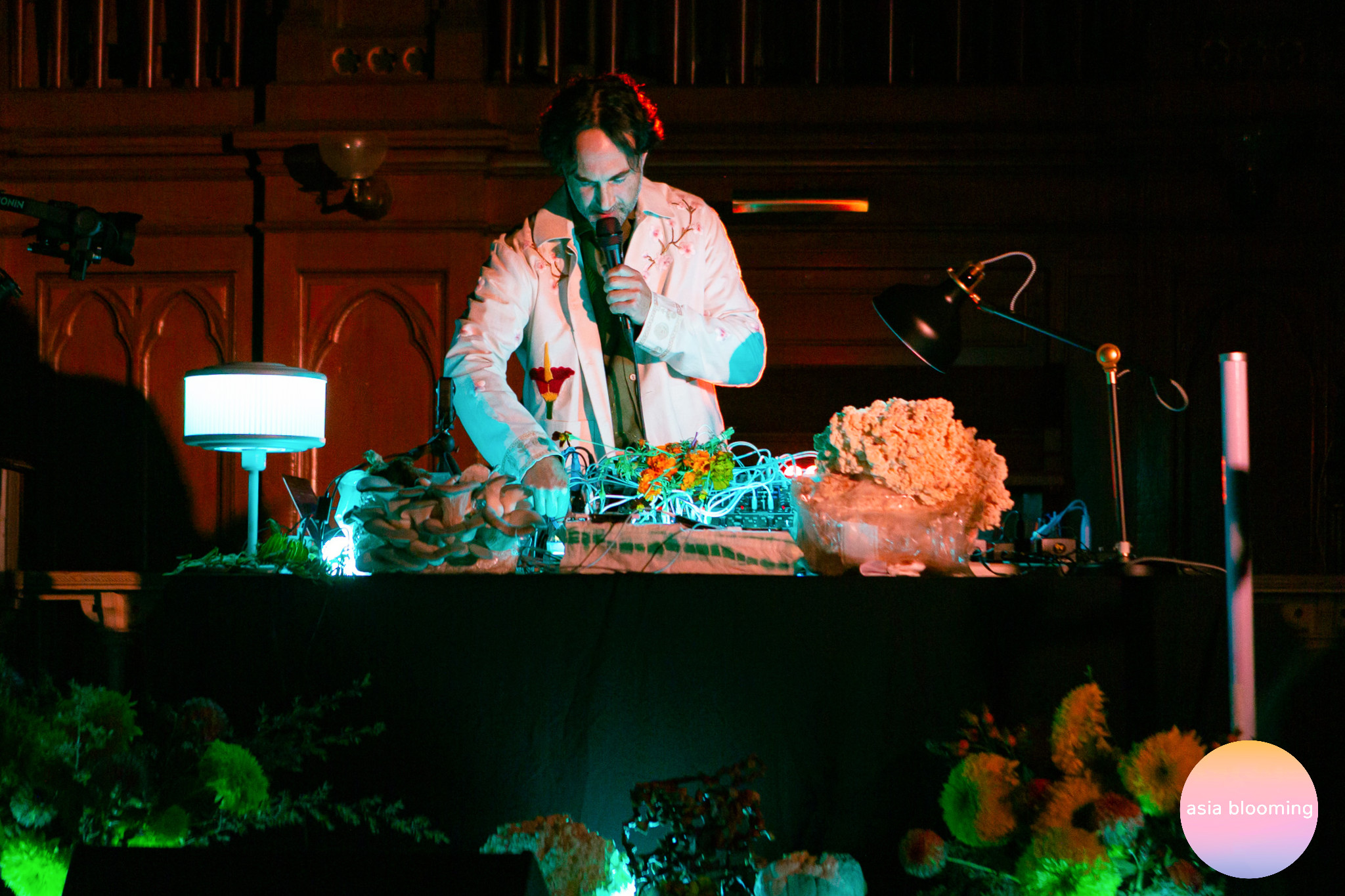
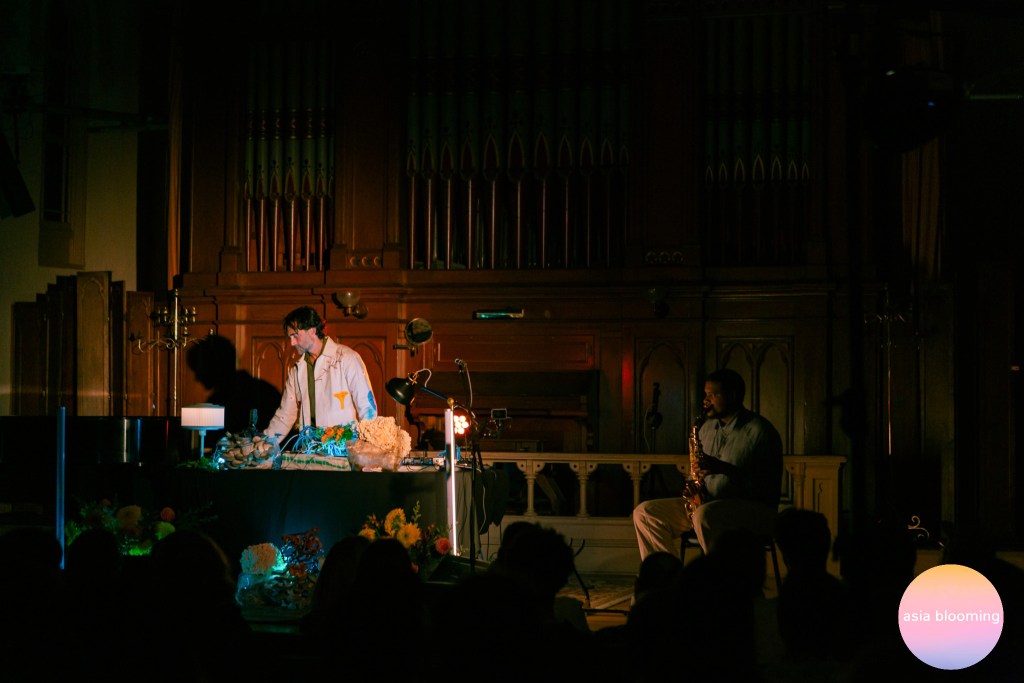
Part meditation, part science lesson, part sound bath, Mushroom Church is, in the creator’s words, an evening of “science, ecology, hope, inspiration, and bioelectricity.” The third stop on Modern Biology’s North America tour, the Portland show on September 21 was, fittingly, hosted at The Old Church, a church-turned-concert venue. It was a full house–people were spilling out of the benches and onto the floor, and the room was buzzing with energy. The modular synthesizer was set up on stage and adorned with several large mushrooms and blooming flowers, the mass of multicolored wires resembling mycelium (the underground network of root-like fungi threads). “Welcome to church,” beamed Tarun Nayar, the musician behind the project Modern Biology, as he stepped onto the stage, clad in a jacket that vaguely resembles a lab coat except with more embroidered flowers. It’s a church in the sense that it has the spiritual reflection, awe, and communal gathering that comes with a regular church, but Mushroom Church replaces the dogma with deep ecology and indigenous ways of knowing. Joining Nayar on stage was Zekarias Musele Thompson, an Oakland-based saxophonist.
Inspired by the book Held by the Land by Leigh Joseph, Nayar invited the audience to ponder what it would feel like to be held in that way, the way plants are held by the soil. What would it feel like if we knew that we belonged? This was one of several ecologically inspired meditations offered that evening, and they served as portals to other ways of being, sensing, and belonging. After briefly explaining that the synthesizer works by converting the bioelectric impulses of an organism into notes and rhythms, Nayar pulled a marigold from a bouquet and connected two wires to it. Strong but irregular plucked notes emerged, a glimmery sonic signature of the vibrant but dying flower. Similarly, when he plugged into a rapidly decaying chicken of the woods, the notes indicated a medium level of bioelectric activity. Contrary to our understanding of death as a single moment, a sonic glimpse into the inner workings of the organisms reveals that electric impulses continue for long after it has been severed from its roots and substrate. In this case, life and death, light and dark, are not so much opposites but rather complementary, coexisting forces as expressed in the philosophy of yin and yang.
Guest artist Summer Dean, also known as the Climate Diva, is a Portland-based storyteller, scientist, and climate activist, who further reflected upon the concept of darkness with a poem. Accompanied by calm synths, she called upon Buddhist and Daoist understandings of emptiness and darkness as hidden potential and compared them to a recent study on the quantum states of darkness. Darkness isn’t the absence of light; it’s the presence of dark photons, perhaps a hidden state of light. Seeds and caterpillars undergo dramatic growth and reconfiguration in the dark. In this “moment where we fail to reconcile with our dark past,” we can “look to Mother Earth” and see that a new future can be forged amidst the darkness, the “soup from which light is born.” “Be a dark photon,” she urged. Later in the show, continuing on with a theme of darkness, Nayar played a passage from Fiona Glen’s Mycoglossia, a book of what he calls “mushroom goth poetry.” Fittingly, he accompanied the passage with sounds that come from an underground geophonic recording. We often think of the ground as still and silent, but this recording proves otherwise, capturing the incessant rumbling and murmuring that happens under our feet.


To demonstrate how different organisms and combinations of organisms influence the sounds being generated, Nayar plugged the synthesizer into several kinds of mushrooms, including a large white coral tooth, a cluster of oyster mushrooms, and a deer mushroom, which was an offering from an audience member. It was fascinating to hear which ones produced notes at a quicker tempo, which indicates more bioelectric activity, and which ones had a slower pace. Nayar then connected two cables to two different mushrooms and invited a kid up on stage to complete the circuit with their body, perhaps a metaphor for how humans can be fully connected with nature. The tiny bit of current sent from the cables through one of the mushrooms would travel through the kid’s body, through the other mushroom, and back into the synthesizer, and the melodious passage that emerged was a glimpse into the inner workings of all of these beings, separate yet connected with each other. Thompson weaved saxophone lines beautifully throughout the otherworldly ambiance of the piece, at times bolstering the texture, other times soaring over it with improvised melodies.
Nayar demonstrated a miniature variant of his modular synthesizer by plugging several into mushrooms, creating an ethereal soundscape. Afterwards, he transitioned into the Q&A portion of the evening. On the more practical end of the questioning, someone asked about how exactly the technology works. Nayar explained that the organisms attached to the cables act as a resistor and the cables translate changes in conductivity into rhythms and notes; this conversion of electrical information from living creatures into sound is called biosonification. Someone else had a more philosophical inquiry, asking about consent and appropriation in the context of using bodies of living or once-living creatures to make music with. Drawing on indigenous concepts of right relationship, Nayar responded that he views the way he interacts with plants and fungi to be a conversation, not an extraction of life force. “Funny enough, in a way, they’re in control,” mused Nayar, reflecting on how his life is now dedicated to sharing the marvels of these mushrooms. He’s articulate and knowledgeable without being haughty, readily admitting when he doesn’t have all the answers. “If you had asked me five years ago if this would be what I am doing, I would not believe you. There’s no rational reason to do this, and I don’t know where this is going, but there is something here worth exploring,” he shared.
To close out the evening, he led the audience in a final meditation, inviting the audience to imagine the feeling of laying in the soil, of sinking deeper and deeper into it until we become part of the soil. Bell-like chimes fill the space, enveloping us as we transported ourselves into the sensation of being held by the land. The evening was less of a performance and more of an interactive offering co-created by the people and mushrooms present. It was a reminder that connection to nature is so much more than the scientific facts and theories; it’s the visceral sense of kinship and empathy towards beings that are different from us, and it’s the feeling that we, like all the other creatures that call Earth home, belong here too. It’s clear from the attendance that there is a hunger for gatherings like these that elicit a sense of awe and remind us that we’re connected to marvels beyond our understanding. Mushrooms have so much to teach us; we just have to learn to listen.
