
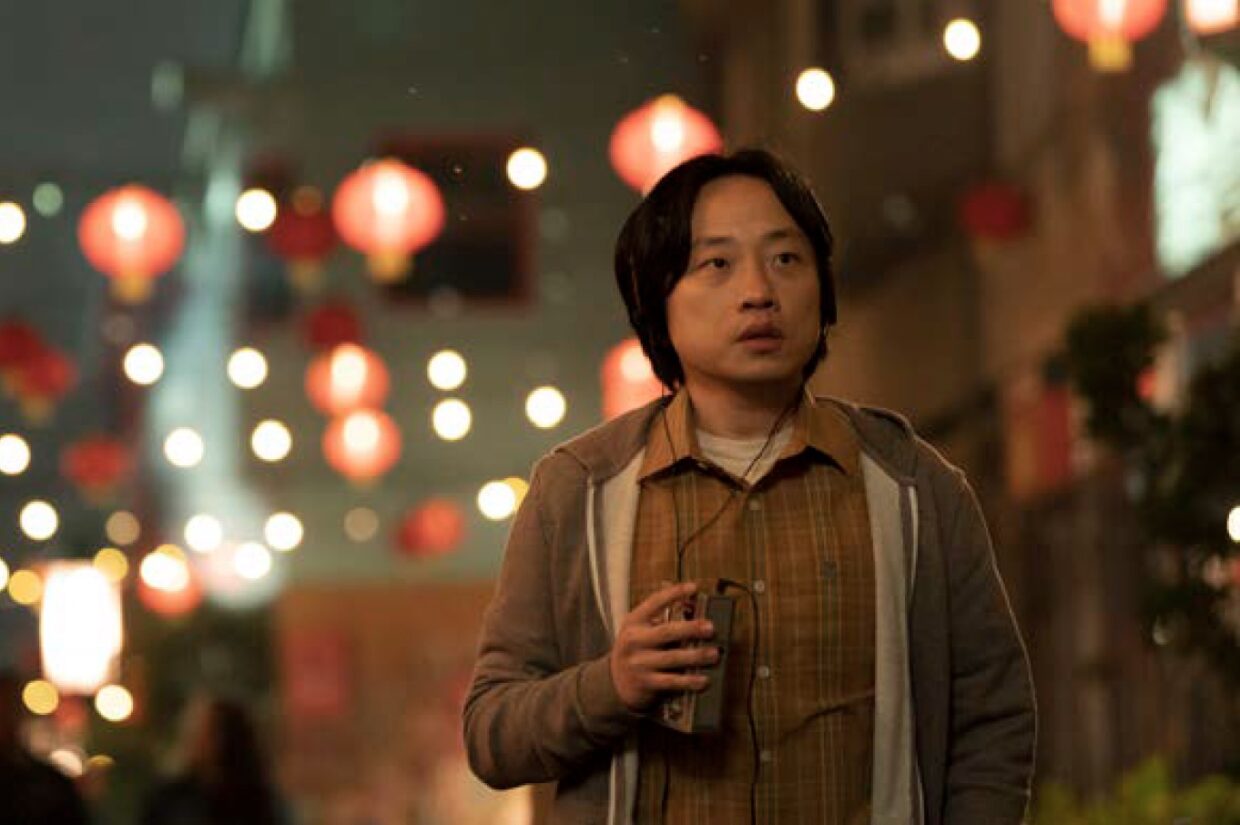

Based on Charles Yu’s award-winning novel, Interior Chinatown is a Hulu TV series that follows Willis Wu (played by Jimmy O. Yang), the “Generic Asian Man” stuck playing “Background Oriental Male” and “Delivery Guy” in the fictional police show, Black and White. Playing average background characters all his life, Willis yearns to be the star of the show, “Kung Fu Guy,” like his brother once was.
Though Willis plays the side character in Black and White, the series begins by introducing him as our main character. Working as a waiter at his Uncle Wong’s Chinese restaurant, Golden Palace, alongside his childhood friend Fatty (played by Ronny Chieng), Willis’ daily life is mundane. He serves food, plays games with Fatty, meets his mom at her apartment for dinner, drops off food for his dad at his apartment, and goes home. Sleep, wake up, work, and repeat. While some, like Fatty, are fine with this repetitive, uneventful lifestyle, Willis craves more. He thinks about his older brother, “Kung Fu Guy,” and how he was his hero before he disappeared mysteriously, and he thinks about how his dad used to be the Kung Fu master “Shifu,” who taught his two sons martial arts. Rather than living in the present, Willis spends his time imagining who he could be, if only life allowed him to be the main character.
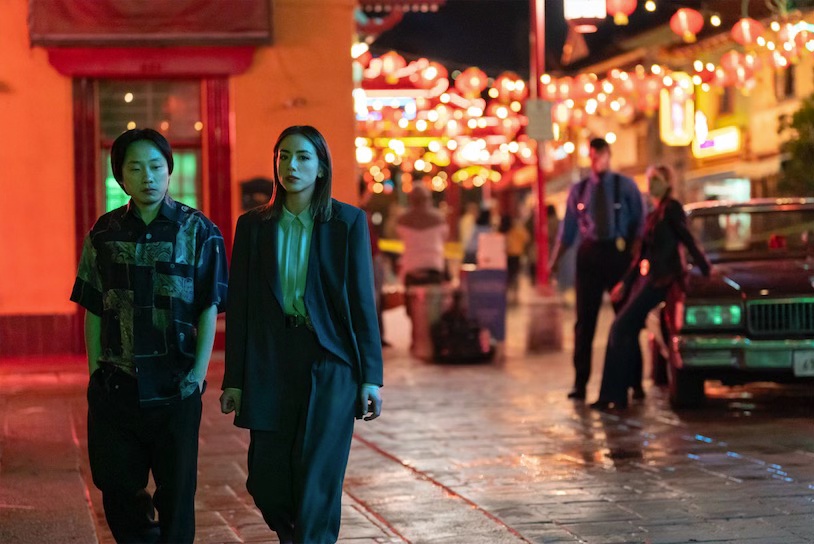
One day, Willis finally gets a chance to shine when Detective Lana Lee (played by Chloe Bennett) stumbles into Golden Palace and asks him for his help solving the weird string of crimes happening in Chinatown. As if she already knew who he was and that he could be of help as the team’s much needed Chinatown expert, Lana offers to help Willis find his brother in return. The two set off as hidden partners, and the pair solve cases together while Willis remains in the shadows. With each case they solve together, they learn little tidbits of information related to the disappearance of Willis’ brother. And yet, the deeper they dig, the more layers they find. From the Chinatown gang, the Painted Faces, Uncle Wong, and even to the Black and White star detectives Green and Turner, nothing is as it seems anymore, and it’s up to Willis and Lana to uncover the truth. Ahead of the show’s official premiere on Hulu, Asia Blooming spoke with actor Jimmy O. Yang, director Taika Waititi, and author and showrunner Charles Yu to discuss the series, its creation, and more.
While Interior Chinatown was inspired by showrunner Yu’s family, he also firmly believes that this story of a waiter dreaming of “making it big” while working hard to take care of their parents is something many others can relate to. “The initial inspiration was my parents, who are immigrants to the U.S., but who are also American. They lived most of their lives in the U.S. and are absolutely Americans, but they’re also outsiders. They felt that way most of their lives as well, so getting to tell this story on a platform like Hulu with people like Taika and our cast and so many other people is an amazing chance to showcase stories about people that don’t normally get that treatment, to really humanize and dimensionalize people,” he began. “People talk a lot about representation and seeing someone that looks like you on screen and how much that means, and I absolutely agree with that. But, I also think it’s important to see yourself in people that don’t look anything like you. We made this with a really inclusive crew – a lot of Asian Americans, but also a lot of non-Asian Americans – and it was amazing to make this with a bunch of people, all of whom were interested in this story for their own personal reasons. People are more than one thing, and it’s not so easy to assume things about demographics and groups. I feel like this is just a story about people, and I want people to watch it that way.”
Emphasizing the story’s relatability, lead actor Yang also found it to be quite similar to his own life. “When I moved to America from Hong Kong when I was 13, Chinatown was like a place of refuge, where we could find grocery and authentic food that we’re used to, like a home away from home for a lot of immigrants. But, I think this show also shows two sides of Chinatown – the facade and the kitschy restaurants, and also the lives of people actually living there. Willis and his family have pretty rough living conditions, and it’s quite informative of the struggles people go through that have been living there for generations. I think this show and book were so brilliantly written in a familiar format that everybody knows. The procedural law and order, right? But, then it puts in how it feels psychologically to be Asian or Asian American in the industry without hitting you over the head with it. It’s an entertaining show anyone can get behind,” Yang shared. “There’s a mystery, and the show gets kind of crazy and fun. Then, at the same time, there’s also underlying themes and messages of what it means to be stuck in the background, because that’s how we feel a lot of times.”
On turning the novel into a show, Yu chalked it up to a big group effort: “It started with developing the pilot and trying to figure out how you could translate from one medium to another, and it ended up being many, many conversations. What I put on the pages were sort of just like the first suggestion to what something could look like to the production designers, the DP, to Taika, and to the actors, so it became a very collaborative thing. How do we actually bring this to life? Rather than have it be a bunch of ideas, how do we make it flesh and blood and people that you really care about?” For Waititi, joining this project was an easy choice because of Yu and his vision. “What drew me to this project was the richness of the story. The book is amazing, and I got to read one of the early drafts of the pilot,” he began. “Coming from New Zealand, and a background and a people who have been marginalized for as long as I can remember and who have never really been part of that broader conversation on a lot of issues, the story really spoke to me. And [I agree that] it isn’t just like me growing up in New Zealand feeling like I was a background character, it’s a worldwide thing. So many people grow up feeling like that, and just to see yourself or someone like you on screen is a massive thing, especially for young people. So, whatever I can do to support anything like that, I will do.”
One of the hardest parts of translating an existing work into a new medium is that the author and the producer may not always have the same vision, and roles may be harder to define. “Luckily for us, [the producer and the author Yu] were the same person, so we just let him argue with himself and would support him and his vision,” director Waititi began. “My job as the director of the first episode was just to help set up the world, set up the tone for the show, and really start getting specific and make decisions on what those things look like and who the actors would be to play these roles.”
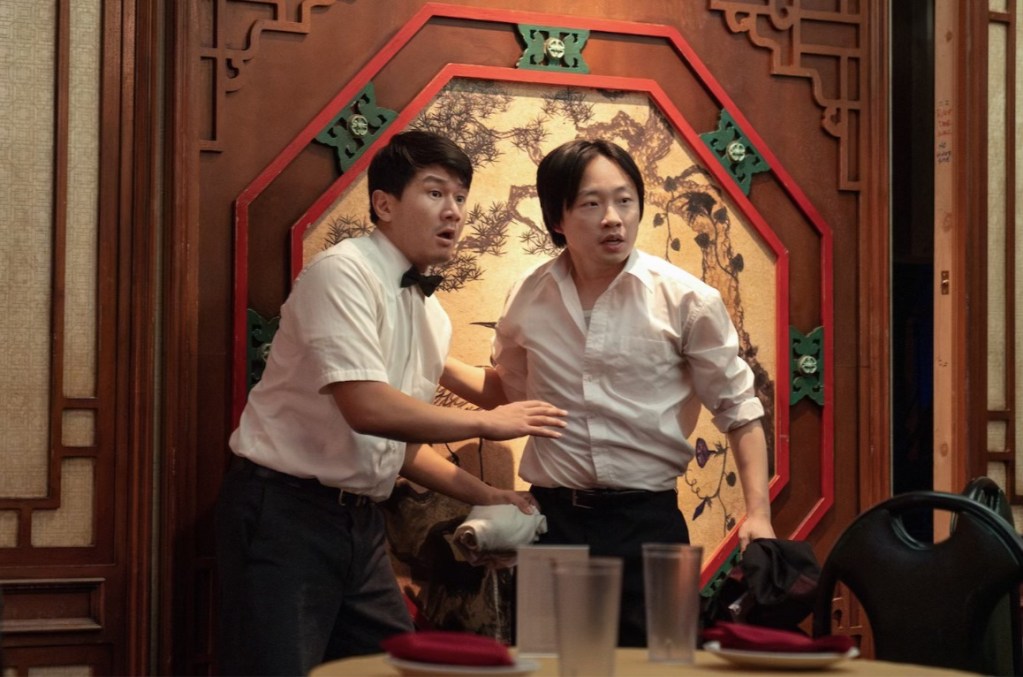
When it came time for casting, neither Yu nor Waititi had anyone particular in mind, though now they can’t imagine anyone else but who they’ve cast. Waititi shared, “When you write a book, every reader is going to have a completely different person in their mind. Us casting Jimmy, he’s now Willis Wu, and he can’t get away from that ever again.” Yu added, “Taika also directed some of the actors in their auditions as well, so it was very much a conversation [between many people to finalize the choices]. I didn’t necessarily imagine a Willis in my head. I probably did imagine myself, but I’m not an actor. My brother is an actor, though, so maybe sometimes I put his face in there. But, realistically, it’s just like any book where you kind of see it, or maybe you don’t. And then Jimmy came along. I knew he was funny and talented, but I didn’t know how hard working he was and how good he would be in the dramatic side of the role, which was cool to see.”
In turn, Yang shared, “It was a blessing that Charlie was on set. He wrote the book and he wrote the show, so any questions or discussions we had, I could go directly to him behind the monitors. Charlie was so kind and welcoming, and also so interested in my story and how I related to the story and how my career kind of paralleled Willis’ life, so I was able to draw a lot from my own experiences.” Expanding more on these parallels, Yang looked back at his own career path and the roles he’s taken: “I’ve actually done a lot of these characters that Willis ends up being assigned to. I was ‘Generic Asian Man.’ I was ‘Chinese Teenager Number One’ on the show Agents of S.H.I.E.L.D. with [my costar] Chloe. I was ‘Tech Guy’ on Silicon Valley. It was actually kind of cool, but it reminded me of my journey, and I couldn’t believe I didn’t even realize I was being put in a box. I think I had a blind optimism, that although I didn’t see a lot of myself on TV or I didn’t see people like me being the star, I was taking one step at a time. I had to play ‘Chinese Teenager Number One’ to get to the next, and I could make some money and become a series regular as ‘Tech Guy.’ There was progress and growth, so I felt good about myself,” he admitted. “For Willis, the worst thing in the beginning was that he was stuck in a loop. But, there was growth, and he saw a way out, and that’s what kept him, and me, going.”
As the novel transitions between screenplay scenes and daily life, this was another challenge to tackle in the into live action. For the show, the crew focused a lot on changes in lighting and cinematography to reflect those transitions. “The main thing we really tried to do going in was just to differentiate the worlds. If you’re thinking about the world around Willis from his point of view and how he sees himself, it’s kind of bland with muted colors. There’s nothing special about it, there’s flat lighting, and we used a handheld camera to film so it sort of feels a bit rough and clumsy. In contrast, within the show Black and White, we wanted that heightened experience. People are backlit, it’s all special lighting, and the camera work is all on cranes and dollies, so it’s always smooth and slick,” Waititi shared. “The really interesting thing is, yeah, that’s the world Willis aspires to get into, and it made me think of how I came from New Zealand, and how I imagined Hollywood and coming to America would be. When you think about those dreams, you realize that the world you came from is actually more beautiful. It’s interesting to see the contrasts of those two worlds.”
Giving another perspective on the transitions, Yang also credited the crew for doing all the hard work. “For me, playing Willis, it’s almost like an approach from the audience’s point of view, right? So, my job is just to stay grounded with him and go through what he’s going through, which is just his relationships with different people, and his journey that he’s putting himself through. And a lot of times, Willis is not supposed to know the bigger mystery of the world. He doesn’t know if he’s part of the show or not, so it’s okay for me not to know, too. It’s probably better that way, so I just focus on the human journey of it. The audience can then relate and see the world as Willis is seeing it.”
Ultimately, all three agree that this show is a unique form of representation that’s important to keep the conversation going and keep pushing forward in making Hollywood a more diverse and inclusive industry. “It means everything, and I’m very fortunate to have actually gone through every number on the call sheet and to be able to inform and help tell this story through Willis,” Yang started. “Charlie’s the mastermind, and we also have Taika who’s amazing, but just being able to be a part of this and bring my own self and my experiences to bring this character to life was quite special. I hope we can further the conversation [with Interior Chinatown]. I think it’s important to see people on screen, but it’s also important to have people behind the camera, too, as a lot of our crew were also AAPI,” he said, giving those off screen their flowers too. “I hope this show will lead to more conversations on representation and what it feels like to be Asian American.”
Interior Chinatown is set to premiere on Hulu on November 19 with 10 episodes.
