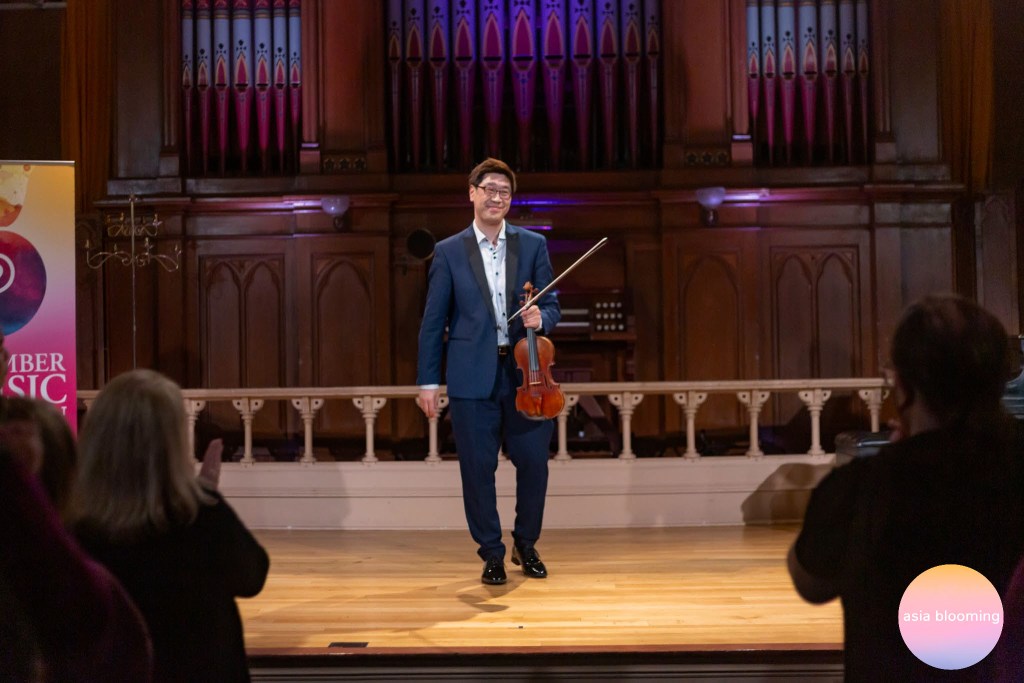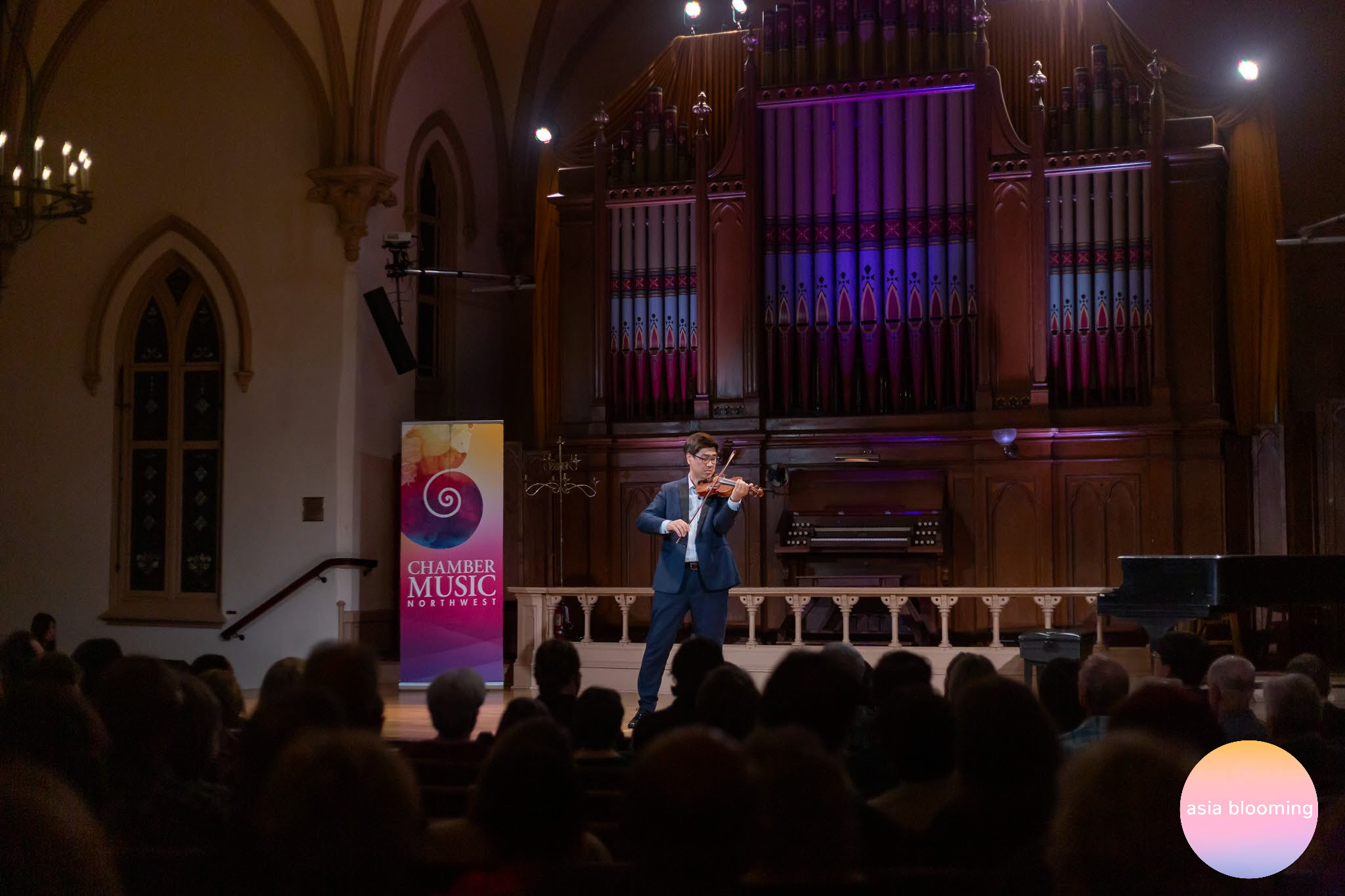
Artistic director of Chamber Music Northwest and acclaimed violinist Soovin Kim performed Johann Sebastian Bach’s six Sonatas and Partitas for Unaccompanied Violin over two evenings in April at The Old Church in Portland, a performance postponed many years due to COVID lockdown. During the opening remarks, Peter Bilotta, Executive Director of Chamber Music Northwest, referenced the attack on arts and culture at the federal level, noting grimly that the National Arts Endowment will likely be a target. But, he noted that music has always been a beacon of hope, even during the devastation of the COVID pandemic, and reminded attendees that art exists because we create it, that humanity’s artistic impulse cannot be taken away. And what better manifestation of this impulse than Bach’s violin works, which were written almost 300 years ago and remain just as poignant and relevant today.
While a solo violin performance may seem out of place for the chamber music-focused nonprofit, Kim found a throughline, noting that in these pieces, the violin attempts (valiantly) to play the parts of multiple instruments while creating a coherent sound. And it’s quite touching to think about this “little instrument trying its best to express the range of human emotions,” shared Kim. The evenings not only showcased Kim’s technical prowess–playing a melodic instrument as if it were a polyphonic one is no easy task–but also his ability to precisely channel specific emotions through the violin. And while his interpretations were influenced by the historically informed performance movement, which uses period instruments and aims to replicate the style of the time at composition, he stuck with the standard 440 A tuning and the modern violin and bow.
The first evening featured Partita No. 3 in E major (BWV 1006), Sonata No. 2 in A minor (BWV 1003), and Partita No. 2 in D minor (BWV 1004). The first movement of BWV 1006 is one of the most well-known Bach pieces, and Kim offered a sensitive reading of this bright, virtuosic movement, leaning into the large changes in dynamics (i.e. loudness) to draw the audience in. Something delightful about Kim’s playing was the way he created spellbinding moments during the quieter sections. The second movement started with a tinge of melancholy, but like dark rain clouds blown away by the wind, they don’t linger for long, quickly making way for a sweet, gentle interpretation of the Loure. Kim’s innocently whimsical rendition of the Gavotte en rondeau is followed by two menuets. The cautious Menuet II contrasted with the sprightly Bouree. In the last movement, Gigue, Kim expressed the different “personalities” of the different voices; the higher voice had a pleading, childish character, and the lower voice was more gruff.
In the second sonata, Kim found a balance between apprehension and courage. In the Fuga, Kim highlighted the theme as it snaked through the airy chords and resolute string crossings, the resonant double stops in the lower register providing a glorious anchor. The Andante opened in a lovely, hushed manner, almost like a lullaby, moving through plaintive emotional swells before ultimately returning to a reverent closing. Kim’s thoughtful phrasing, smooth articulation, and unhurried pace in the last movement lent it an air of wistfulness.

The well-loved Partita in D minor features emotive and stately movements like the Allemande and the Sarabande, as well as livelier movements like the Courante and Gigue, which are accompaniments to Baroque dance forms. And one of Bach’s most monumental works, the Chaconne, is the last movement of this Partita. Bernard Chazelle, computer scientist and lover of Bach’s music, called this movement a “grieving dance” that expresses profound emotions in a controlled manner. The longest of the movements, it consists of 15 minutes worth of variations on a simple bass line in an expansive and majestic way. Kim’s rendition was grounded in tenderness and patience, and he lingered just a touch longer on the bass notes to draw out the ascending pattern. He took attendees on a journey through stormy chords, a pastoral major section, gripping runs, and meandering phrases, offering a distinct flavor for each variation while ensuring cohesion. The crowd was enraptured, giving Kim several well-deserved, hearty standing ovations at the end.
When Kim entered the stage on the second evening, he was greeted with extensive applause by the many audience members who attended the first performance. Sonata No. 1 in G minor, BWV 1001 is often interpreted in a serious, heavy manner, but in Kim’s hands, it felt more precious, as if he were trying to keep a deep sadness from seeping out. The devilishly difficult Fugue was light and dance-like, and while Kim’s phrasing and dynamics were engaging, there were moments where the chords didn’t ring as well. After the dainty Siciliana came the captivating Presto, which Kim kept rhythmically stable and with delightfully sinewy swells in dynamics.
In the Allemande in Partita No. 1 in B minor, BWV 1002, the chords are luxurious, perhaps so much so that they absorb some of the momentum from the swaying, dotted rhythm. The Double (a variation on the material introduced in the previous section) was simple yet expressive, with smooth articulation and clear tone. The Courante was robust and airy, and the Double took the ideas in the Courante and put them at warp speed. Kim phrased and brought out the various voices beautifully while performing at an almost comically fast speed. Unsurprisingly, it was a crowd favorite. Following the pensive Sarabande is a light, mysterious Double, expressive and smoothed out with legatos. The last movement is strident and fanfare-like, with pockets of sweetness, and Kim opts for fairly long articulation while still maintaining space between notes. Closing out the two-evening Bach marathon is Sonata No. 3 in C major, BWV 1005. Kim highlights the theme as it moves through multiple voices in the celebratory Fuga, and in the calm, slightly melancholy Largo, he stays fairly faithful to the written rhythm, taking a bit of extra time on the double stops. There were lovely dynamic swells in the final Preso assai, which is a sprightly and virtuosic movement.
Kim brings the solo Bach pieces to life with thoughtful phrasing and a patient, sensitive reading, leveraging the wider sonic possibilities of the modern violin to create the expansive sound Bach envisioned. Despite the technical difficulties of many of the pieces–some of the chords seem perfectly designed to create hand cramps–Kim finds an underlying tenderness and creates an enchanting listening experience.