


Art of Manga is the first major exhibition in North America that showcases manga from the 1970s to present day. Held at the de Young museum in San Francisco, the exhibition presents more than 600 drawings by 11 influential manga artists. Listed in exhibition order, the featured artists are Chiba Tetsuya, Akatsuka Fujio, Takahashi Rumiko, Taniguchi Jiro, Yamazaki Mari, Araki Hirohiko, Yamashita Kazumi, Tagame Gengoroh, Yoshinaga Fumi, Oda Eiichiro, and Tanaami Keeichi. The exhibition explores the power of manga as a visual storytelling medium, examining various themes of the human condition from the mundane to the spectacular. The exhibition offers both the manga enthusiast and the curious a closer look at not only the manga panels of celebrated stories, but the context behind the works, as manga evolves over time. Art of Manga is currently on view until January 25, 2026.
In partnership with the de Young museum, California College of the Arts (CCA) hosted a special conversation with one of the featured artists, Tagame Gengoroh. Regarded as one of the most prolific artists illustrating gay manga, Tagame primarily creates erotic gay manga, but also creates works for general audiences that explore LGBT themes. The conversation began with Tagame giving a presentation on his career, before Justin Hall, professor of comics at CCA, moderated a deeper dive into his work as a gay erotic artist.
Tagame first realized he was gay when he was six years old, when his father put on a film, The Ten Commandments. While his father didn’t think much about showing a child a religious film, Tagame recalled that the scenes of naked and bound men, like Moses being captured as a slave and forced to appear before the king, made him feel “itchy,” a feeling he couldn’t quite understand at the time. When he became 13, he discovered the gay magazine, Sabu. “I didn’t really have any awareness of what that [gay magazine] meant, but I realized this was something that I’ve been looking for.” Everything became clearer when he had his first crush in high school, helping him confirm his sexuality. His passion for art and drawing led him to enroll at Tama Art University, where he also came out as a gay man.
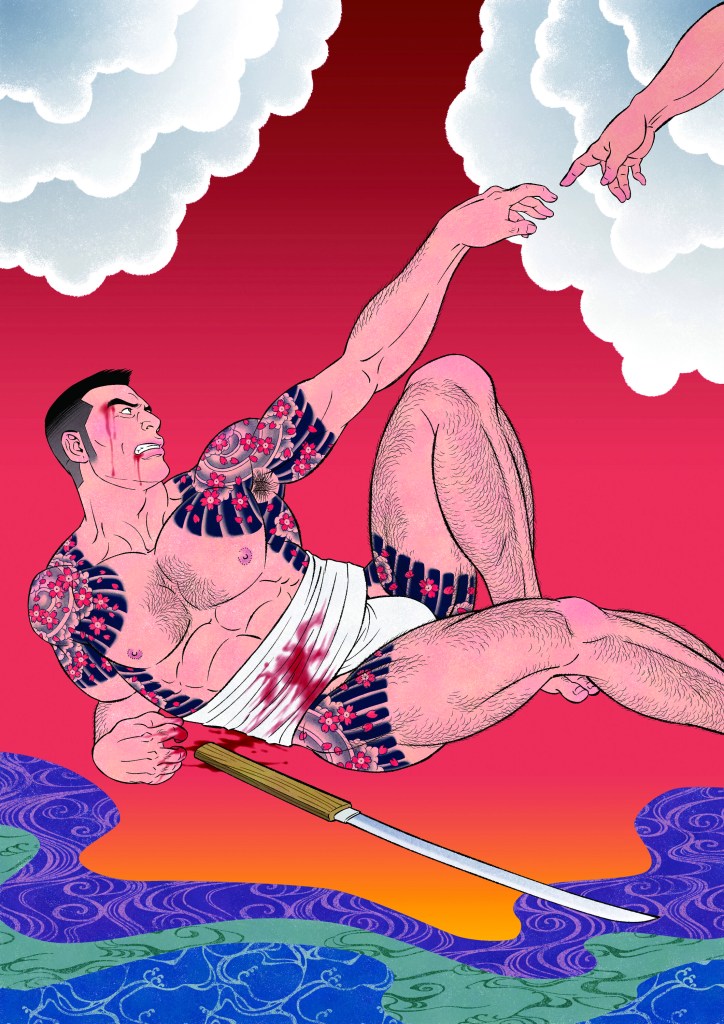
Cover illustration of the book Christian Art Without Honor and Humanity [Old Testament Edition], 2020
(「仁義なき聖書美術【旧約篇】」表紙用装画), 2020
©Gengoroh Tagame
During his university years, he discovered Drummer, a magazine focused on leather culture and BDSM. “I was so shocked when I saw this,” he began. “They draw full penises in the magazine. In Japan at that time, and even now, you’re not allowed to publish that. I was surprised not only by the art, but at the fact that you can draw stuff like this overseas.” As a result, Tagame was inspired. From that point on, he became more serious about drawing erotic gay art and made his formal debut in the late 1980s. During a time when interest in gay media was growing in Japan, his early works, The Toyed Man and The Silver Flower, saw success and helped demonstrate the artistic potential of the genre.
In 1995, Tagame and a friend founded G-men, a gay men’s magazine that focused on depicting muscular and larger men. From drawing some of the covers to contributing serialized work to this magazine, Tagame felt like he accomplished something great through this work. During this time though, he said that when he included female characters into his stories, he often received protest letters from gay readers. However, as people broadened their interests, the magazine also became more flexible in terms of what Tagame could explore, including drawing more interesting female characters like an evil maid torturing the protagonist. He mentioned that some of his gay readers came around and even called it “camp.”
When he was first approached to create works for general audiences, it was a thought he had never considered before. Since he saw the founding of his own magazine as a major personal achievement, Tagame was open to experimenting with new types of stories. This resulted in My Brother’s Husband, a story about a single father in Japan whose perspective on family, love, and acceptance changes, when his late twin brother’s husband from Canada comes to visit. The series gained mainstream popularity, earning international accolades like the Eisner award as well as a live-action television adaptation. He also published other all-ages works like Our Colors and Fish and Water.
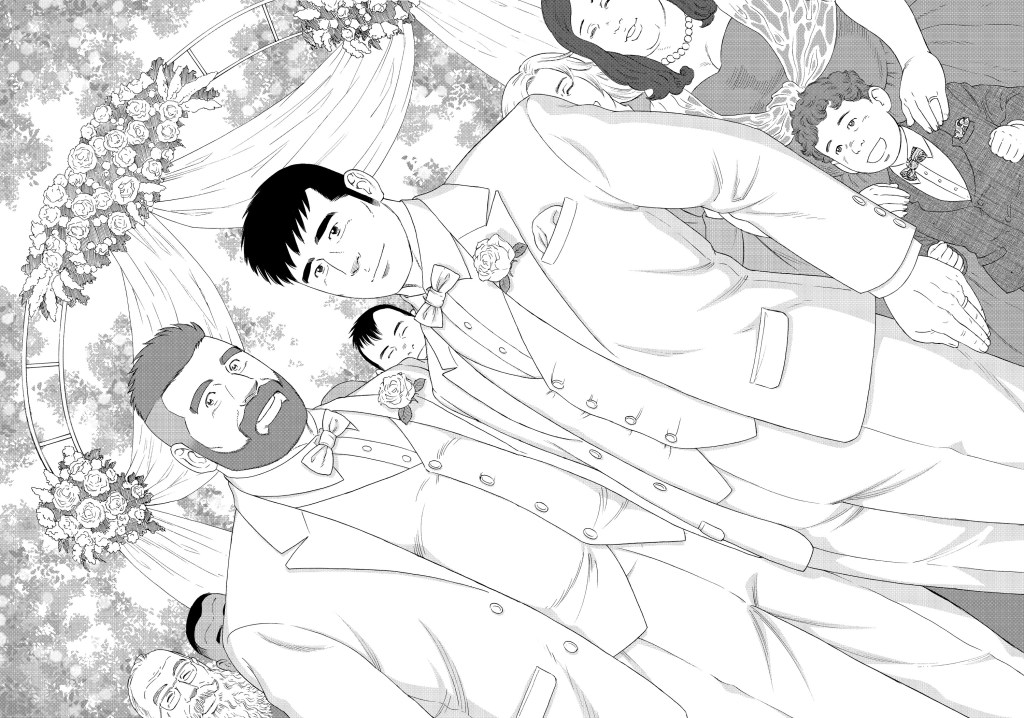
Futabasha Publishers Ltd. (Publisher)
My Brother’s Husband (弟の夫), 2014-2017
©Gengoroh Tagame/Futabasha Publishers Ltd.
“A lot of people thought that I had switched lanes and that I was just going to be drawing for all ages. But actually, that’s not what I do, as you can see,” he said before showing the next slide of intense pornographic imagery. “While I was serializing My Brother’s Husband and then Colors, this was the sort of thing I was drawing on the side.” He discussed a range of works, from fantasy stories featuring orcs with enormous penises who encounter men who desperately want to have sex with them to historical fiction such as a 1940s wartime story set in China about a Japanese spy captured as a sex slave. Summarizing his work up to this point, Tagame said, “I am doing both stories that are for all-ages, while also continuing to work on my erotic art. I think this [balance] really suits me.”
He’s now working on another all-ages series, Yuki wa Tomoe ni, which follows a novelist and painter who have feelings for each other, but haven’t confirmed their sexual identities yet during the turbulent Taisho era. Chapters are currently being released monthly in Futabasha’s Web Action, and Tagame estimates that he’ll be able to release a book (tankoubon) in February 2026.
While many thank Tagame for moving the representation of gay men in media to more diverse figures, he said that he simply draws the type of men he’s attracted to, and that’s reflected in his characters. Taking a step back, he noted that he doesn’t think too much about how others react to his art, though he is happy to hear people enjoy it. “Basically, drawing erotica and drawing stories, it’s something that I do to please myself,” he began. “If people want me to be too conscious of their own desires, that’s diverting me from doing what I want to do, which is to create art.” His work is a testament to the power of staying true to your creative vision, ultimately creating art that resonates with people around the world.