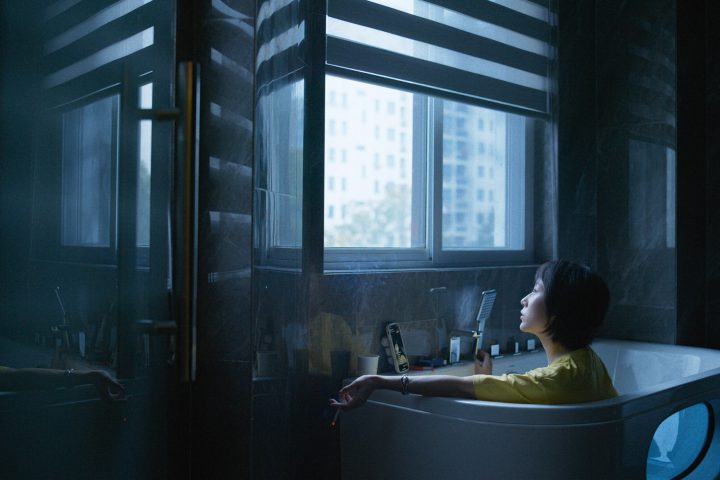
A passion project seven years in the making for actress Lucy Liu, Rosemead is a tragic story about a mother and son, made all the more harrowing by the fact that it’s based on true events. Typically movies with plots that could be described as frustrating and depressing would be a difficult watch, but the performances of Lucy Liu as Irene, a middle-aged Chinese woman with terminal cancer, and Lawrence Shou as Joe, her teenage son with schizophrenia, are captivating.
In Rosemead, California, Irene runs a print shop, a family business she oversees alone after the recent loss of her husband to cancer. After finding out that her own cancer has come back and that the new trial treatment she’s enrolled in isn’t working, she chooses to hide her illness from her 17-year-old son, Joe, who is battling his own health crisis after his father’s death. Although he receives therapy and medication for his schizophrenia, Joe still experiences haunting visions of his dad’s final days and the voices in his head convince him to stop taking his prescription.
Rosemead highlights the tragic consequences of ignoring mental illness. While many Asian immigrant parents may believe that “saving face” and quietly trying to deal with mental health issues within their own family is the best way to handle the situation discreetly, they end up ignoring their children’s cries for help and painting mental illness as something to be ashamed of. When Irene overhears an acquaintance gossiping about Joe behind her back, she confronts her and stands up for her son. But even during this exchange, she denies that anything is wrong with Joe, saying instead that he is seeing a therapist because he’s interested in psychology and not because he’s receiving treatment. While it’s obvious Irene loves her son and will do anything to keep him safe and happy, she is afraid to have a truly vulnerable conversation with him about what he’s suffering through, instead often making the choice to pretend everything is peachy and trying to clean up any problems on her own. The tragic irony is that reactions like this only further the taboo around mental illness and distance parents from their children, who no longer feel it is safe to confide in them.

As Joe experiences more hallucinations and psychosis, a sense of dread starts to build as the film progresses, and as a viewer, you might find yourself bracing for what comes next. Director Eric Lin portrays these schizophrenic episodes using auditory and visual elements like constant overlapping whispers and stuttering images, making viewers feel the fear and paranoia as if they were in Joe’s head. Shou embodies a wild and frenetic energy in his performance as Joe, adding to the mounting anxiety and tension as the film progresses. Beyond the representation of schizophrenia from Joe’s perspective, Rosemead also highlights the institutional and systemic problems around how mental illness is handled in society. For one, lack of discourse on mental health is prevalent among the Asian American community in the film. Irene’s well-meaning and supportive friend cannot fathom that Joe’s condition is of a psychiatric nature and suggests that perhaps he’s possessed by an evil spirit. While Joe’s friends are sympathetic and decide to broach the topic when they find one of his disturbing drawings, their intervention doesn’t go much further than talking about how they cope with stress.
When Irene discovers Joe’s obsession with mass shooting events, she begins fearing that he might harm someone or himself. News stories of massacres and school shootings are an internet search away and access to guns seems all too easy. Irene can no longer turn a blind eye to her son’s spiraling condition, but at the same time, she has lost trust in authority figures like Joe’s therapist and the police. Her fear elevates when she learns that, with Joe turning 18 soon, he will be subject to the 5150 involuntary hold as an adult. As a result, Irene is hesitant to confide in or involve anyone else, and she decides she needs to take matters into her own hands, ultimately leading to an irreversible decision that will haunt her for the rest of her life.
Liu holds nothing back in her portrayal of a woman going through a mother’s worst nightmare. To outsiders, Irene appears submissive and unassuming, with her small frame and graying hair. But Liu’s performance showcases Irene’s fortitude and formidable nature, fighting through life as a single, ailing mother while also bearing the burden of her son’s illness. Although her body is physically weak from the cancer and her demeanor is polite and agreeable, her strength when it comes to Joe goes beyond what most people can imagine. Liu’s final scenes in the film are particularly haunting, and her anguish and torment will undoubtedly linger with viewers even after the story has come to an end.