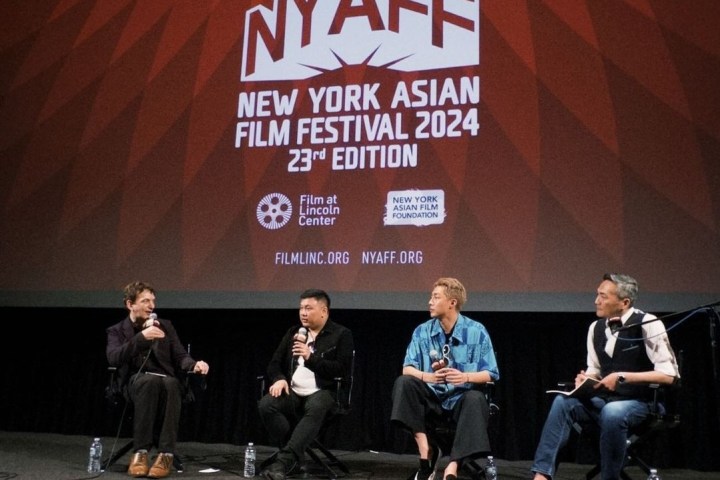
Godzilla Minus One has been the talk of the theatrical town since its domestic release in Japan and U.S. premiere in 2023. The movie’s Oscar nomination for Best Visual Effects makes it the first in the entire franchise to be nominated, including the Legendary Pictures productions. Despite Minus One’s smaller budget compared to its American counterpart, film critics and fair-weather moviegoers alike have praised its impressive storytelling as well as its special effects. With the black and white edition—Minus Color—feeding more fuel to the fire, the movie’s staff have been booked and busy with awards season.
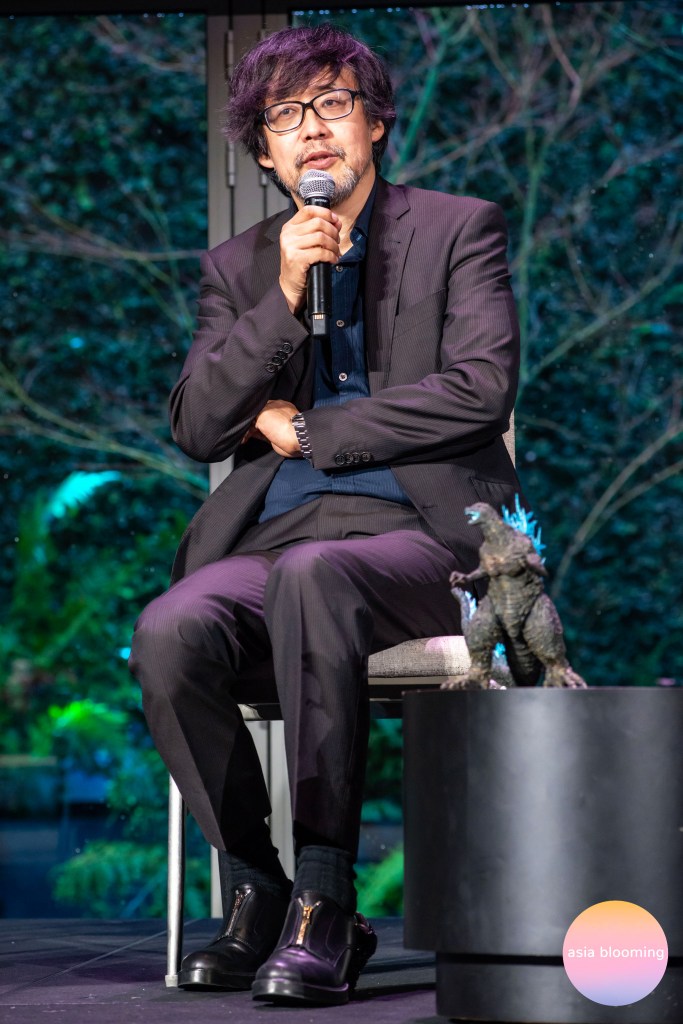
After the panel at the 14th U.S.-Asia Entertainment Summit and Game Changer Awards, Asia Blooming spoke with Director Takashi Yamazaki, Producer Kenji Yamada, and translator Mikey McNamara on the making of the movie, as well as the involvement of late Producer Shuji Abe.
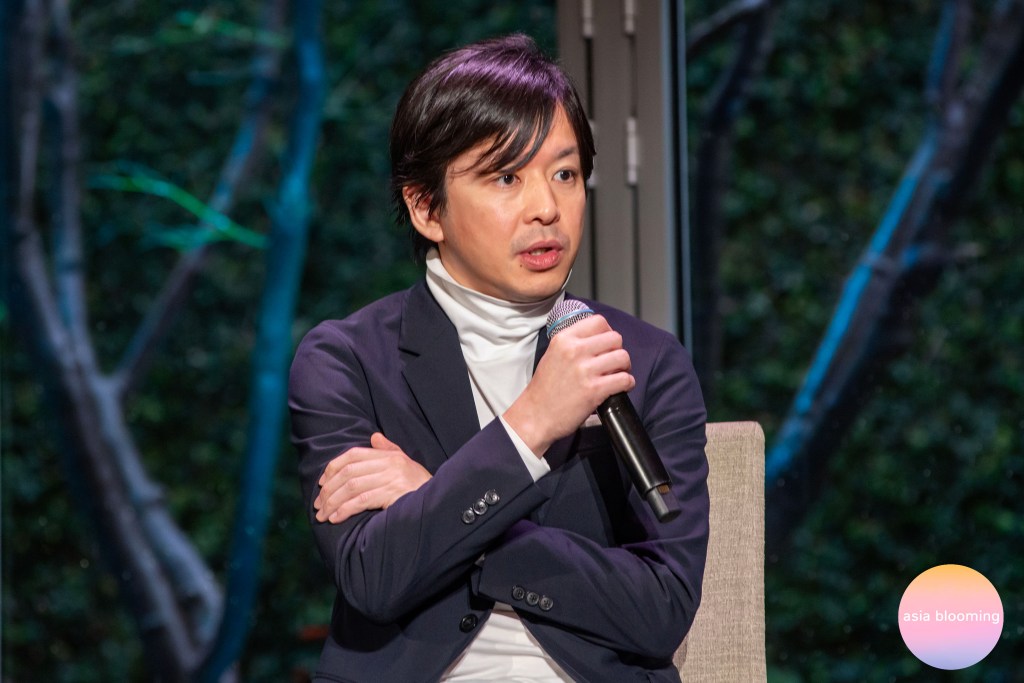
We’re deeply sorry for the loss of the recent passing of late producer Shuji Abe. Could you speak to his work and contributions to making Minus One?
Producer Yamada: Actually, Producer Abe had been working with Director Yamazaki since he debuted as a filmmaker. There’s an enormous amount of history between the two. The way I see it, the two had a long running history to which I was allowed to participate in. Shuji Abe is this lighthouse-like figure, who served as a beacon to shine light on the darkest parts of production. But he also helped move projects forward, so that there was constant progression in all the films that we make.
How did you conceive Godzilla’s look for Minus One? Compared to Shin Godzilla—which was more focused on the color red and more focused on his flesh—Minus One has more prominent spines and a focus on his rocky skin texture.
Director Yamazaki: The original sculptor for Shin Godzilla is actually a senior of mine from the same school. Part of my motivation was thinking, “How are we going to beat his design and make ours cooler?” I think in Shin Godzilla, they approached Godzilla’s design as a mushroom cloud with legs. It was a very grotesque, extremely bizarre expression of what Godzilla represented. In many ways, referencing the panel as well, we were trying to do everything counter to Shin Godzilla as a core concept of Godzilla Minus One. Be it the story elements or the design, this was our response to the success of Shin Godzilla and taking a different approach. We wanted to make it the coolest Godzilla we could.
For Godzilla’s final heat beam, he’s been affected by the decompression, so much that his eyes become pure white and his whole body swells and bulges out. But he doesn’t roar before we see his mouth, we only hear the instrumentals before it goes silent. Why did you want this last heat ray to be so horrifying?
Director Yamazaki: I wanted the entire crew that was on all the different battleships, as well as the audience, to get this sense of dread: “Ah, this is it. We tried everything they possibly could but we’re at the end of our wits, and there’s no path out of this.” No matter how hard you try, or no matter what you do, there are certain unsolvable situations or situations you can’t overcome. At the very end—not just the crewmen of the ship but also the audience—I wanted the timing to be perfect so that even the audience felt, “Oh my goodness, this is it. We’ve tried everything.” Really putting them emotionally at the bottom, at the lowest they can possibly go when Shikishima just flies in.
To follow up on that fly-in scene, there are many parallels to the 1954 Godzilla movie. However, one of the biggest differences is that Serizawa dies to stop Godzilla whereas Shikishima survives. Yet, he’s not hailed as a hero and the ending seems more grim as Godzilla is likely to come back. Why did you want to frame the ending with lacking fanfare?
Director Yamazaki: For me—as Godzilla represents the historical symbol of war and the atomic bomb—the characters didn’t necessarily defeat this massive evil creature as much as they quelled the anger of this divine being, who was affected and directly impacted by the hydrogen bomb and the atom bomb testing. To me, it was almost this offering to restore balance between God and mankind.
Even for us, as we were working on the film—the later and later we were in production—I felt that we were writing this mythology of humans killing or quelling God’s anger. It’s a big deal for the characters, and even for us as the filmmakers. Instead of it being this massive fanfare event, it’s almost accepting and coming to terms with the truth of what they’ve done. But also knowing that Godzilla was, in part, created by mankind and the effect of what mankind has done. The byproduct, so to speak. Returning it to the ocean, in a way, I think is not an event to be celebrated. This is the first time I’ve been asked about why Shikishima’s return is so solemn, and why people don’t seem to be happy at the end.
What went into deciding the budget of this film, including the Minus Color version?
Director Yamazaki: I think it’s important to not just look at it in the context of “Why did we release it in the U.S.?” as much as looking at it in the context of “Why did we even created in the first place?” For us, part of it is paying homage and respect to the original 1954 Godzilla. But as the director, I also wanted to instill the same type of fear and terror that I imagine moviegoing audiences felt in 1954. Removing color enabled us to recreate some of that shock factor.
The colorist really poured his heart and soul into recoloring the black and white version. It wasn’t just a simple CTRL, ALT, DEL. To me, to not share the shock factor, the emotion, etc. in this product we created with as many people as possible in and of itself would be a crime.