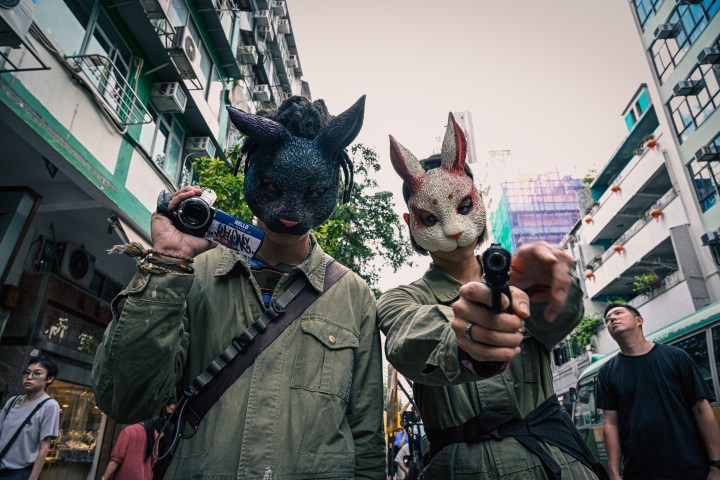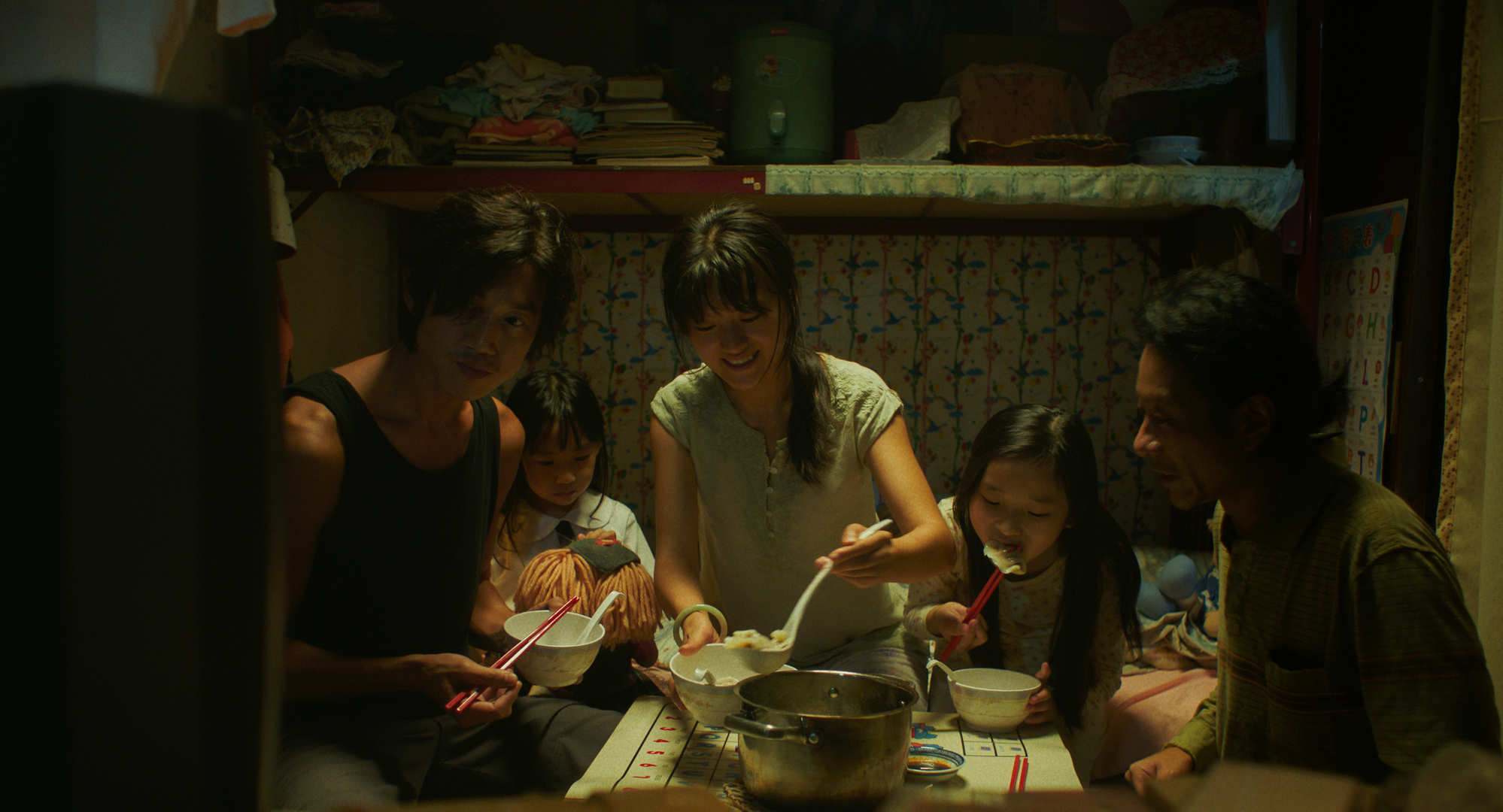

Released in 2023, Sasha Chuk’s debut film Fly Me to the Moon is making its rounds at festivals around the world, including this year’s New York Asian Film Festival. Chuk originally wrote the story as a short, semi-autobiographical novel before turning it into a feature-length film in which she serves as director, screenwriter, and actor. Pulling moments from her own childhood when she immigrated from Hunan, China to Hong Kong, she elaborates upon her experiences by depicting a pair of sisters as they adjust to living in a new city with their mother and drug-addicted father. The story takes place across two decades, with the first act taking place in 1997, the second act in 2007, and the third and final act in 2017. Over the years, we see the daughters learn to assimilate to their new environment, struggling to take care of each other and their family while finding their own path in life. Fly Me to the Moon is a beautiful work of film, a cinematic tapestry woven together by a compelling narrative about family and identity, supported by strong actors, including both newcomers like Yoyo Tse and veterans like WuKang Ren.
During NYAFF, Asia Blooming sat down with Sasha Chuk herself to learn more about how her own life is reflected in the film, the significance of the various languages and dialects used in the dialogue, and aspects of the filmmaking and casting process.
Note: This interview has been edited for clarity and brevity.
It’s great to meet you, Sasha. It was a pleasure to view your film “Fly Me to the Moon” for the New York Asian Film Festival this year. To get us started, I know you’ve described yourself as a writer at heart, and I understand this film actually stems from a semi-autobiographical story that you wrote a few years ago. Considering many of your personal experiences have shaped this film, what elements would you say from your own life are reflected most prominently in “Fly Me to the Moon”?
Chuk: The background of the characters are based on my true story [of immigrating] from Hunan, China, to Hong Kong when I was six. I don’t have any siblings, so that part is fictional. One of my favorite scenes in the film is when the whole family [rides up] the glass lift. That is one of my favorite parts. Every time I watch it, I’m filled with emotions because that part is based on a very bittersweet moment that I shared with my parents. That’s probably the very first [moment] that captured my point of view of the night vibe of Hong Kong. I like that [scene] because it’s contradictory that the background music is sad, but the dad is looking at the daughter and they are smiling. So I think that contradiction is my favorite part.
That was a really beautiful scene. I feel like a lot of the scenes that I saw throughout the movie feel very intimate and personal. Knowing that this particular scene comes from your own experience definitely makes it resonate that much more.
Chuk: Thank you.
Prior to making this movie, you also worked with your producer, Jun, on the short film, “Plain Sailing.” What was it like to be able to collaborate with him again on an even bigger project?
Chuk: Actually, Plain Sailing was like practice [for] this feature film. Before making Fly Me to the Moon, I wanted to act, direct, and write [in the movie], but I wasn’t sure if I could multi-task. I think working on Fly Me to the Moon was totally different from the short because a feature film is a lot tougher than making a short film. But I can see that Jun, me, and my cinematographers, we were more mature than when we were doing the short [film]. For example, I still remember that Plain Sailing took place in Taiwan. We shot under Covid, so it was very tough, and it was very troublesome to travel and to apply for the visa from Hong Kong to Taiwan. It took us more than three months to get the visa. During shooting, I still remember we argued so much. Like, if we had five days of shooting, probably we argued for a day. But because we had that much more experience from shooting the short, when shooting Fly Me to the Moon, I don’t think we argued at all.

I know one unique aspect of the film is that the characters are speaking in a mix of dialects and languages. There’s Hunanese, Cantonese, Mandarin, and even a little bit of Japanese, and the characters are often switching between these dialects mid-conversation. For me, I saw this as showing the different aspects of the sisters’ identities as immigrants, and reflecting the themes of belonging and discrimination that we see throughout the story. From your perspective, why was it important for you to incorporate all these different dialects and languages in the film?
Chuk: Languages are the first thing that makes me feel like I’m an outsider. I moved to Hong Kong when I was six and at that time I couldn’t speak Cantonese. At that moment I felt like I was a minority. So I really wanted to depict that part in the film. At first, I [thought] maybe this film cannot resonate with a lot of people because it’s about a family that immigrated from Hunan, China to Hong Kong. But I’m wrong. Being a minority is universal. Everyone could be a minority in different circumstances that [make them] feel like an outsider, so I think that part resonates with a lot of people. Talking about switching languages, actually, my experience is not very similar to the character of the little sister. She’s ashamed, she doesn’t want to speak her dialect to her family, and she wants to conceal that she’s from mainland China in school. But actually from my own experience I’m proud that I could switch languages seamlessly between Hunanese and Cantonese. I still remember I would talk in dialect with my parents in front of my classmates so that they couldn’t understand what we were talking about. So it’s a way to hide, if I don’t want people to understand me. I think language is actually a very important part of telling the story about the identity crisis that [comes with] being a minority. That’s why I would like to emphasize the languages in the film.
You talked a little bit about how Hong Kong audiences have received the film, but I’m also wondering, how have international audiences also accepted this film and what were their reactions to it?
Chuk: I still remember our world premiere in Tokyo, and there was an audience [member] from Shanghai, but she had been living in Tokyo for almost 20 years [and could relate to the film]. So the immigrating part, identity crisis, is something universal that could relate to everyone. But when there’s a Hong Kong audience, [with people who] were born in Hong Kong, how could the movie relate to them? And just like I mentioned to them, being a minority is very common. [Whether it’s] the identity crisis, or being a minority, or dealing with your parents — in Fly Me to the Moon it’s the father’s drug addiction problem — there must be something that the audience can relate to around [the idea of] family. So I’m not worried that foreigners cannot understand it because the whole story is universal.
On a related note, the Chinese title of the film (但願人長久) actually translates more directly to “I wish you a long life.” I’m curious about how you settled on “Fly Me to the Moon” as the English title.
Chuk: The Chinese title is from a very famous poet from the Song dynasty, Su Shi. “但愿人长久”, that phrase is from [one of his] poems, but “fly me to the moon” is actually translated from [another] poem. The original line, is “挾飛仙以遨遊”, like you fly to the moon with your favorite ones, just like the part of the film where the family rises in the glass lift together. I actually wrote the [novella] first and then I wrote the script. In the last paragraph of [the book], Yuen travels back to the glass lift memory in her dream. She sees her family and [her younger self] traveling together in the glass lift. She feels like the lift stops on a very high floor and then she feels like that moment could be memorized forever. And she sees that her family, her parents are flying to the moon, through the glass lift. So it’s her imagining that [she and] her family were still in a good relationship at that time. She’ll always remember that even though the reality is not like that. So I named the film Fly Me to the Moon in English because of the original poem of Su Shi and also Yuen’s [dream].
That’s very poetic. I remember there was that scene in the movie when Yuen wakes up and describes a dream she had about a happy memory from when she was younger. So I see how you’ve incorporated that in the film from your original story.
Chuk: Yeah, exactly. Especially the phrase “of the moon,” of course we all want to see the full moon, but the moon has various phases [just like how] our life has ups and downs. So I think the title includes the message to accept that life is not perfect, to embrace the imperfection of life.
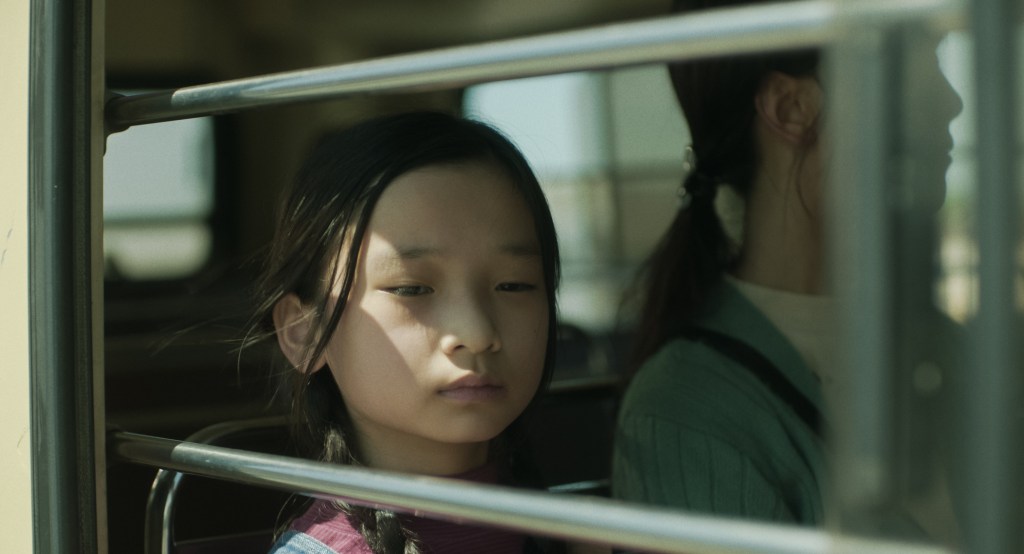
Another question I have is around you working with Chloe and Yoyo who play the younger versions of yourself. The casting is spot on. What was that casting process like? And how did you ultimately choose Chloe and Yoyo to play those parts?
Chuk: Casting took me so long because I had so many actors in the film. Because I got the funding from the Hong Kong government, they suggested that I could just work with four actresses instead of six actresses to play the pair of sisters [across three time periods], so I could use the same actress [for] the adolescent and adult parts. But I feel like how we look [during those ages] are totally different. I insisted that I want to work with five other actresses, so it took me two years of casting [for both] the little sister and the older sister.
Yoyo was the easiest [to cast] because I worked with her in my short film, The Dropout of Her. So she was the first one [who came to] mind and I [told] her two years ago before filming that I wanted her to be part of my film. When I met her, she was a student who I found in the shopping mall. So she’s totally natural in my short film. That’s what I want. That’s why I didn’t want to cast any models or [seasoned] professional actors. I like the natural way that she acted. She follows her own feelings.
But Chloe was the most difficult one to look for. I spent two years, and I actually cast many, many children at that time. The primary school where I filmed Fly Me to the Moon [is actually] the primary school that I went to when I was a kid. I tried to look for an actress to play Yuen [there], and there was actually one student who I really liked. She didn’t have any professional training in acting, but she looks a bit like me because we both have the single eyelid. We only had maybe two months or a month before filming Fly Me to the Moon, so we didn’t have much time for training, and she was very afraid of the camera and couldn’t memorize all the dialects. So two weeks before filming Fly Me to the Moon, I decided that perhaps I should give up working with her and find a new [actress].
Chloe was [originally] cast as a [side character] at first, but all of a sudden, her face came to my mind. She actually resembles Yoyo, so I [re-casted] Chloe again [as Yuen]. We gave her the audio of the dialect and the scripts two days before casting, and she memorized the dialect perfectly. I still remember at that time she was doing her first [audition], and she remembered all the dialogue by herself. She said she listened to the audio on her own without any parents’ instruction. While talking with her, interviewing her, [I can tell] she’s a very clever, smart girl, and she’s very mature. She couldn’t cry during the audition, and then I said [asked if she] missed her father. Because of COVID, she couldn’t meet her father at that time. All of a sudden, she just burst into tears. And then I could relate. [Throughout] shooting, I didn’t treat her as a kid, I treated her as an equal. I just talked to her like I talked to anybody else, like I talked to Yoyo. I think Chloe is such a surprise to me. Although she’s a kid, working with her is very easy because she understands everything. I think she’s as professional as everybody else in the film.
I know that this film is a big milestone project for you. It’s your debut in acting, screenwriting, and directing for a full feature length film. I know in the beginning of our conversation you mentioned you weren’t sure you would be able to multitask and do all three of these, but I want to say you did a phenomenal job. I’m curious to know, what aspect of these three roles did you enjoy the most when you were working on Fly Me to the Moon?
Chuk: I think being a director is the most satisfying role in Fly Me to the Moon. Being an actress and a writer are both enjoyable, but [I loved] seeing my actors shining [in front of the] camera. Yoyo won a lot of awards in the Golden Horse and in the Hong Kong Film awards. I’m very proud of her, and I think it’s very satisfying as a director. I can still recall the first time I met her in the shopping mall. She was a student, she was kind of afraid of the camera at that time, and she didn’t even know what acting meant. But now, seeing her going up to the stage and accepting awards and becoming a professional actress is something really big and very satisfying. And like what I mentioned earlier, seeing Chloe speaking the dialect fluently, and acting like a professional actress too. She’s not afraid to work with very experienced and well-known actors like Wu Kang Ren. I feel like that is what I enjoy the most, the role of being a director.