Warning: This article contains spoilers.
When someone passes away, it’s common to wish for the departed’s soul to rest in peace. But, what if there’s no rest for the dead after all? In director John Hsu’s Dead Talents Society (鬼才之道), the afterlife is all about spirits working tirelessly to scare the living and become urban legends, otherwise they will disintegrate into nothingness. In the underworld, would you rather keep working to exist, or choose to disappear forever?
There are two ways for ghosts to survive in the afterlife. If their loved ones remember them, preserve their items, and continue to burn offerings for them, ghosts will get by just fine. If their loved ones don’t carry out these acts, ghosts are granted 30 days to obtain their haunting license, or they will simply vanish. This story follows Cho Hsiao-lei (Gingle Wang/王淨), also known as “Rookie,” who leads a mundane life even as a ghost. There are legendary haunting ghosts, such as Catherine (Sandrine Pinna/張榕容), the Back-Bending Ghost of Room 414, and Jessica (Eleven Yao/姚以緹), the creator of the viral online cursed video), who work hard to earn money for their own pride and for ghost society. Meanwhile, Rookie relies on her loved ones’ offerings to get through each day.
On her birthday, Rookie visits her family home to enjoy offerings of chicken nuggets and other snacks and to spend the night. Unfortunately, when she wakes up, she’s faced with a big problem—her sister accidentally threw away the one award Rookie ever earned, or in other words, an item that was of importance to Rookie. This kickstarts her 30-day countdown to find a company to sponsor her and help her obtain her haunting license, which leads Rookie to the big haunting audition. While all the haunting agents such as Jessica scoff at her lack of talent in scaring and her lack of an eventful death backstory, a mysterious man named Makoto (Chen Bolin/陳柏霖) offers to take her under his wing. As it turns out, Makoto is the haunting agent for Catherine, who despises taking in trainees as she had previously been betrayed by her one and only trainee, Jessica. Despite this, Makoto still insists they help, and thus ensues a comically grotesque journey into finding the perfect haunting method for Rookie.
At the surface level, this film is just a comedy horror, similar to the American “Scary Movie” franchise films. The movie pays homage to many East Asian urban legends and stories, with ghosts haunting mountains, tunnels, hotel rooms, and more. Even for Catherine’s character, she permanently haunts room 414, which is a play on words; in Mandarin, the number four is pronounced similarly to the word for death, and is known to be a bad luck number. At the beginning of the movie, one patron can be seen knocking on room 414’s door and apologizing for disrupting before entering the room—a common superstition of excusing oneself before entering a hotel room in fear that it may be a spirit’s resting place. In other scenes, audiences can see different characters from various different Asian horror films such as Shutter, The Ring, and The Grudge. While each of these characters and stories are iconic and well-known outside of their respective movies, within Dead Talents Society, they’re just like any other ghost who is looking for strategies to help them stay “alive.”
The ghost society itself is similar to modern day work environments, as the ghost chair (the leader of the society) can easily revoke someone’s license or refuse to renew it because they didn’t make enough revenue this quarter, even if they’ve always been a top haunter. In life and in death, everyone is just working to make a “living.” Dead Talents Society takes a look at a problem many people face today—a sense of hopelessness and yearning to find their place in a world that largely recognizes what’s popular and viral online. Many people struggle with feeling like they must do more, accomplish more, and be more to earn attention and love. As such, Rookie is easily discouraged, and she lacks motivation and self confidence. Though she doesn’t want to disintegrate, she doesn’t think it’ll be possible for her to obtain her haunting license because she’s always lived her life in the shadows, while dead and while alive; she’s never been an award winner or the main character in her own story. To her, going viral to earn her stay in the afterlife seems like an impossible task, so she finds herself simply existing and drifting. She doesn’t want to die, but she doesn’t have the will to live either.
As the movie progresses—a slow but steady process as it has a nearly two-hour runtime—audiences can see more of Rookie’s past, and how it’s truly shaped her future. She’s always lived with the pressures and expectations from her family, as her sister always excelled at everything. Her sister had shelves upon shelves of awards, and the one award Rookie ever earned was a fake one her dad made for her so she could feel included. Ultimately, her obsession over this award was even what led to her death, symbolic of how trying to live for someone else or to match someone else’s expectations can kill you physically, emotionally, and mentally.
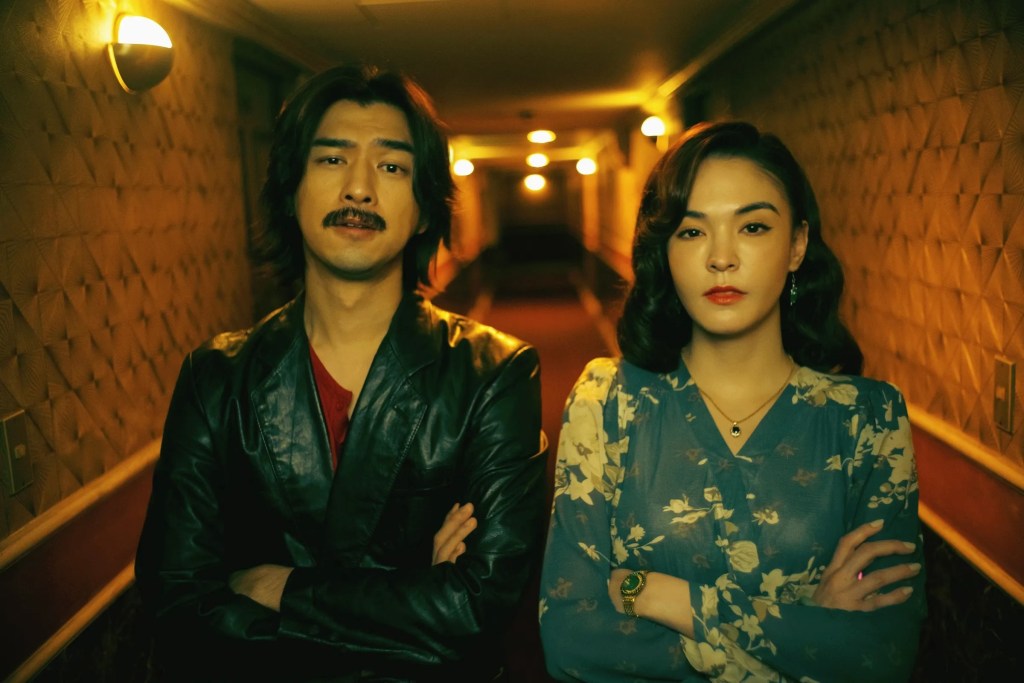
After she’s taken under Catherine’s wing, she still finds it hard to believe in herself, and while Catherine pretends to be nonchalant, she grows to care for Rookie. She pushes her past her limits, guides her, helps her obtain her haunting license, and ultimately, she believes in her. While Catherine had always been a main character herself, by the end of the film, she’s even willingly given up on her own standalone fame, finding her place as a supporting character to help Rookie grow and continue to find her footing in the world. The pair’s growing bond and relationship is portrayed perfectly by Pinna and Wang with subtle body language. Wang’s eyes remain empty and hopeless until she realizes how much Pinna’s character is willing to do for her, and Pinna’s eyes remain locked on Wang’s character, even when no one else is watching. The two had a chemistry reminiscent of a pair of sisters, as they argued and encouraged one another throughout the film.
While the film probes some meaningful topics, it is still a comedy. There are many scenes that are so wildly absurd that you cannot help but laugh. The actors masterfully brought deadpan jokes to life with their stoic faces and monotone delivery, reminding everyone that they’re ghosts. The film also moves at a pace that keeps viewers engaged and interested, without rushing past any small details. Hsu cleverly jumps back and forth between scenes in the world of the living and the dead, depicting haunting as scary on one side and just another performance on the other. One of the best scenes that depicts this would be the film’s opening, when Catherine first scares a hotel patron. As the camera pans toward Catherine, the perspective switches, and instead of seeing things from the scared patron’s point of view, audiences are suddenly in the world of the dead, watching backstage as Catherine stretches and gets ready for her bone-breaking backbend. Piecing these types of scenes together, the movie is like watching a horror movie while watching the making of it all at once.
Spanning genres like comedy, horror, and coming-of-age, the film may seem bizarre, but it’s all assembled together like a perfectly fit puzzle. There’s just enough of every emotion—angst, comedy, horror, sadness, and joy—that everything balances each other out, and though the film touches on the heavy topic of finding oneself, it does so in a lighthearted manner that still keeps it as an enjoyable and easy watch. Ultimately, the film is about learning to love life and love oneself. It’s a reminder to always appreciate your loved ones, even if they’re no longer by your side (so you can keep them fed and unforgotten), and it’s a reminder that your accomplishments and ability to go viral don’t actually determine your worth. Being surrounded by people who support you wholeheartedly, finding confidence to be yourself in a world where everyone is pretending to be a character for fame, and learning to let go of the past is what it means to truly live—even if you’re a ghost.