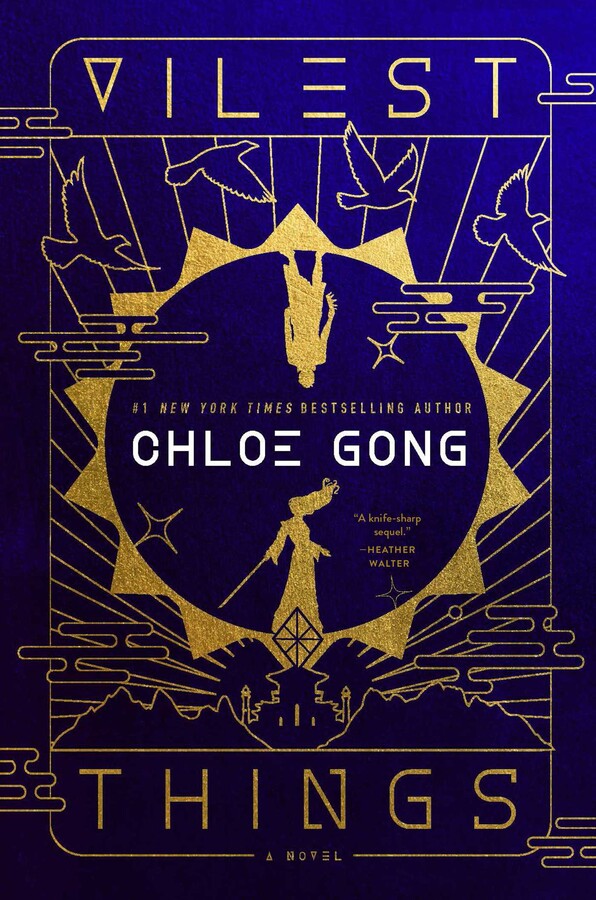

Vilest Things is the name of the second installment of Chloe Gong’s Flesh & False Gods trilogy, which reimagines Shakespeare’s Antony and Cleopatra. Yet the book feels like it should be called Violent Things instead. Then again, perhaps that’d sound too much like These Violent Delights, the title of Gong’s young adult debut. Still, one can’t deny that there’s a distinct style to Gong’s writing, narrative choices, and parallels that resonate from one novel to another.
It’s a good thing; Gong’s prose is almost always a winner, with its beautiful, incisive structure and way of phrasing things. As a writer, Gong also knows how to execute twists well and in the most thrilling fashion, creating emotional havoc for the reader, all in a positive way. These are the best parts of experiencing Gong’s books, and also what makes her books so deserving of praise.
With all those commonalities come moments when it feels like Gong’s already done so much with her previous books that there’s not much new coming to the table. Vilest Things occasionally feels like a rehashing of many of the dynamics and twisted politics of Gong’s previous books without the clear concept that really made those novels shine. The first book, Immortal Longings, derived its unique angle from its setting of San-Er, modeled after Hong Kong’s Kowloon Walled City. Vilest Things, however, moves the story for the most part away from San-Er. It’s the loss of the most defining parts of the story. Although Gong still executes a well-charted plot, this second book feels like it doesn’t have a clear factor that stands out.
The book starts with Calla Tuoleimi assuming the role of advisor to newly-coronated King August. Only Calla knows he is actually her ex-lover Anton Makusa by virtue of the body jumping rules in this world, where individuals are able to jump into other individuals’ bodies at will. Anton’s furious at Calla for having betrayed him back in Immortal Longings, while Calla is feeling tense about Anton’s position on the throne. Then Anton’s former lover, Otta Avia, awakens from her coma with news that threatens the fate of the monarchy: the real crown of the throne is outside of San-Er, and that only when it’s found can anyone truly claim power. Calla, August/Anton, Otta, amongst other palace officials, go on a journey to find the crown, but each of them face new, challenging developments that may end the world as they know it.
Gong’s always been good at writing the enemies-to-lovers dynamic as demonstrated with Roma and Juliette in her Secret Shanghai series. In Vilest Things, there’s still some of that there, with plenty of violence, simmering jibes, sexual tension, and angst. One might think that Gong would have channeled more angst into the relationship, though. Otta Avia is meant to be Anton’s first love, so the news that she’s returned is implied to present a huge obstacle in Calla and Anton’s relationship.
That isn’t the case. Instead, readers are constantly told about Anton’s deep-seated love for Otta, but there isn’t that much action indicating so. In fact, Anton barely seems to register Otta’s return at all, and is just in a state of hate-filled yearning for Calla for the majority of the book. It might not be so disappointing if Otta’s return wasn’t built up to be such an impactful event, but her return doesn’t seem to have an effect on Calla and Anton’s romance at all. Things might have been different if, say, Anton had clearly made a choice to sacrifice Calla for Otta in some manner, or even just displayed some desire for Otta in a way that left Calla feeling betrayed. There’s so much potential for angst in the romance, but Vilest Things pretty much leaves that untouched.
Readers of the first book will recall the big reveal that the Calla readers have grown accustomed to all throughout the story isn’t actually the real Calla, but instead an imposter who, as a young girl, jumped into the real Calla’s body, displacing the real Calla’s soul. Anton, however, was never in his original birth body in the first book. The notion that both of these individuals were engaging in intimate activity in bodies that aren’t their own is jarring. Gong implies that this reaction is somewhat lessened by the idea that the fake “Calla” is, for all intents and purposes, Calla, since this Calla took over the original Calla’s body from such a young age that she’s essentially forgotten her own identity and has become Calla, in a way. Anton using multiple different bodies in his relationship with Calla, however, seemed like it lessened the romance in the first book.
Anton does return to his original birth body at one point in Vilest Things. This is somewhat of a relief given that Gong amps up the physical intimacy in this installment with Anton back in his original body. Those questions around jumping bodies and ownership are major points in not only the plot, but also the romance — Gong explores those questions in the former, but not so much the latter, which warrants a little more attention.
As in her Secret Shanghai series, Gong displays her ability of incorporating intelligent politics into romance and vice versa. If there’s one theme she always gets across, it’s that of power and what happens when different parties fight over it. As with the Secret Shanghai series, the politics ends up feeling convoluted. There are so many different characters that it’s easy to lose track of who’s who and who wants what and why is this character doing this, again? There’s this sense that Gong knows the different stakeholders and has a well-intentioned plan of bringing their objectives to the surface. Gong’s books always bring up ideas of rebellion and covert operations, which are quite exciting. Sometimes it’s just difficult to figure out what those ideas are leading up to.
Vilest Things has lots of things that readers familiar with Chloe Gong’s works will love: violent politics and power struggles; steamy enemies who used to be lovers who have now become enemies once more; strong, smart female characters; and epic settings. The most glaring absence in this particular follow-up to Immortal Longings is its setting of San-Er, which readers got such an immersive sense of in the first book. It’s a credit to Gong’s worldbuilding that San-Er really feels like the core of the story, just as the settings are so crucial to her other novels. When San-Er no longer feels like the primary setting, it’s as if the story, like one of the character’s journeys, gets harder to navigate.