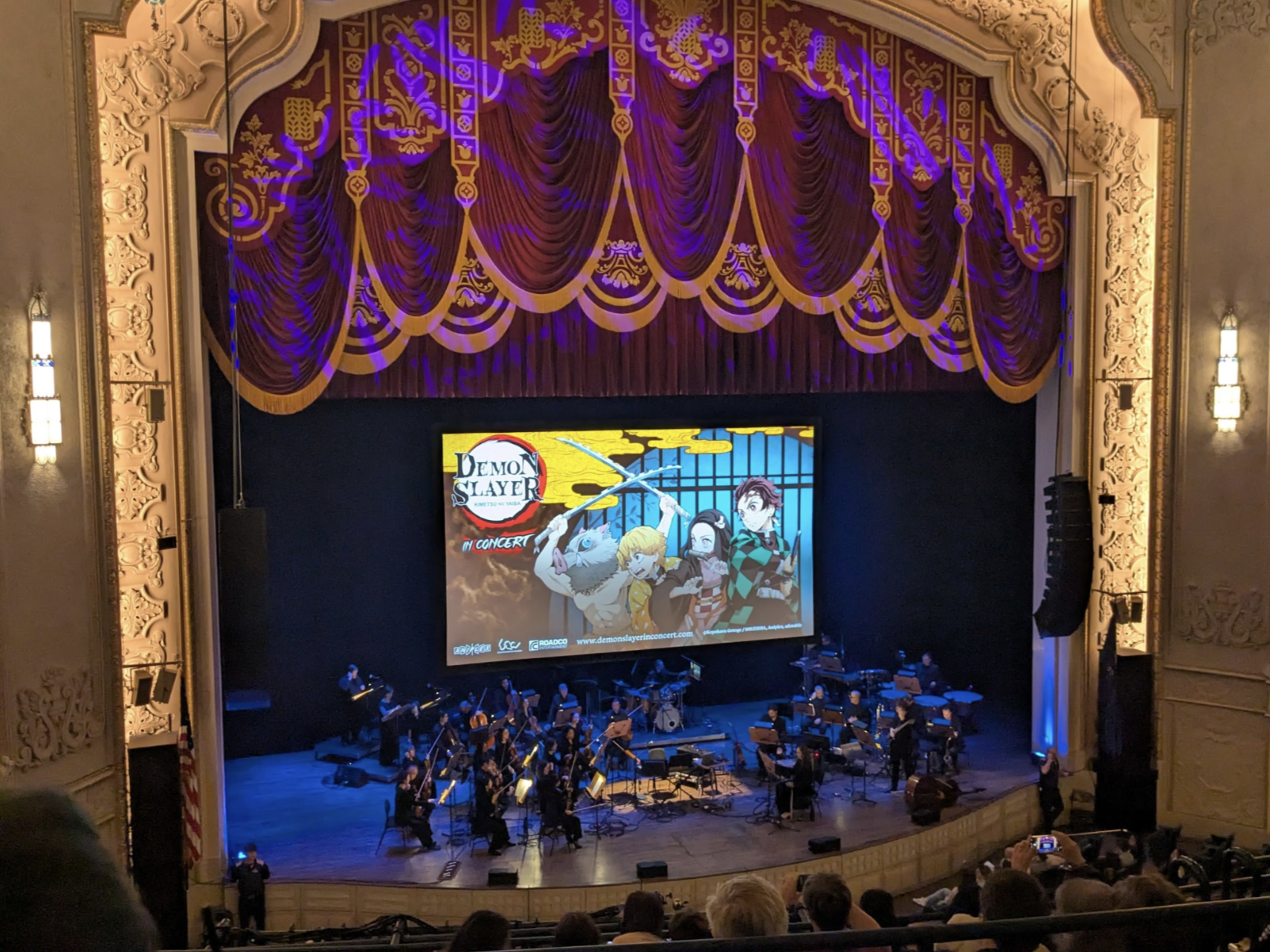
The stirring soundtrack of Demon Slayer: Kimetsu no Yaiba was brought to life in Portland by musicians from the Oregon Symphony. Fans of all ages, several who wore outfits inspired by the main characters of the anime, streamed into the Arlene Schnitzer concert hall in downtown to catch this special orchestral performance of the iconic anime soundtrack.
Led by GRAMMY-nominated guest conductor Esin Aydingoz, the ensemble onstage was an eclectic mix consisting of select members of the symphony, an electric guitarist, an electric bassist who doubled as a double bassist, a full drum set, and three chorists. Aydingoz served as both the conductor and the keyboardist for the evening, adding an extra layer of versatility to the ensemble’s sound. While the ensemble was much smaller than a regular orchestra, the electronic amplification and rich instrumentation allowed their sound to feel larger-than-life and do justice to one of the most popular Japanese franchises of all time. A screen behind the ensemble projected scenes from the anime to experience key plot points alongside the live performance.
As the screen introduced us to Tanjiro, the main character of the show, the ensemble opened with a stirring brass fanfare and sweeping strings, which quickly shifted to a quicker, march-like tempo punctuated by the punchy vocal “hah’s”. “Demon Slayer Corps (鬼殺隊)” was heroic and triumphant, and “Family (家族)” was tender and pastoral. What could go wrong? Everything, apparently. “Nightmare / Thug (悪夢 / 暴漢)” was somber and dirge-like, accompanying scenes of Tanjiro finding his family murdered and desperately trying to save his sister, Nezuko. The repetitive strings and low, slow wind section emphasized the gravity of the scene. Tanjiro carried his sister on his back and was thrilled to find her alive, only to find that she had transformed into a demon when she attacked him. She overpowered him and he barely held her back, tears in his eyes as he pleaded with his sister to remember their bond. In the rousing, operatic “to destroy the evil,” the fervent strings and choir built off each other in rhythmic succession, with solo female voice and piccolo piercing through intermittently. This piece accompanied the scene where Giyu, an experienced Demon Slayer, prepared to take down Nezuko, but after seeing the siblings risk their own safety to protect each other, he let them go.
The Main Theme of the anime opened with a plaintive female voice that was accompanied by the shamisen sound effect from the keyboard, and it segued into a regal, string-forward section where the timpani joins the shamisen in the alternating rhythms. “The Selection Begins / Water Breathing ~ Hand Demon (選別の始まり / 水の呼吸~手鬼)” featured ascending staccatos from the string section and liberal inclusion of the drumset, both of which drive the momentum forward. It accompanied the scene where Tanjiro put his training to the test and fought a massive “Hand Demon.”
“Kibutsuji’s Scent (鬼舞辻の匂い)” featured a haunting female vocal melody with rhythmic piano and/or string pizzicato accompaniment. It’s also the main theme of Demon Slayer’s primary antagonist, Muzan Kibutsuji, who is displayed onscreen in the scene where he pretended to be a human but turned other humans into demons in front of Tanjiro in an unsubtly veiled threat. To lighten the mood and to round out the first half of the concert, the ensemble played an adorable child-like piece which normally accompanies little post-credit clips (“Taisho-era secrets”) that offer extra tidbits about the characters.
After the intermission, the comedic energy was sustained for a little bit longer, with the first song “Agatsuma Zenitsu (我妻善逸)” being a silly ditty full of cutesy vocals, slidey brass, and cheeky offbeats. The screen showed the scene where the blond haired boy, Zenitsu, was desperately trying to get a woman he just met to marry him, to Tanjiro’s chagrin. The scene and music then shifted to introducing Inosuke, an eccentric demon slayer who wears a boar’s head. His bold and brass-forward theme represents his brash nature. “Water Breathing ~ Kyogai Mansion Battle (水の呼吸~響凱屋敷戦 / 水の呼吸~届け / 水の呼吸発動~其ノ弐)” was a triumphant track mostly in a major key, and it accompanied the battle between Tanjiro and the drum demon, who can flip gravity by beating the drums on its body. “Confrontation with the Twelve Kizuki (十二鬼月 対峙)” and “Kamado Tanjiro no Uta (竈門炭治郎のうた)” were slower, sweeping, and melody-driven, with the latter featuring just a piano and a single vocalist or a single woodwind instrument for most of the beginning.
The longest piece in the set, “Demon Extermination ~ With Nezuko on the Back (鬼退治~禰豆子を背に)” felt almost like a compressed symphony. Its main theme/motif started off as a haunting vocal melody, then turned into a brass and choral fanfare, and later was passed to what sounds like a hammered dulcimer sound effect from the keyboard. It gets converted to major at the end, as if to musically symbolize Tanjiro’s ability to use kindness to create silver linings from difficult situations. After ending the official program with the soaring and hopeful “Gurenge ( 紅蓮華)”, originally performed by the singer LiSA, the orchestra offered an encore in response to the resounding applause from the crowd. The final selection was “Mugen Train Avant-Grade M01 / HOMURA (「無限列車編」アバン劇伴 M01 / 炎)”, the main theme of the movie Mugen Train and also another song originally sung by LiSA. It was a delicate and beautifully emotive song to wrap up the concert with.
The dialogue-free scenes projected onscreen demonstrated how much of the emotion and drama of the anime is wrapped up in the soundtrack, and it was a treat to experience the captivating orchestration with the brilliant and versatile Oregon Symphony live.