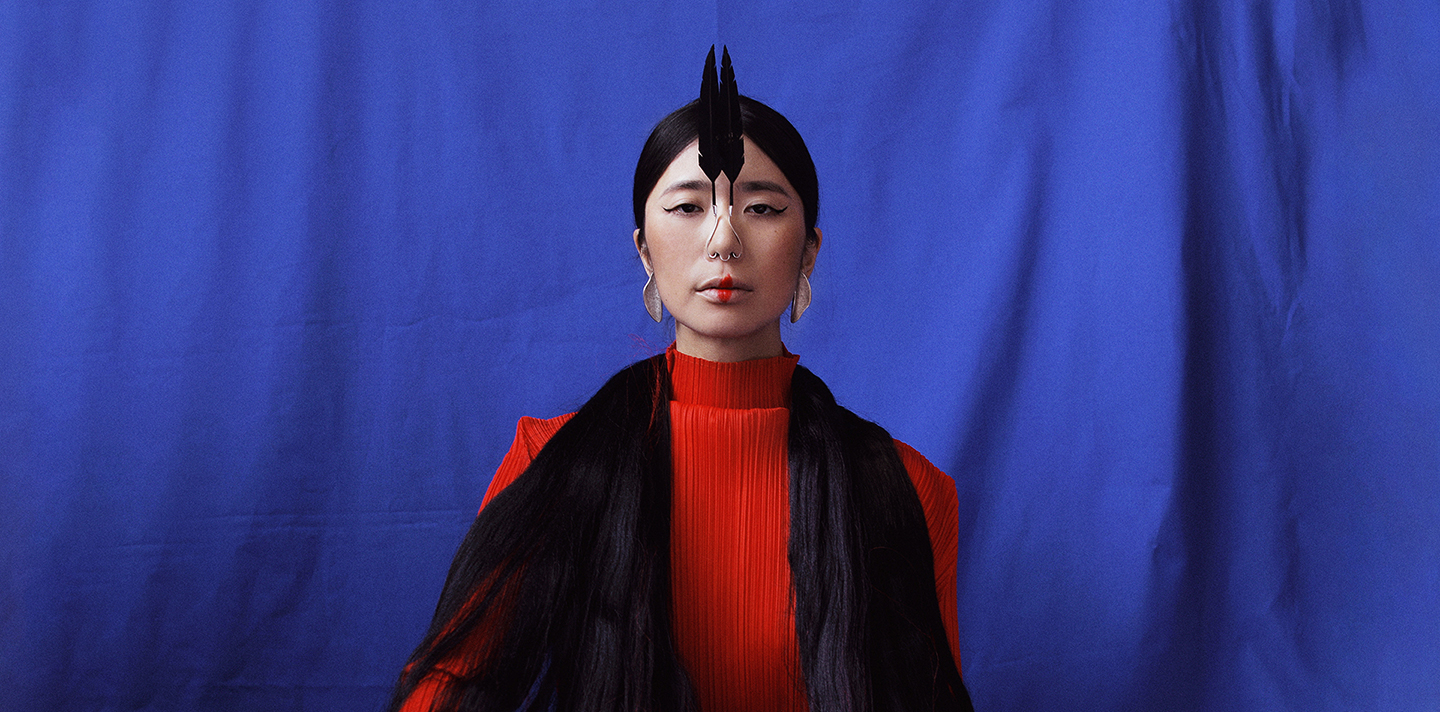
Asia Blooming sat with experimental voice artist Hatis Noit just before her performance at The Old Church in Portland to talk about her fascination with the human voice, the ebb and flow of creativity, art as a continual process of discovery, and her recent discovery of American comfort food. The Japanese singer is on her first North American tour and is showcasing many of the pieces from her latest album, Aura, which was released in 2023. She speaks softly and radiates calmness for most of the interview, but when she talks about why she finds the human voice so compelling, the passion she feels is palpable, lighting up her expressions and her tone of voice.

Note: This interview has been edited for clarity.
What is your relationship with the space that you perform in?
Personally, space is so important, especially when I perform live. I feel like every time I get into different spaces, it’s like meeting some person for the first time. I can try to know what the space is like, and yeah, of course the sound and also the energy in the space as well. Having live performances feels like collaborating with a space. I just had the soundcheck earlier here, and I really loved the ambiance.
If this space (The Old Church) was a person, how would you describe it?
Very welcoming, and not cold at all. Some churches feel very sacred in a way that’s not very friendly, but this space is very warm. The structure of the space is very nice as well. The stage and auditorium are quite wide, so none of the audience members feel too far from the stage, and it’s easier to connect with them.
Does being in different cities and natural environments impact you and your performance?
Even though I play the same song and the same set, the performance is very much impacted by the audience, the history of the place, and the character of the place as well.
It seems like being self taught sets you free to explore directions and synergies that may not have been provided through formal training. What’s your approach to learning and skill building?
I’m definitely a free spirit and love to explore all types of vocalization techniques, and I find the human voice to be such a beautiful instrument. It’s so intimate–it’s literally in our bodies, and the use of this instrument is very much a physical practice. When I was a kid, I noticed that despite being in noisy environments like big cities, I could always easily pick out the human voice and have been fascinated with it ever since. Our voices carry with us our pasts, and I find it so beautiful that everyone has a unique voice. I’ll collect and mimic various vocalization techniques and explore the limits of my own voice, and I’ll combine these techniques to make music that I personally enjoy listening to.
I don’t think I’m a technical singer or even a good singer, but I feel that the human voice has got such a strong power that comes across even in the absence of technical perfection.
And not only does everyone have a unique voice, our voices also change over time. How do you reckon with the way our voices change throughout our lives?
When we get get older, of course, our voices decay the same way our muscles slowly weaken. One of my favorite singers is Ikue Asazaki, a folk singer from Amami, and her voice is incredible. Some people struggle with it and feel that it sounds off, but I just cry when I listen to her voice. It’s so strong, and it’s not about precision or technique, it’s more like the character and richness of her voice. The body remembers all the history of her personal life, her emotions and sensations, and her voice transmits this information in a way we can feel.
What is a typical practice session like for you?
I always feel sorry for the people who live next door. I can be so loud and sometimes I’ll make such weird sounds, especially when I’m trying a new style. I try not to practice at night though!
Are there any techniques or concepts that you’ve been exploring lately?
There are so many! There’s a singing technique from the southern island of Japan, places like Okinawa or Amami, that sounds so beautiful. I’ve also found a music genre from Thailand called “mor lam,” which is practiced primarily in the southern parts of the country and also in Laos. The style reminds me of old folk and pop from Japan, and it’s quite intense but amazing.
Do you ever get stuck in the creative process, and how do you work with and through that feeling?
Yes, for one, the pandemic was very hard for me because I love performing with people in actual space. Going outside and seeing the sky and the trees is one of the ways that I get inspired, so it was very hard for me to find inspiration during lockdown.
When I finished making the last album, I felt totally burned out because it felt like I did everything I could do. It took so long to complete the album–the oldest song is 10 years old or something like that. I have a really rich relationship with each of the songs on the album, so afterwards, I wondered if I could make another thing. Fortunately, I could do so many shows around Europe and sometimes even on this side of the world. At some point, I realized that I am very comfortable performing these songs. I didn’t feel shy anymore about these songs. And at the same time, I started missing the vulnerable state of myself that arises when I perform something new. When I create and perform newer songs, I still don’t know where the song wants to go. Sort of like the “What do you want to do? What are you?” feeling. So after that creative rut after my last album, I’m making new songs now and feeling excited about it.
What’s your process for making new music?
I’ll make some sketches in my home studio, and at a certain point, I’ll feel like I can take the song on stage. It’s still unfinished, even on stage, but like I mentioned, space is really important to me and inspires where I take my songs. Especially with the newer songs, they’ll be a bit different at every new space, and I enjoy that. In this phase, the character of the song becomes more clear, and I come to understand those songs more and more through different spaces.
Sounds kind of like meeting someone new.
Totally. After we meet someone and get to know each other more, it feels more comfortable to be together.
That’s fascinating, this continual process of unfolding and discovering. Do you notate your songs?
Actually I don’t. My setup for composition is the same as the stage setup, just a microphone and a [vocal] looper. Especially in the beginning [of a new song], I record every time and then I try to combine my favorite moments. Recording is basically my score! It’s very intuitive, in a way.
Do you have any rituals you do before a performance?
Some quick vocal warmups and some stretching. Breathing techniques and a bit of movement also help me be more grounded.
Final question–is there anything you’re particularly excited to do on tour (besides performing)?
I really love exploring local food, and it doesn’t necessarily have to be some posh cuisine. When I was at a festival in Knoxville, I didn’t know what grits was, so I ordered it out of curiosity, and it tasted amazing! Like rice porridge. I normally eat rice at home, but I cannot take a rice cooker on tour, and I was really missing eating rice. So when I discovered that grits taste like rice, I was comforted.