


Music offers a window into the world during which it was created. Chamber Music Northwest’s “Russian Revelry” performance, featuring world class pianist Wu Han and cellist David Finckel, transports the audience into the complicated conditions of art-making during the Soviet regime. The three composers selected in this program each had a different relationship with the regime, but their compositions reflected and refracted the aesthetic mandate of socialist realism in their own ways.
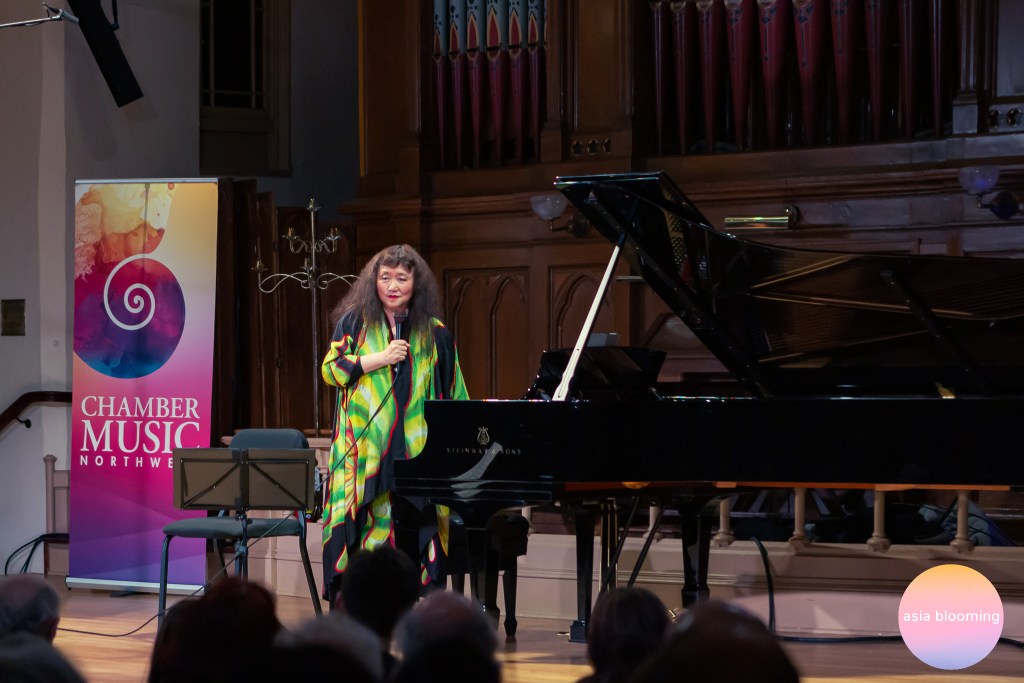
Wu Han, clad in a bright, multicolored dress and red heels, has a vibrant personality, eager to share her knowledge about the program. She talks about how Nikolai Myaskovsky used to be one of the most well-regarded composers in Soviet Russia. He won the Stalin Prize five times and served in an official capacity with the state in activities related to commissioning and reviewing music. He wrote the Cello Sonata No. 2 in A Minor, Op. 81 after being criticized as not aligning well enough with the Soviet artistic style, so this composition was to prove his alignment with the state-sanctioned principles.
The first movement of the sonata opens with a dramatic theme that almost veers into melancholic territory, but instead soars into a more glorious mood. There’s a recurring passage in which one of the instruments has a serpentine, chromatic section, and the other instrument plays a secondary melody before returning to the main theme. The theme reliably ascends from a lower register into the upper range of both instruments, as if mimicking the sun coming out from behind stormy clouds. Finckel coaxes the cello to sing sweetly, even at the high end of the range, and Han brings out the dichotomy between assuredness and agitation in the movement. There’s a similar tension in the second movement, the Andante cantabile, between passion and serenity, where there’s a buildup to a very expressivo moment that quickly dissipates into a quiet calm. The Allegro con spirito is spurious and harried, but even amidst the tumbling 16th notes, the piano appears with a long, if not a bit off-kilter, melodic line. Han and Finckel masterfully navigate this rollercoaster of a movement, keeping the audience at the edge of their seats up until the thrilling finale. This cello sonata embodies the socialist realist principles by being accessible and having a partiinost sensibility, or a striving towards betterment, and it allows Myaskovsky to regain favor with the powers that be.
Sergei Prokofiev was inspired to pen his Cello Sonata in C Major, Op. 119 after hearing his dear friend Myaskovsky’s cello sonata. While he was not as deeply embedded in the state as Myaskovsky was, he had been conscripted to rewrite compositions to ensure alignment with state ideals, but he also faced criticisms for some of his own compositions. The first theme in the piece is resolute and mostly stays in the cello’s lowest range, and it is soon punctuated by an iconic motif in Russian music, the militant, repeated notes, which Han describes as mimicking the sound of trains running through the region. This all fades temporarily into a pleasant, pastoral passage where a melody is passed back and forth between two instruments, even at one point unexpectedly appearing through pizzicato (plucked notes). The repeated notes return as a simmering motif, but they are not quite as ominous as before. The next section splices together a melody that is flighty and gavotte-like with a passage featuring triumphantly pounding chords underneath a songlike cello line. The cello then gets a solo to infuse the slowed-down version of the gavotte-like theme with drama and melancholy, which Finckel does so in a gorgeously rich manner. There’s a rumbly, almost harsh passage where the cello plays a quick succession of string crossing arpeggios that evaporates into dreamlike harmonics at the finale.
Like Myaskovsky’s sonata, this piece also has the urge to delve into darker, more agitated worlds, but instead finds an uplifting resolution. The second movement is childlike and playful, the short, bouncy piano chords, pizzicato, and spiccato (bow bouncing) lending it a tongue-in-cheek quality. Watching the interplay between Han and Finckel is like watching best friends pranking each other, and their joy is infectious. After the luscious cello interlude, the recapitulation and end of the movement brings more antics that earn chuckles from the audience. The last movement is majestic, though it had elements of mischief and uncertainty from the first two movements. There are feisty interchanges between the piano and cello, as well as regal passages where the instruments join together to march resolutely towards a stately, but not pompous, ending.
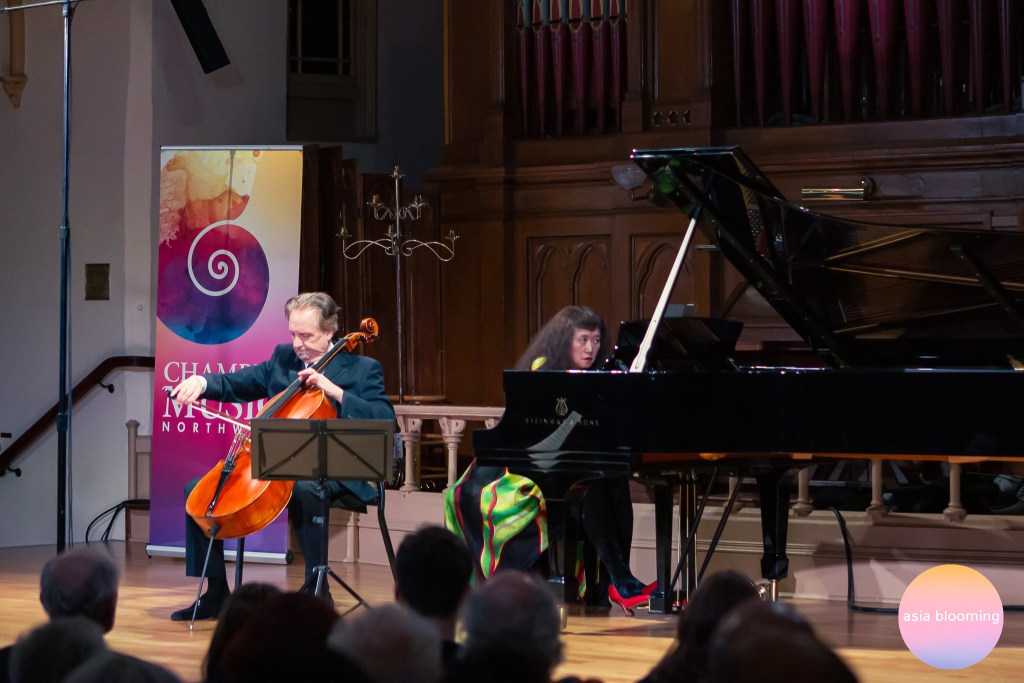
Sergei Rachmaninoff was exiled from Soviet Russia due to his status in the gentry class, so he was not subject to the same scrutiny as the other two composers in the program, but, nonetheless, his sonata for Cello and Piano, Op. 19 still contains several qualities that make it distinctly Russian. Contrary to popular opinion, Han shares that she and Finckel “absolutely do not” consider this piece a “showoff” piece. In the first movement, the half step ascending “leaning note” motif and the motif where the same note is repeated three times are fleshed out into a richly textured movement with a captivating melody. Roiling piano arpeggios (a Rachmaninoff classic) that shift seamlessly between major to minor create an emotional tension characteristic of Russian music. Han executes the increasingly frenetic 16th notes with ease and grace in the middle passage.
Unlike the previous two composers, Rachmaninoff tends to build tension more slowly and hold on to it for longer, sometimes letting it ease up a bit, but he’s less likely to completely switch moods. Even when there seems to be a moment of glory, the storm clouds are not far away, and Han and Finckel bring out this apprehensive quality. The second movement starts off brashly and ominously, the hammering, repeated notes reminiscent of Schubert’s “Der Elkonig,” a violin solo based on a monstrous myth. In the middle of the movement, a bit of respite is offered as the piano and cello sing gently at the upper end of their ranges, but the stormy mood returns with a furor. After the calmer, appassionato, third movement, which Han describes as representing the “Russian heart,” the fourth movement depicts Rachmaninoff’s experience in hypnosis and his triumph over this career-halting depression. The celebratory mood isn’t marred by the small pockets of uncertainty, and the duo’s expressive execution earns a standing ovation from the entire hall.
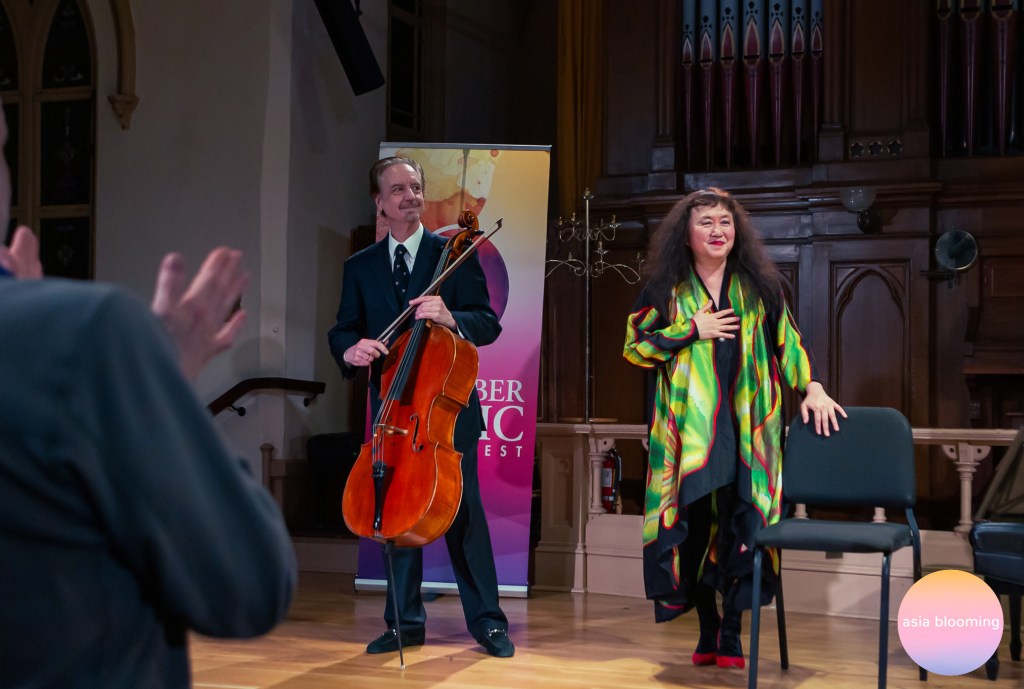
As a final gift to the crowd, the duo performs Rachmaninoff’s Prelude, Op. 23 #10, a gentle piece with a soaring cello line and sparkly piano grace notes. Han and Finckel’s tenderness during this piece is like the auditory equivalent of a soft scarf. This performance features several composers who had to adapt their artistic style to survive in mid 1900s Russia, serving as a reminder that expression and creativity can be reshaped, but never snuffed out.
